Additive manufacturing has evolved from prototyping to an established production technology in many industries. However, with increasing industrialization, the demands on downstream processes are also rising. To enable economical and process-safe series production, comprehensive solutions from printing to post-processing are required.
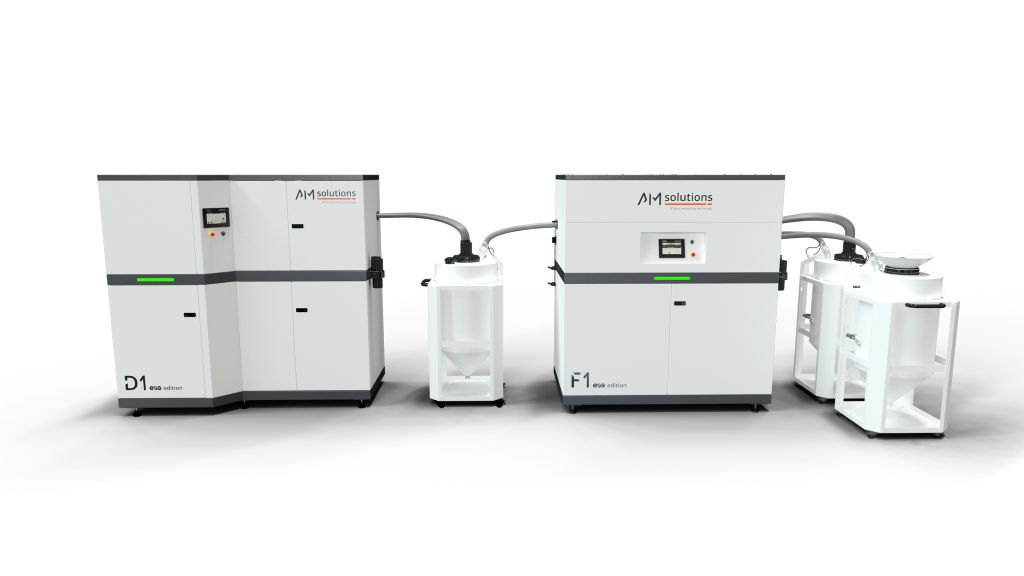
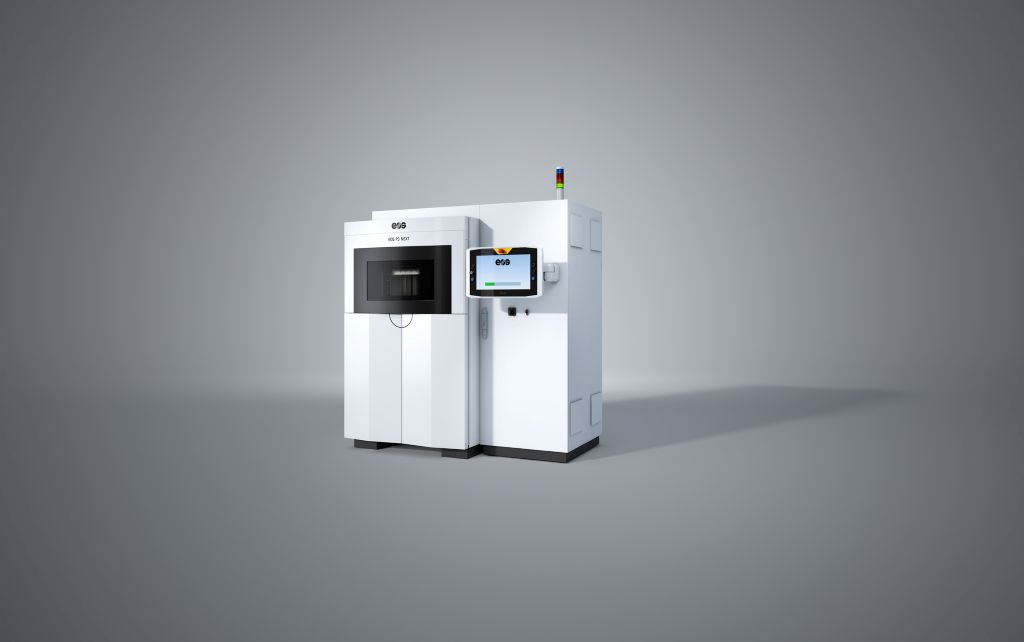
EOS, a global market leader in industrial 3D printing technology, and AM Solutions – 3D post processing technology, an expert in the post-processing of 3D printed parts with decades of experience in surface treatment, have developed the D1 and F1 systems for this purpose. These technologies can be seamlessly integrated into the EOS P3 polymer platform, which also includes the recently launched EOS P3 NEXT. Furthermore, the F1 system is compatible with all available EOS polymer printers. These systems not only automate the depowdering, sieving, and powder mixing but also bridge the gap between high-quality printing and practical, production-ready post-processing. This enables customers to ramp up production without increasing complexity.
"Customers are no longer satisfied with just achieving a good print," says Fabian Krauß, Head of Polymer Product Management at EOS. "They expect operationally ready systems that deliver finished parts with minimal manual effort. This is precisely the focus of our collaboration with AM Solutions. The D1 and F1 systems were not developed in isolation – they are part of a broader workflow strategy that prioritizes consistency, traceability, and throughput as highly as geometric freedom."
The cooperation between EOS and AM Solutions goes beyond technical integration. The goal is to establish a seamless process chain that considers all relevant aspects – from powder handling to sustainability to operator safety.
David Soldan, Head of AM Solutions – 3D post processing technology: "Since the presentation of the development status in November last year, we have continued our collaboration intensively and have already made significant progress. The collaboration with EOS is extremely constructive and based on partnership. In our opinion, the two machine solutions will prove to be true game changers."
Comprehensive answers to central AM challenges
Scaling additive manufacturing requires automated, robust processes, especially in post-processing. Here, bottlenecks often arise due to manual work, high variability, or lack of traceability. At the same time, the demands for sustainability, skilled labor shortages, and occupational safety are increasing.
The D1 and F1 systems specifically address these challenges:
-
An optimized workflow, innovative software, and state-of-the-art hardware features increase the productivity of the EOS P3 Next by 50% and reduce costs by 30%. Machine availability is up to 90%, and the solution is characterized by doubled material efficiency with an impressive recyclability rate of 80%. Image: EOS Automated depowdering and closed powder handling reduce manual labor and minimize health risks.
- Integrated sieving and mixing processes enable reproducible reuse of powder with individually definable mixing ratios.
- User-friendly operating concepts reduce dependence on specialized skilled workers.
Sustainability and material efficiency in focus
A major advantage of additive manufacturing is the ability to reduce material waste compared to traditional subtractive manufacturing processes. However, efficient reuse and recycling of polymer powder remains a challenge.
The F1 from AM Solutions uniquely combines the processes of sieving and mixing. The intelligent system ensures reproducible results by creating a high-quality mixture of new and used powder with customizable mixing ratios.
"The technology from AM Solutions is a perfect complement to the EOS P3 polymer platform, including the new EOS P3 NEXT," says Krauß. "Thanks to this collaboration, our customers will receive an end-to-end production solution that optimizes their production workflow and allows them to grow at their own pace."
Soldan adds: "We are very proud that we have jointly developed a solution for powder handling that is as user-friendly as possible while minimizing exposure risks."
Automated post-processing not only creates efficiency but also safety and scalability. By integrating the automated depowdering solution D1, EOS users benefit from a closed system that minimizes powder contamination and ensures consistent processing. This innovation is particularly beneficial for industries with strict quality requirements such as aerospace, medical technology, and automotive manufacturing. Krauß explains:
"Customers are no longer just asking about the production of the parts themselves. They want to know how the entire production chain is managed, how materials are handled, and how automation can reduce the cost per part."
Future model for the AM industry
The partnership between EOS and AM Solutions exemplifies the transformation in the AM industry – away from isolated solutions towards connected, industrial process chains. Soldan states: "Our combined expertise enables a solution that could only emerge through close collaboration in this quality and practicality." While a first development stage was publicly presented at Formnext 2024, the solutions are now being used by selected beta partners. They demonstrate how automation redefines post-processing as part of the entire production process. Krauß sums it up: "It's about more than just improving post-processing. It's about redefining production processes in AM from start to finish." The close integration of development and application shows how close additive manufacturing is to its complete industrial integration.
Contact: