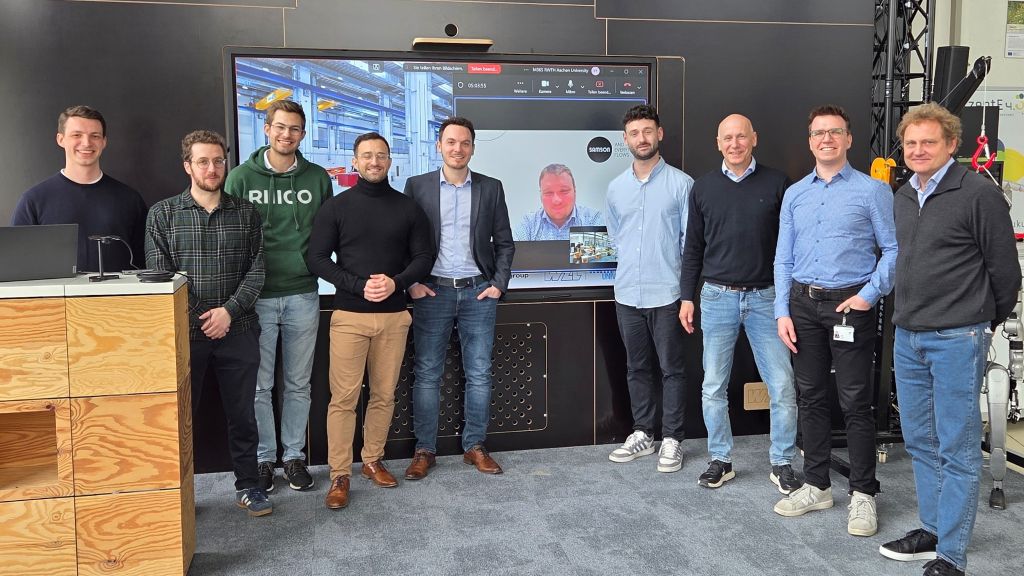
The research project 'AutoSim' develops new methods for the automated creation of simulation models for the manufacturing industry. The goal is to significantly ease the generation of photorealistic and physically accurate models of their production environments for companies and to reduce existing manual efforts. The project involves the Machine Tool Laboratory WZL of RWTH Aachen as well as the software company RIIICO. Associated partners include Miele, Schaeffler, SAMSON AG, and the SMS group.
The focus of the project is on the intelligent preparation and linking of heterogeneous production data. Methods are being investigated that automatically segment, classify, and enrich 3D scans with physical properties to make them usable for simulation applications. Additionally, the project partners are developing a natural language interface that makes any remaining manual process steps particularly user-friendly. This should also allow downstream processes to be carried out easily with the generated simulation models.
The basis of the developed methods are interoperable information models. They enable data from different sources, such as 3D scans, CAD models, or existing databases, to be uniformly described and made usable across systems. In this way, heterogeneous data sources can be linked along a continuous process chain: from scanning the real production environment to the finished simulation model.
'With AutoSim, we are creating the conditions for significantly more efficient and user-friendly creation of simulation models. Companies can thus access digital representations of their production more quickly and use them for optimization and planning processes,' says Petar Tesic, project manager at WZL of RWTH Aachen.
By combining intelligent data processing and interoperable information models, AutoSim helps simplify the integration of simulation solutions into existing IT landscapes. At the same time, manual work steps are reduced, and the creation of digital production models is accelerated. The project thus makes an important contribution to the digitization of the manufacturing industry.
Contact: