

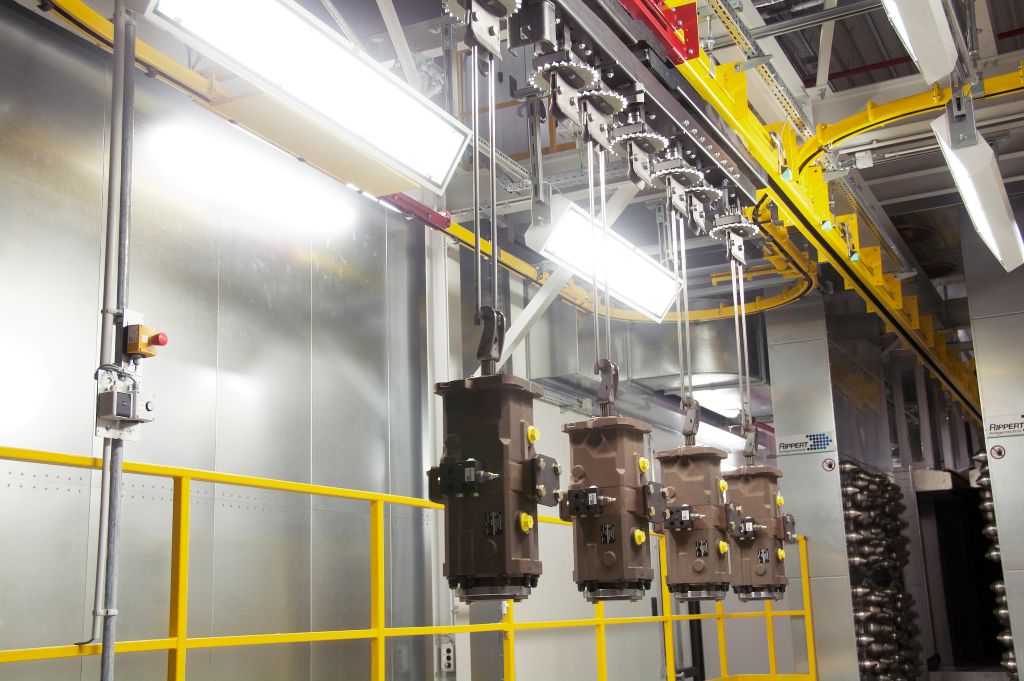
The company LHY Powertrain, formerly known as Linde Hydraulics, manufactures pumps, motors, and valves in Aschaffenburg, among other products. The finished products are largely automated and wet-painted in the in-house painting facility. However, this was not always the case. Until 2016, the company entrusted an external coating contractor with this final production step – with all the consequences: there was a lack of flexibility, control, and influence over quality defects and complaints, as well as a lack of in-house expertise in this area. Higher production volumes inevitably led to rising transport costs and greater planning efforts in logistics. They had become dependent.
Just like LHY Powertrain at that time, many mechanical engineering companies still work with external coating contractors today and ultimately do not have control over the wet or powder coating of their own products. And this is also widespread in the industry: painting systems from the eighties or nineties – hopelessly outdated. 'With such systems, it is no longer possible to improve product quality and respond to increased market demands,' warns Volker Wegmann from the Fraunhofer Institute for Production Technology and Automation IPA. 'Thus, the painting process becomes the bottleneck in the value chain.'
Solid knowledge instead of gut feeling
'It's time for mechanical engineering to pay more attention to painting technology, to bring the relevant expertise into their own company, and to build future-proof painting systems,' advises Oliver Tiedje, head of the Coatings and Multifunctional Materials division at Fraunhofer IPA. He, along with Wegmann and other colleagues, has just written the newly released white paper 'Future-Proof Painting in Mechanical Engineering.'
In it, the authors not only explain in detail what advantages a proactively planned in-house painting system offers, but also show what competencies are necessary.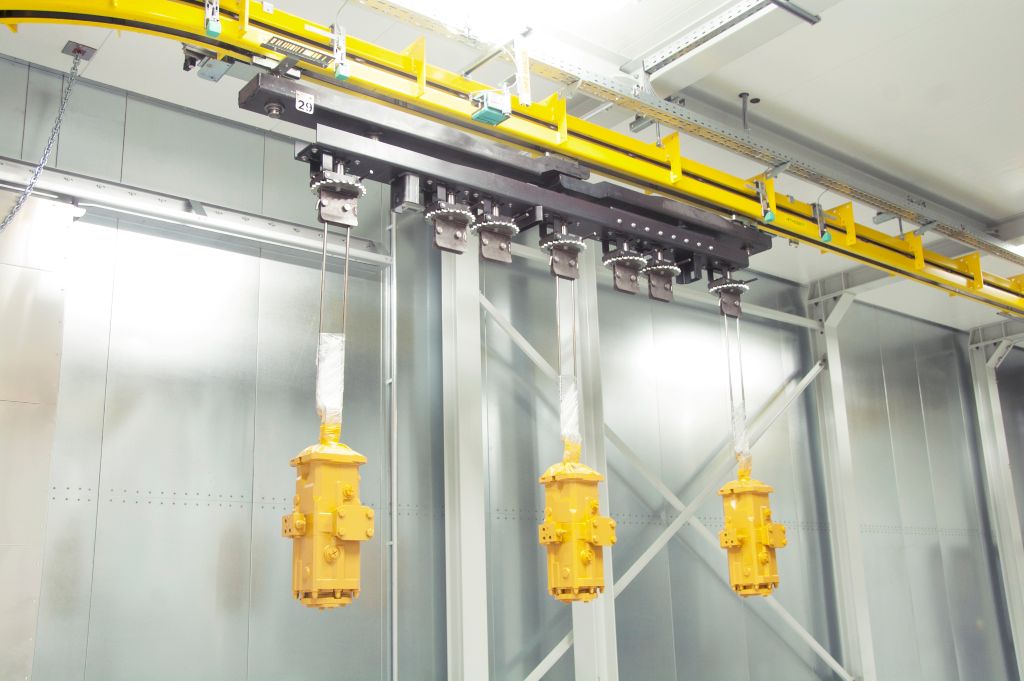
'Painting systems are often in operation for 30 years,' says Wegmann. 'So you need to know not only the current state of technology but also be able to assess which new processes and materials will come in the future. Furthermore, planning incorporates expertise from several scientific disciplines: engineering, chemistry, physics, often also biology – and business administration, because of course, the system must also be economically viable.' So, solid knowledge instead of gut feeling.
Not an insurmountable problem
When LHY Powertrain commissioned Fraunhofer IPA to plan a future-proof painting system for the company, an interdisciplinary research team initially developed a catalog of requirements with all the criteria that the system should meet. The scientists then began the actual planning. The result was an energy-efficient and flexible wet painting system, among other things, with 'Power & Free' conveyor technology including color sorting buffer, nine-zone pre-treatment, and high-rotation atomizers with color change in the robot arm including frog technology to reduce material losses. A combined wet adhesion and topcoat dryer with multiple strands for drying thin and thick components, as well as a vision system for workpiece recognition and painting program creation, was also integrated into the system.
'Planning a future-proof painting system is not an insurmountable problem and especially not something to be postponed for long,' says Wegmann. 'And those who want to be on the safe side can seek help.'
Contact: