
Compact articulated arm robots for industry still pose challenges for designers in energy guidance. There are hardly any suitable solutions on the market for the fast rotational movements along the first axis and the confined space conditions. igus now closes this gap with a new free-hanging energy chain from the twisterchain series. At the same time, it also addresses a second problem: energy guidance along the fifth axis of palletizing robots. Many designers have so far been experimenting with their own solutions here.
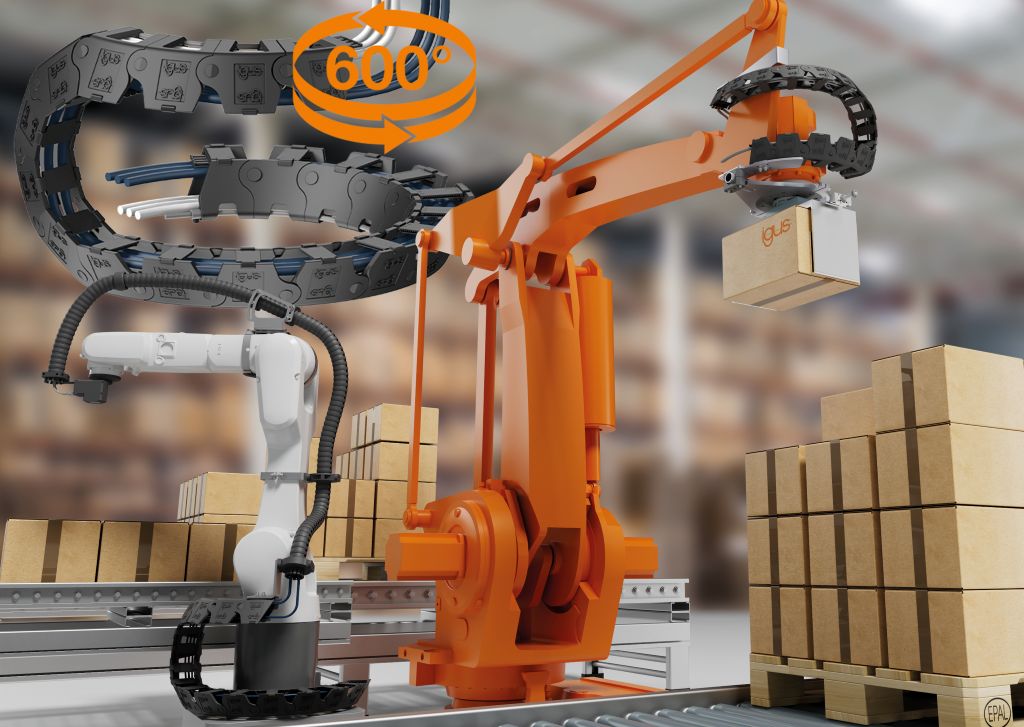
Compact industrial robots like the KR AGILUS from KUKA or the FANUC LR Mate can be found everywhere in the industry. They screw, glue, load, and take on pick-and-place tasks. However, as established as the robots are, there has always been a problem. 'For the cable management at the base of the small robots that rotate 360 degrees, there are no suitable rotary modules on the market that can follow the movement,' says Matthias Meyer, head of the triflex e-chains and Robotics division at igus. The reason for this is often the connector plate for power supply on the back of the robot, which obstructs rotary modules. 'Therefore, many designers still resort to makeshift solutions, such as hanging hoses that drag across the floor and wear out quickly.' To solve this problem, igus is now bringing a free-hanging twisterchain energy guide to the market. The rotary module is positioned in an arc around the robot base - on the floor or a raised platform. The fixed point is attached to the ground, while the follower side is slightly higher on the first axis. As the robot rotates, the energy chain gradually lifts upwards and settles into a new plane. 'Thus, for the first time, we can rotate 360° around the base of the robot without colliding with the connector contour,' says Matthias Meyer. Improvised solutions are no longer necessary, significantly increasing the reliability of compact industrial robots.
Fifth axis of palletizing robots safely guided
With the new free-hanging twisterchain, igus also addresses a second problem: energy guidance at the fifth axis of palletizing robots. These robots often route the cables through the robot arm. However, only up to the fourth axis. 'Suitable solutions for the rotational movement at the fifth axis have so far been lacking. Designers often resort to corrugated hoses that move uncontrollably and can collide with the tool,' says Matthias Meyer. The free-hanging twisterchain can also be used here for more safety. The specially developed design allows the energy and data lines at the fifth axis to follow the 360-degree rotations of the tool. Through controlled and defined movement over two planes, a collision of the lines with the robot arm or tool is excluded. 'This provides maximum freedom of movement for applications with extended rotation angles and ensures a permanently reliable energy guide even with highly dynamic motion profiles,' says Matthias Meyer.
Quick assembly and easy retrofitting
The new twisterchain variant can be installed quickly. 'Since the solution is free-hanging, we only need two attachment points on the robot. Expensive guide troughs and complicated alignments are unnecessary,' emphasizes Matthias Meyer. The e-chains can also be adapted to different cable configurations thanks to a flexible internal layout with removable shelves. Another advantage: the energy chains can be opened at the inner radius, allowing users to insert the cables from the outside. Matthias Meyer: 'This is a significant advantage over hoses, where the cables must be threaded through. Here, different connector sizes are always a limiting factor.' For precise adaptation to each application, the system features an adjustable pre-tension. This can be precisely matched to cable weight and required rotation angle - a crucial advantage for fine-tuning robots and machines that require the highest repeat accuracy and stability.
Contact: