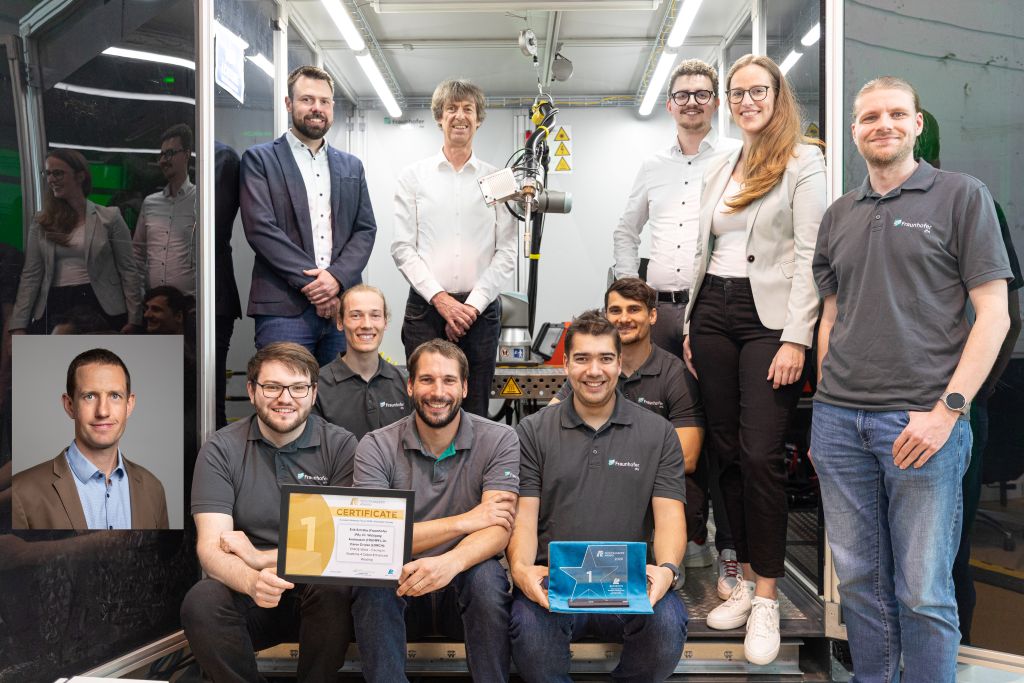
Technology transfer that works: At the 'European Robotics Forum' (ERF), the applicant trio won the prestigious award at the end of March. It rewards research that has reached industrial application. The content of the application was a 'No-Code' solution that allows companies to use Cobots for welding in small batch sizes without specialist knowledge or high effort.
Fraunhofer IPA, together with Trumpf and Lorch, has developed a technology that revolutionizes collaborative welding robots: An intelligent sensor add-on enables fully automatic initial planning of the robot path without prior programming.
Renowned Award of European Robotics
With this solution, the development team applied under the project name 'TR4CE-Weld – Tracing in Realtime 4 Cobot-Enhanced Welding' for this year's 'euRobotics Technology Transfer Award'. Sponsored by the European Robotics Association 'euRobotics' and awarded annually at the 'European Robotics Forum', the application was successful with a written part and a presentation directly at the ERF, this year in Stavanger, Norway.
The award has been honoring outstanding achievements in the transfer of robotics technology from research to industry since 2004. It emphasizes the crucial role of technology transfer in keeping European robotics at the forefront of global competition.
Tailored Solution: Nearly triple-digit number of realized robot cells
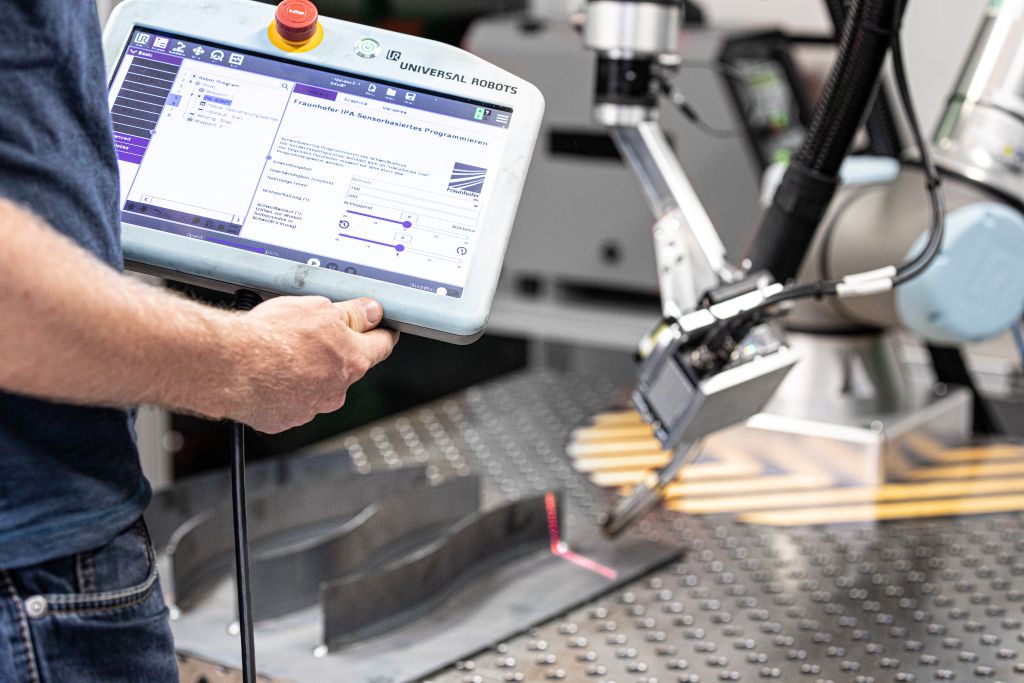
The award-winning solution met a critical market need, as demographic change and skilled labor shortages are dramatically exacerbating the lack of qualified welding personnel. Automation is therefore becoming indispensable even for smaller quantities, but has previously been hardly economically feasible – especially in small and medium-sized enterprises (SMEs). The cooperation between research and industry provides a practical answer: Handling remains simple and quick – even without in-depth expert knowledge.
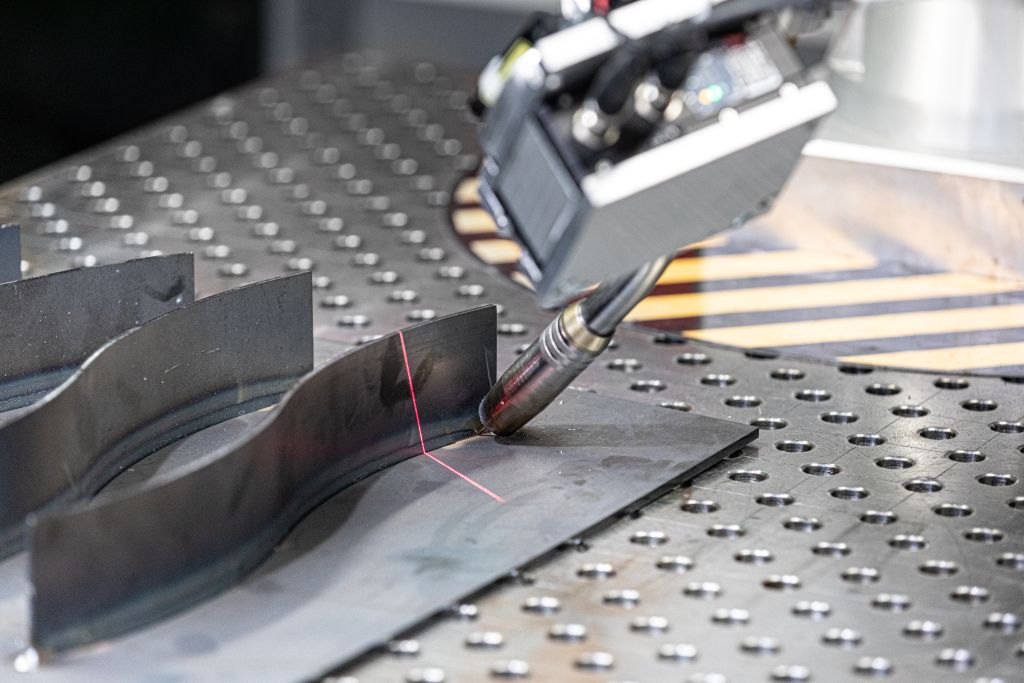
The specialist only positions the robot at the starting point of the seam. A pre-installed laser triangulation sensor then independently detects the joining zone. The software calculates the welding path and torch orientation in real-time, allowing the operation to begin within seconds. The breakthrough: While previous sensor systems only corrected pre-programmed paths due to tolerances, the new development takes over the complete initial programming. Deviations in subsequent components are automatically compensated. This innovation opens up efficient production of small batch sizes with Cobots at a completely new level.
Both industrial partners have acquired licenses and have been bringing the technology to market for a few years: Trumpf integrated the system under the name 'Smart Seam Tracking' into the award-winning arc welding cell 'TruArc Weld 1000'. Lorch offers the extension as 'Seam Pilot' for its collaborative welding robot.
Sensor Add-on Detects Welding Seam
For the Fraunhofer Institute for Production Technology and Automation IPA, the award is a confirmation of outstanding practical research. The technological foundations for this success were laid within the framework of the AI advancement center 'Learning Systems and Cognitive Robotics' with funding from the Ministry of Economic Affairs, Labor and Tourism of the State of Baden-Württemberg. This allowed for the development of an exemplary solution that provides added value to many companies.
Furthermore, there has been a long-standing cooperation between Fraunhofer IPA and the company Trumpf within the framework of the 'S-TEC Lab Flexible Sheet Metal Production'. The goal of this collaboration is to successfully transfer research results into entrepreneurial applications. In this context, the transfer of the award-winning solution was also made possible.
Further Development of the Technology
The award proves that even in one of the oldest robotics disciplines like welding, there is still potential for innovation. However, the end of the line has not yet been reached. The team at Fraunhofer IPA is already working on a transfer to other adaptive robotic processes, on multi-layer welding, and also on the integration of optical quality inspection into the Cobot. Interested companies with corresponding use cases or questions are welcome to approach the Fraunhofer IPA team for a 'proof of concept'.
Contact: