
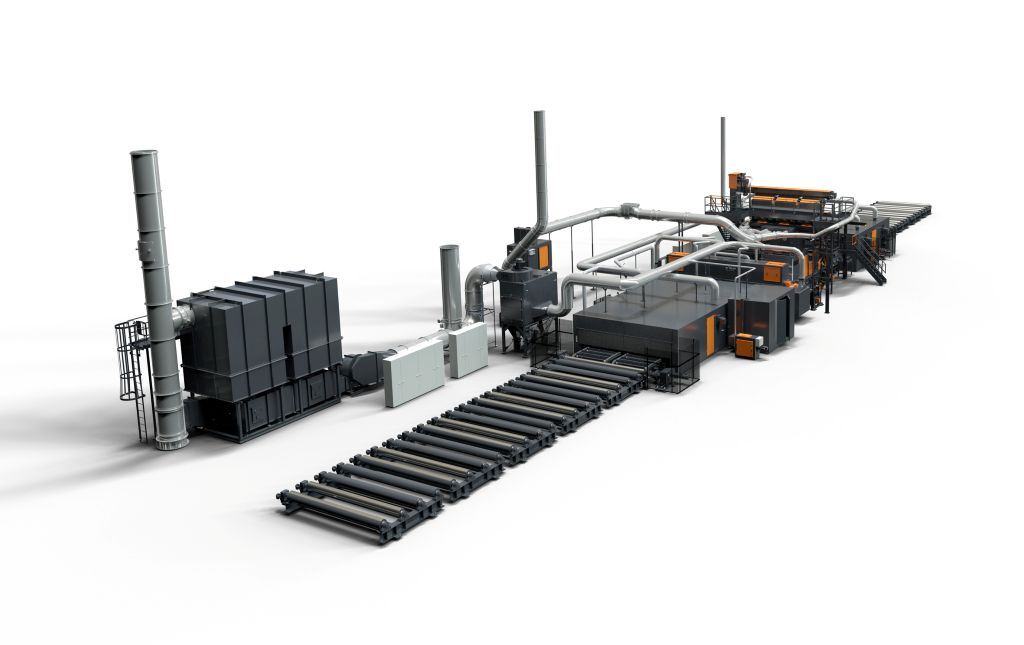
In the middle of a green meadow in an industrial park in the USA, one of the largest steel producers in North America has built a gigantic rolling mill for steel sheets. This sets new standards in terms of the size of the rolled and processed sheets and belongs to the most powerful steel mills in North America. In addition to particularly thick and large-format, hot-rolled steel sheets, the company offers its major customers from the oil and offshore industry surface treatment of the rolled products as an additional service, which is becoming increasingly important in the industry. This is specifically implemented with a conservation line of the type KON 47/3-HD in rolling mill execution by Rösler Oberflächentechnik GmbH.
Gigantic steel sheets require utmost precision and maximum performance
With a length of about 75 meters, a blasting medium throughput of 3.7 tons per minute, and a production volume of 122,000 tons per year, the conservation line designed and manufactured by Rösler Oberflächentechnik GmbH for the American steel producer is a true powerhouse. However, it must be, as the sheets processed here have enormous dimensions. Depending on the rolling thickness of the slab, i.e., the steel blank, they can be up to 4,300 mm wide, 18,000 mm long, and a maximum of 203 mm thick. 'This was our challenge: To be able to blast such large and heavy plates with a maximum weight of over 45 tons, an extremely robust system is required that is extremely powerful but also works precisely and reliably achieves the required cleanliness level of 2.5 SA. Combined with a rather tight schedule, this was an exciting and ambitious project for us,' says Marcus Witter, Global Sales Expert at Rösler.
Rösler conservation line offers customers additional value
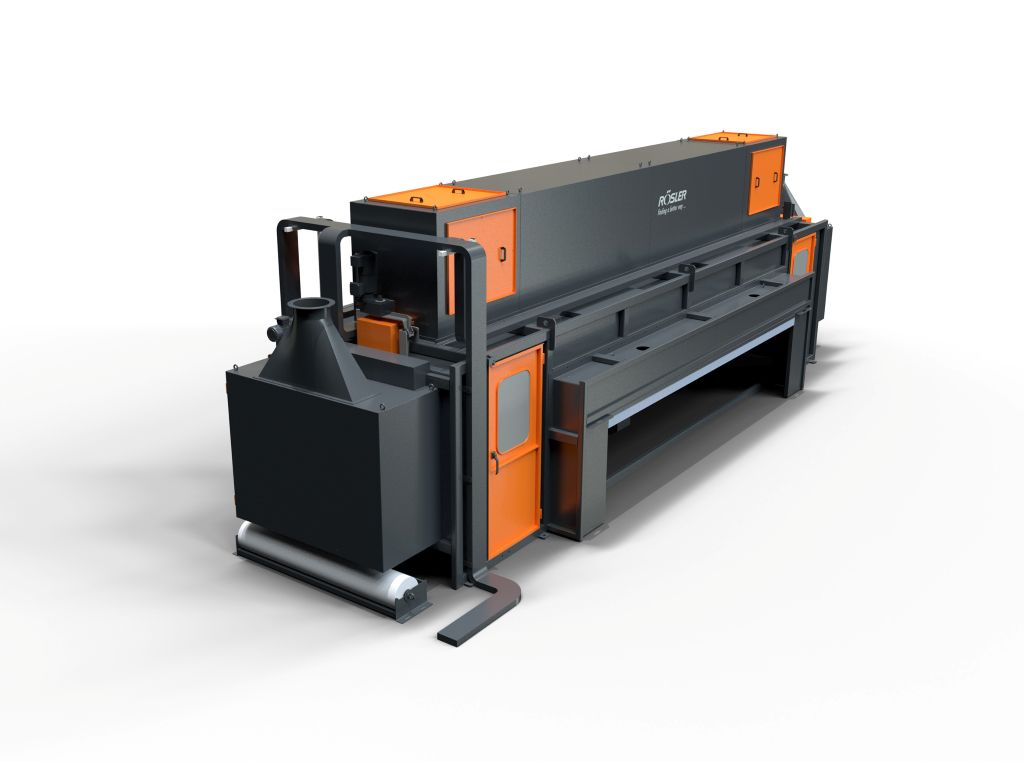
The location of the Rösler system at the end of the process chain already indicates its special position within the rolling mill: The Rösler conservation line does not offer standard processing but an optional additional service that is gaining importance for more and more intermediaries and end customers: The customer has the choice between a hot-rolled sheet or a sheet that has already been blasted and/or painted. 'Depending on what happens with the sheet, this can be a very attractive added value. For example, if sheets have long shipping routes and possibly show initial corrosion spots.',
In this case, it makes sense to blast and apply corrosion protection before shipping. At the same time, the customer saves one to two process steps in their own production because they can cut and weld the sheet directly without having to remove the weldable primer beforehand,' explains Global Sales Expert Marcus Witter from Rösler. The facility uses solvent-based primers, as required in shipbuilding and offshore applications. Solvent-containing paints are also used in traditional steel construction. Due to the increasing demands for environmental protection, Rösler conservation lines are also capable of processing water-based paints.
System design and equipment ensure maximum efficiency and cost-effectiveness
The centerpiece of the Rösler conservation line is a roller conveyor blasting system. Preceding it is a blow-off unit that prevents the entry of contaminants, as well as a pre-heater. This has a maximum operating temperature of 260 degrees and is heated very efficiently with two gas burners in recirculation operation. Here, the sheets are heated to the optimal operating temperature for later painting. Subsequently, they are transported via a short intermediate roller conveyor into the blasting system, which is equipped with ten Gamma 400G turbines, each with 30 kW. The turbines can be selectively turned off automatically, depending on the sheet width. This increases efficiency, reduces wear, and thus lowers operating costs.
Specifically for automatic sheet width detection, the system has been equipped with an improved blasting medium return and distribution system to ensure a uniform blasting medium distribution with optimal cleaning performance, even with selective shutdown of individual turbines. To withstand the weight of 7 tons per running meter and the blasting medium throughput of 3.7 tons per minute even under full load and continuous operation, the blasting chamber is completely made of 8 mm manganese steel and additionally equipped with replaceable manganese steel plates with a thickness of 8 mm.
After blasting, the sheet is automatically cleaned using an integrated cleaning station, ensuring it is free of blasting medium and dust before being transported to the automatic painting system. There, the two-component paint is applied using the airless method. Sensors detect the sheet size and width as well as the transport speed of the sheet, minimizing unnecessary overspray, i.e., the blowing of paint in the room, and ensuring greater efficiency and lower paint consumption. In the final state, the painted sheet must have a dry film thickness of 15 to 25 µm.
Once the sheet is painted, it goes into the paint dryer heated to around 60 degrees. The sheet passes through this on a special chain conveyor to prevent damage to the paint on the underside of the sheet and avoid visible defects. A thermal afterburner ensures that the solvent-laden exhaust air from the painting system and the dryer is cleaned and that the emission limits of the system are safely adhered to.
Successful commissioning despite the most demanding assembly conditions and highest time pressure
Since the end of 2023, the Rösler conservation line has been in operation and runs reliably and continuously. The assembly of the conservation line was a real challenge due to the tight schedule for the construction of the entire rolling mill. While the conservation line was already being set up, construction work on the hall continued at full speed to complete the roof, exterior walls, and other necessary installations. 'This made the assembly of the system a real challenge, but we wanted to support our customer in meeting their tight schedule. This was only possible through direct daily exchange between the project teams on both sides, which we found very pleasant and constructive and ultimately led to mutual success,' says Marcus Witter from Rösler.
Rösler Oberflächentechnik GmbH is proud to have been part of this exciting project and looks forward to further projects of this dimension.
Contact: