
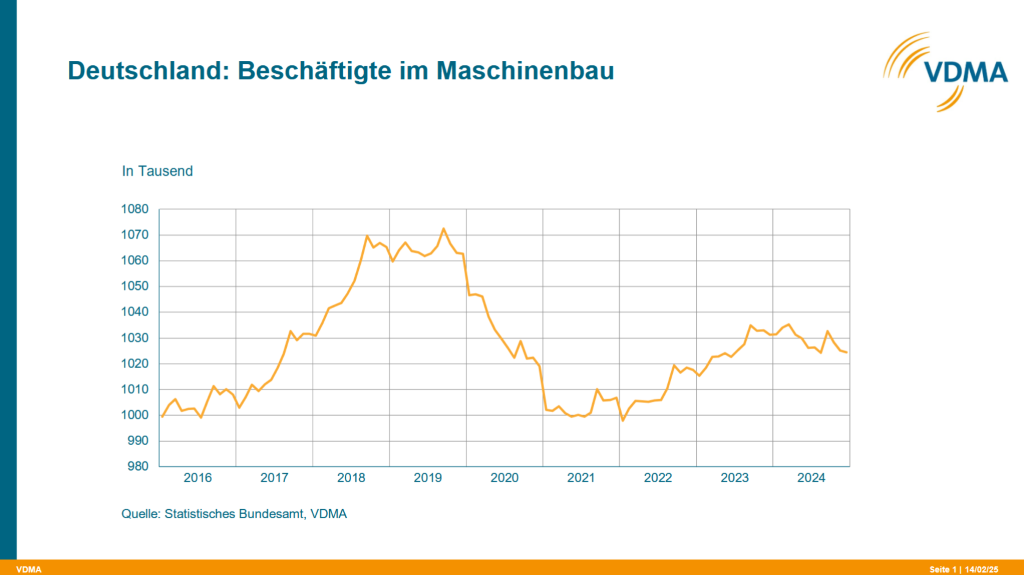
In the challenging year 2024, companies in the mechanical and plant engineering sector in Germany have largely managed to maintain their core workforce. Throughout 2024, around 6,800 jobs (a decrease of 0.7 percent) were lost. By the end of the year, a total of 1.02 million employees were working in companies with at least 50 employees. 'Thus, the mechanical and plant engineering sector was able to maintain its position as the largest industrial employer in Germany. This is remarkable because mechanical engineering production fell by a price-adjusted 7.5 percent in the past year, according to preliminary figures from the Federal Statistical Office. Moreover, mechanical engineering had already experienced a slight decline in production in 2023,' commented VDMA Chief Economist Dr. Ralph Wiechers on the employment balance.
The outlook for the labor market remains bleak overall. Significant leading indicators such as the ifo Employment Barometer or the results from the latest VDMA economic survey clearly indicate that job reductions are likely to continue in the current year 2025. Enormous cyclical and structural pressures will continue to hit manufacturers of investment goods, namely the mechanical and plant engineering sector. 'This will not pass without leaving traces on employment figures,' says Dr. Wiechers.
Short-time work continues to rise
Many companies are currently relying on tried-and-true instruments to maintain employment. These include the use of individually agreed working time accounts as well as temporary short-time work. According to estimates from the Federal Employment Agency, the number of short-time workers in mechanical engineering was around 53,000 in October – with an increasing trend. According to the latest VDMA economic survey, every fourth company in mechanical engineering (27 percent) expects an increase in short-time work in its own company in the first half of 2025. Another 58 percent expect a stable level. However, this will not be able to prevent a further, hopefully only slight reduction in employment. While companies will strive with all their might not to reduce their core workforce due to the persistent shortage of skilled workers, 60 percent of companies expect to maintain their core workforce at a constant level in the first half of 2025 despite the challenging situation.
However, about a quarter of companies feel compelled to reduce personnel. 'How much of this will be permanent, and how much can be compensated later through new hires, cannot be said reliably,' explains Wiechers. 'We have a mix of cyclical pressures and profound structural changes. The challenge is to take sensible employment and skills-preserving measures while cushioning, but not preventing, structural change. Because a politically desired and supported retention of urgently needed skilled workers in permanently non-competitive positions ultimately harms all parties involved more than it helps.'
Rapid reforms in the labor market are necessary
To counteract the trend in the labor market, the next federal government must act quickly and implement employment-preserving reforms. So far, there is no sign of this, laments the VDMA Chief Economist. Instead, social security contributions have continued to rise at the turn of the year and are now as high as before the Hartz reforms. 'There is a significant structural need for action to stabilize social security systems. Because their contributions continue to drive up employment costs. They have an immediate negative impact on employers' ability to retain employees and hire new talent,' emphasizes Wiechers. Additionally, a modern working time law is needed with weekly instead of daily maximum working hours, as well as a noticeable reduction in bureaucracy, especially in labor law. 'Everyone agrees that we want to maintain the industrial middle class. Those who are serious about it must not shy away from sometimes painful reforms in the labor market!' demands Wiechers.
Source: