
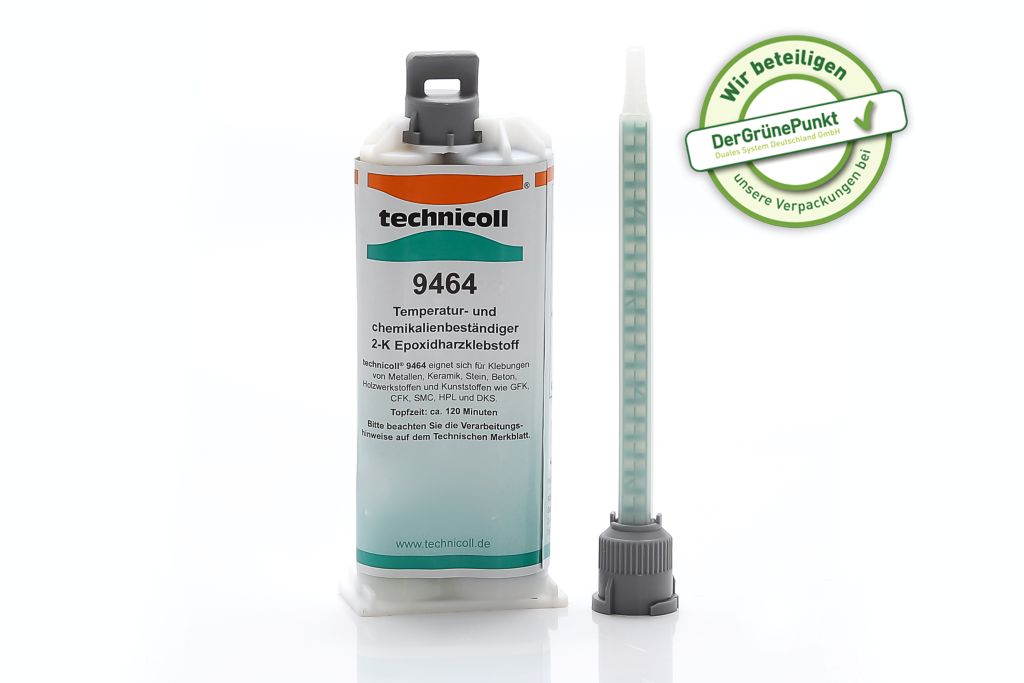
High temperatures, aggressive media, demanding material combinations, and strict safety requirements: In many industrial applications, an adhesive must do much more than just bond two components together. With technicoll 9464, RUDERER KLEBETECHNIK GmbH offers a powerful 2-component epoxy adhesive for high-strength structural bonds that must reliably perform under thermal, chemical, and mechanical stress. The black, pasty adhesive impresses with high temperature resistance up to +150 °C, very good chemical and aging resistance, low outgassing properties, and self-extinguishing fire behavior. For users, this means: more safety in adhesive selection, fewer compromises in the process, and durable connections even under demanding operating conditions.
When temperature, chemistry, and safety come together
Whether in rail transport, aviation, motorsport, automotive, electronics, or the composite industry: Technical bonds are often permanently subjected to high demands. Components come into contact with oils, fuels, diluted acids, or other media, are exposed to fluctuating temperatures, or must remain load-bearing in safety-relevant constructions over the long term. technicoll 9464 was specifically developed for such tasks.
The 2-component epoxy adhesive can withstand temperatures of about -40 °C to +150 °C. For short periods, it can even withstand temperatures up to +180 °C, making it suitable for applications where a powder coating is planned after bonding. This allows downstream coating processes to be better planned without having to consider the bond as a weak point in the overall process. At the same time, technicoll 9464 offers excellent resistance to many aggressive media such as oils, gasoline, and diluted acids. This makes it a reliable solution for components that require not only high strength but also chemical resistance.
Stable connections in demanding material mixes
In modern constructions, metals, composite materials, wood-based materials, glass, ceramics, rubber, or thermosetting plastics often come together in tight spaces. Screws, rivets, or welding often encounter constructive or optical limits. Adhesive technology, on the other hand, enables surface, stress-free, and material-saving connections – even with complex geometries and components with high functional density.
technicoll 9464 is particularly suitable for bonding metals such as aluminum, steel, stainless steel, and galvanized steel, as well as for thermosets and composite materials such as GRP, CFRP, and SMC. Polyester laminates, wood-based materials, ceramics, stone, concrete, and glass can also be reliably bonded depending on the requirements. The adhesive is pasty, gap-filling, and shrinks only slightly. For an optimal adhesive gap, technicoll 9464 is blended with glass beads with a diameter of 200 µm. This supports a uniform adhesive layer and helps achieve reproducible results in the industrial process.
Fire behavior in focus
Especially in transport applications, the fire behavior of materials and bonding solutions plays a central role. technicoll 9464 meets the requirements for self-extinguishing fire behavior according to EN 45545-2 for rail transport, FAR 25.853 for aviation applications, and ABD0031 (AITM). This opens up additional safety for manufacturers, designers, and users when selecting a suitable adhesive for demanding assemblies.
The low outgassing properties are also an important advantage in sensitive applications – for example, in aerospace, in electronic assemblies, in sensor applications, or in components with high requirements for material compatibility and long-term functional safety.
From sensors to sandwich panels
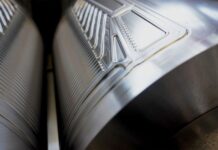
The application possibilities of technicoll 9464 range from high-strength structural bonds to technical special applications to components with high requirements for temperature and media resistance. Typical examples include bonding grinding cylinders in the automotive industry, sensor bonding, applications in motorsport and automotive under the influence of temperature and chemicals, bonding oil filter elements, electronic communication components, motorcycle covers, as well as applications in aerospace.
In panels and lightweight constructions, technicoll 9464 can also showcase its strengths. This includes honeycomb core structures, aluminum and stainless steel sheets, wood, composite materials, selected thermoplastic materials, and foams. In practice, the adhesive is suitable wherever a connection must be permanently high-strength, shape-stable, durable, and process-safe.
Practical processing for professional applications
In addition to technical properties, safe and traceable processing is also important in manufacturing. technicoll 9464 has a processing time of about 120 minutes, providing enough time for positioning and joining the components. The processing strength is reached after about eight hours, and the final strength after a few days. This allows the adhesive to be used in various manufacturing processes – from single applications to small series to industrial processes.
RUDERER supports customers not only with high-quality adhesive products but also with application technical consulting. The focus is on the specific requirements: Which materials should be bonded? What temperatures, chemicals, or media will act on the bond? What strength, gap geometry, and process time are needed? Only from this consideration does the suitable adhesive solution emerge.
"In high-performance bonding, not only pure strength matters. It is crucial that adhesive, material, process, and later stress match," explains Petra Ruderer, managing director of RUDERER KLEBETECHNIK GmbH. "technicoll 9464 is a strong solution for applications where temperature resistance, chemical resistance, and safety are required together."
Strong solution for demanding industries
With technicoll 9464, RUDERER expands the application spectrum for demanding structural bonds in industries such as transport, vehicle and special vehicle construction, aviation, electronics, communication technology, and the composite industry. The adhesive combines technical performance with practical processing and is suitable for applications where conventional joining techniques reach their limits. The adhesive is particularly valuable wherever components are permanently loaded in operation and the connection must remain clean, safe, and economical.
Contact: