What if additive manufacturing customizes complex components for the hydrogen economy? How can powder be turned on and off as quickly as a light switch? How does a tool autonomously know how much load it is currently under? At Formnext, Fraunhofer ILT will present three intelligent answers at the Fraunhofer joint booth that make additive manufacturing significantly more economical.
Whether filter structure, powder switch, or sensor: what was previously a separate component, an external assembly, or an additional manufacturing step is increasingly being integrated directly into the additive processes or the manufactured structure. This approach is consistently pursued by the Fraunhofer Institute for Laser Technology ILT.
"We think of additive manufacturing not just from the component perspective, but from the process chain. Wherever an additional component, a manufacturing step, or a maintenance task can be eliminated, we apply our methods," says Dr. Tim Lantzsch, head of the Laser Powder Bed Fusion (LPBF) department at Fraunhofer ILT. "The goal is to make AM more economical and thus more competitive. And we are succeeding!"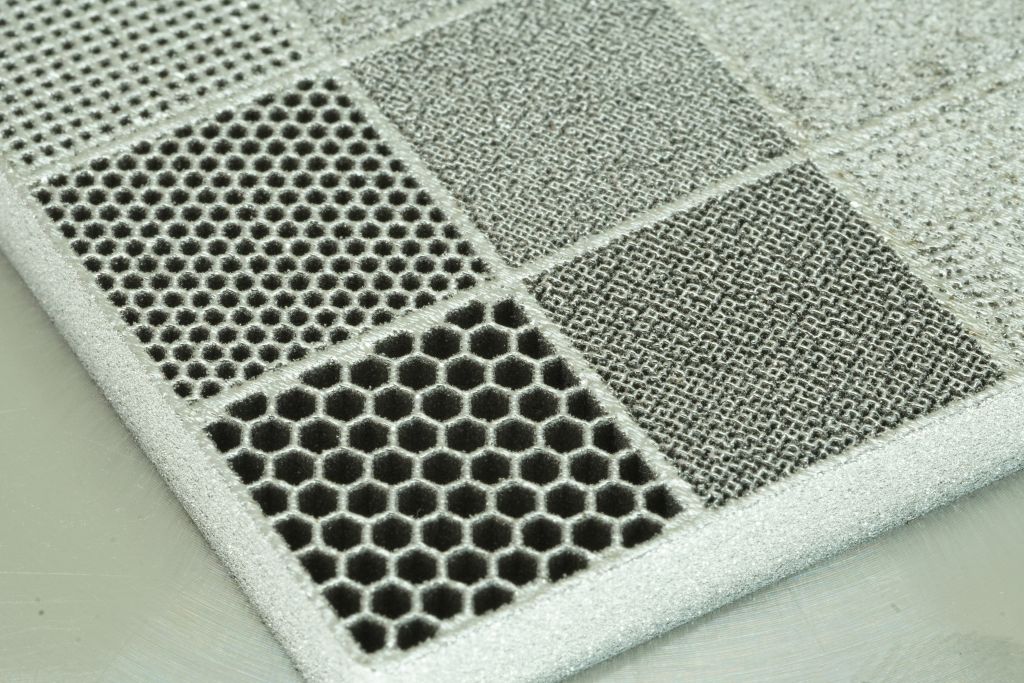
Powder on, powder off: Switching in milliseconds
Metal powder is one of the biggest cost drivers in laser metal deposition (LMD). A significant portion of it flows unused through the system, for example, when the laser briefly pauses during complex path planning, while the powder continues to flow. The consequences: expensive powder loss, contaminated components and handling systems, as well as risks for plant components and occupational safety.
Previous solutions switch the powder mechanically, with switching times of over a second and wear on the moving parts. For highly dynamic LMD and EHLA processes with frequent, short switching, this is too slow and uneconomical.
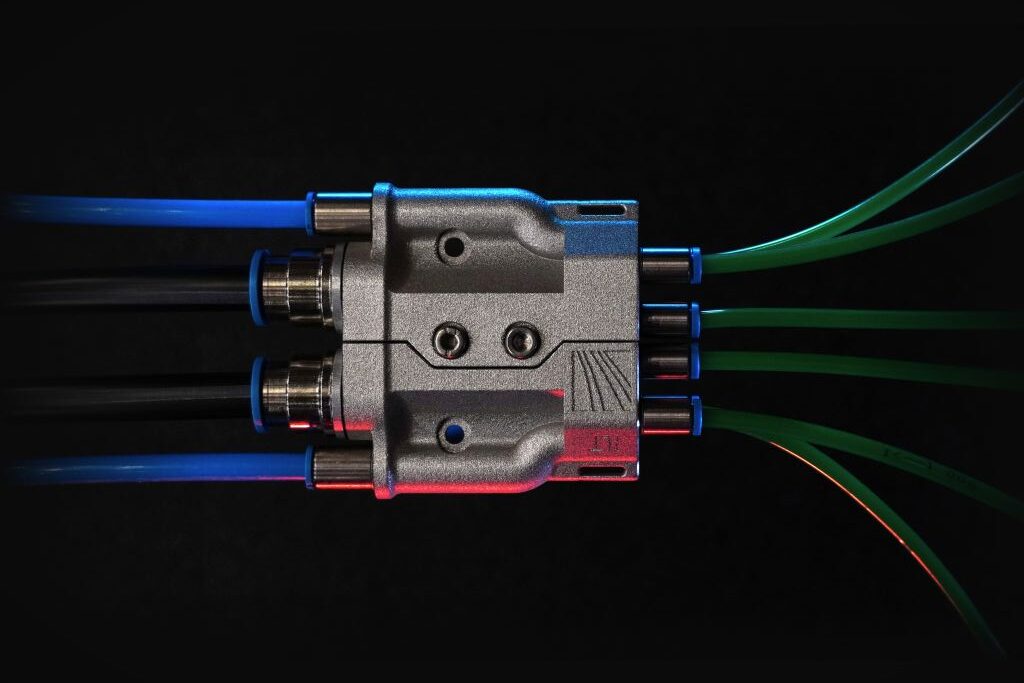
The Fluidic Powder Switch developed at Fraunhofer ILT, on the other hand, switches directly at the nozzle, where the powder reaches the process. The principle is based on the Venturi effect: a control gas flow creates a vacuum in a cross-section narrowing and sucks the powder into a collection container instead of directing it into the process zone. Since there are no mechanically moving parts in the powder path, the patented system operates almost wear-free and maintenance-free. In addition to simple on and off switching, it also allows for switching between multiple materials and a gradual adjustment of the powder mass flow.
The economic leverage is considerable: the switching time decreases by more than an order of magnitude compared to mechanical systems. The operating costs of the control gas are more than three orders of magnitude lower than the material costs of the saved powder.
"Every gram of powder that does not flow unused through the system saves costs, protects the component, and conserves resources," explains Viktor Glushych, group leader for LMD coating and heat treatment at Fraunhofer ILT. Glushych has significantly contributed to the development of the innovative Fluidic Powder Switch. "We are particularly pleased that the switch not only works in the lab but is already running in series production with initial customers. That was exactly our goal: an industrially viable, robust, and economical solution."
Porous Structures Made to Measure
Permeability in metal components is usually achieved through separately manufactured metal foams, fabrics, or sintered filters that must then be joined. This takes time, restricts design freedom, and increases thermal and electrical resistance at every joining point.
At Fraunhofer ILT, researchers use Laser Powder Bed Fusion (PBF-LB/M) to intentionally set controlled porosity instead of avoiding it. Dense and permeable zones are created in a single, monolithic component, with sharp or gradual transitions, all without post-processing.
In the LPBFCells project, funded by the Federal Ministry for Economic Affairs and Energy (BMWE), Fraunhofer ILT produces the porous transport layer (PTL) of an electrolysis cell in a single component instead of from stacked sintered layers: with lower contact resistances, integrated flow-field and support structures, and significantly faster iteration of new cell geometries. As a demonstrator, Fraunhofer ILT will showcase an electrolysis cell with a gradated PTL made of pure titanium at Formnext 2026.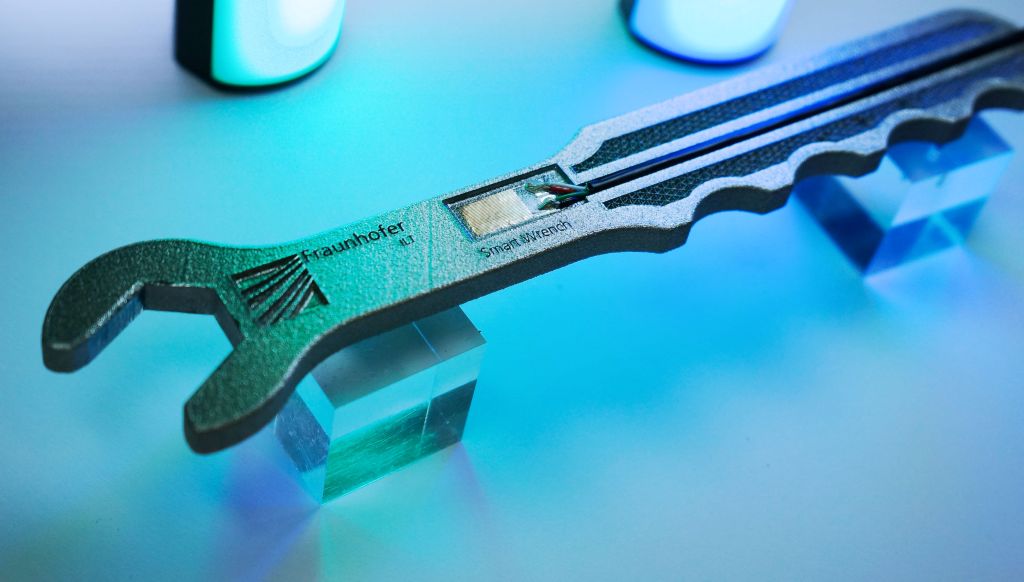
"By understanding porosity as a design feature, dense and permeable structures can be tailored to the function of the component," says Alexander Neuke, research associate at Fraunhofer ILT. "This is particularly interesting for hydrogen applications like electrolyzers or fuel cells, where different porosities are needed across the component thickness. But I also see great potential for filters or turbomachines."
Components that tell their own story
Additive manufacturing occurs layer by layer, making areas accessible that are not reachable in a finished component. Dr. Samuel Fink, group leader for thin film processes at Fraunhofer ILT, takes advantage of this. He integrates sensors directly into LPBF components, such as printed strain gauges. The sensor layers are created using inkjet, aerosol-jet, or pad printing; they can be applied and precisely positioned during or after the build process. The smart components produced this way provide real-time data on load, deformation, or the onset of crack formation.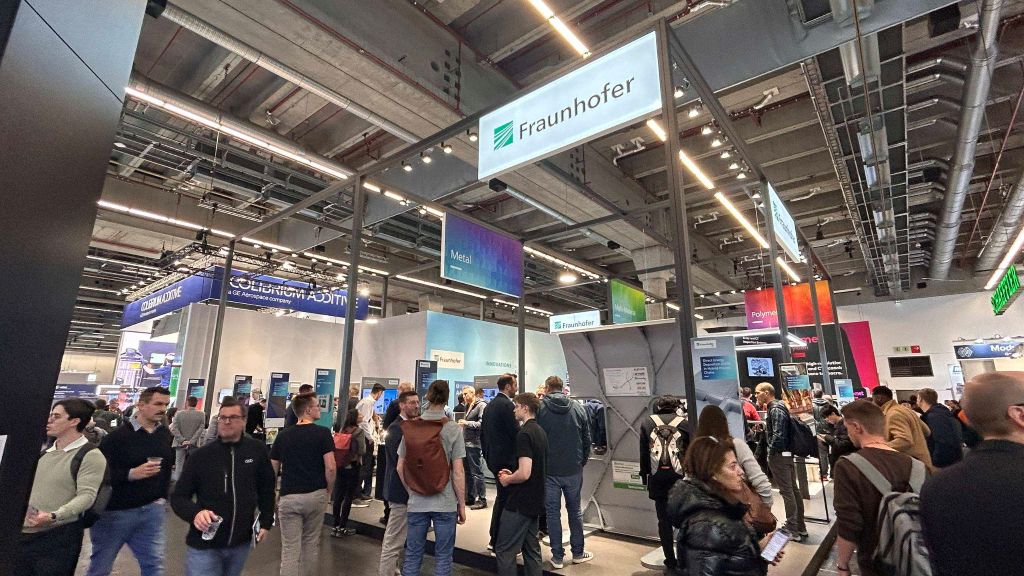
At Formnext, the institute will showcase a functional demonstrator: a wrench with an integrated, in-situ printed strain gauge. Under load, the embedded sensor provides real-time data on deformation and stress distribution directly in the component, protected from mechanical wear and thermal stress. This opens up condition monitoring, predictive maintenance, and greater operational safety for safety-critical applications, while simultaneously reducing system complexity, as external wiring and measuring points are eliminated.
"Everyone is looking for additive sensors, but there is still a lack of robust, efficient processes and suitable materials," explains Samuel Fink. "With the Smart Wrench, we show what is already possible: the sensor technology delivers data exactly where it matters most in the component. This is an important step towards truly series-compatible additive sensor solutions."
Fraunhofer ILT at Formnext at the Fraunhofer joint booth D31 in Hall 11.0
Contact: