Raw materials are becoming scarce, supply chains remain vulnerable, waste costs money, and regulations are tightening. The 'Handbook of Circular Value Creation' published by Fraunhofer IPA and Fraunhofer IAO shows how companies can extend the use of products, return materials, and develop new business models.
In factory halls, workshops, recycling facilities, and development departments, it is decided how much value is contained in a product – and how much of it is lost. An electric motor can be repaired instead of replaced. Plastic can flow back as a raw material into new products. Yet many companies still operate according to the model: produce, sell, use, throw away. This linear system consumes raw materials, generates waste, and makes businesses vulnerable to fluctuating prices and uncertain supply chains.
With the 'Handbook of Circular Value Creation – Key Concepts, Technologies, Business Models, and Framework Conditions', the Fraunhofer Institutes for Production Technology and Automation IPA and Work Science and Organization IAO, together with other experts, present a practical overview. The volume is edited by Prof. Dr. Alexander Sauer, head of the Fraunhofer IPA, Dr. (habil) Robert Miehe, head of Sustainable Value Creation Systems at Fraunhofer IPA, and Prof. Dr. Katharina Hölzle, head of the Fraunhofer IAO.
'Circular value creation does not mean managing waste better. It starts much earlier: at design, material selection, business model, and data throughout the entire product lifecycle,' the editors explain in the handbook. The volume thus shows why recycling alone is not enough. Products must be designed so that they can be repaired, reused, refurbished, or recycled at a high quality.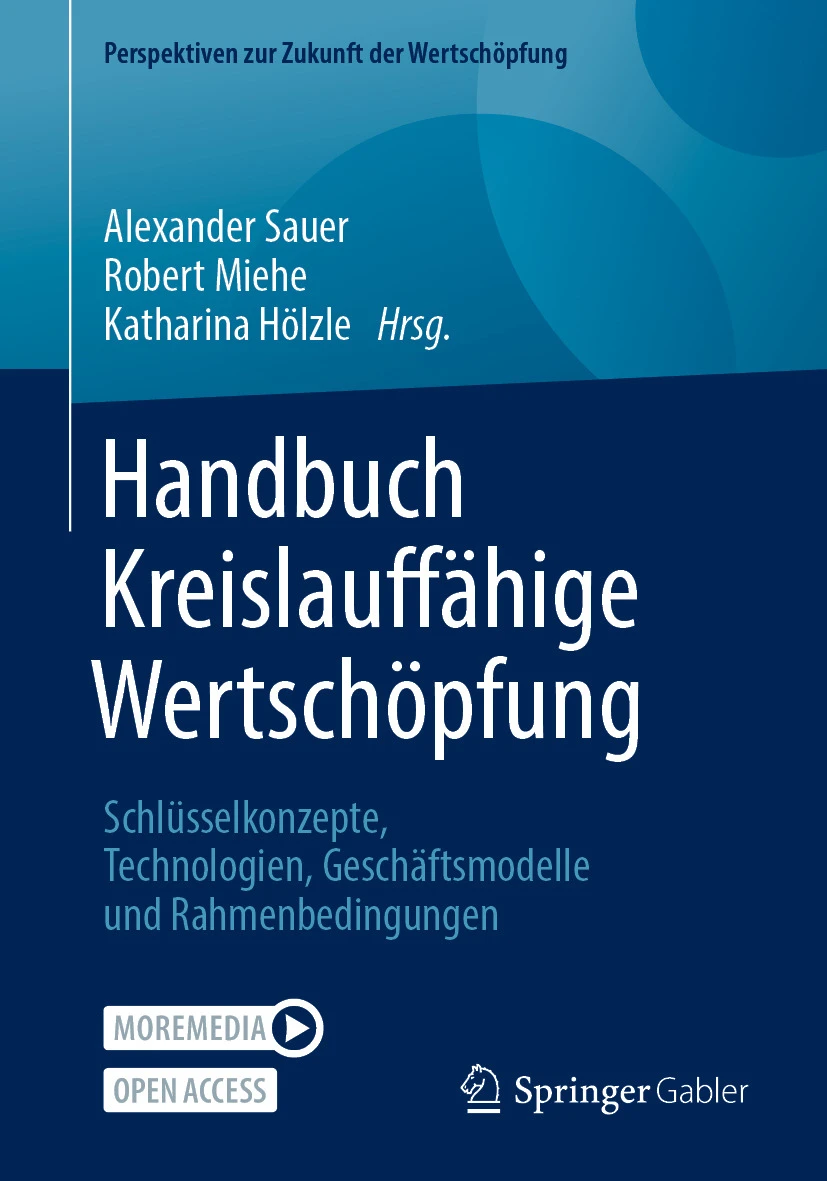
Today, many products lose almost all their value at the end of their use. Components end up in scrap despite still functioning. Materials are mixed, even though they could be reused separately. Companies often do not know exactly which substances are in old products, the condition of components, or how they can be economically returned.
From Throwing Away to Reusing
The handbook clearly and practically explains the key building blocks of a circular economy. It describes how companies can design products, processes, and supply chains so that raw materials remain in circulation longer. This includes repairable products, modular designs, digital information about materials, new service offerings, and collaborations across company boundaries.
Another central theme is digitalization. The Digital Product Passport can, for example, store what materials a product contains, how it has been used, and how components can be disassembled. Such information helps manufacturers, repair shops, recycling companies, and customers. It reduces search efforts, avoids wrong decisions, and makes secondary raw materials more usable.
And in the end, companies must make money: This requires a rethink of business models. In circular business models, companies do not just sell a product but offer usage, maintenance, and take-back in combination within a product-service system. This creates an incentive to make products more durable and easier to repair. Those who remain the owners of the product benefit more when materials and components retain their value.
The practical benefits are manifold: Companies can save raw materials, reduce cost risks, and become less dependent on volatile markets. Products that are easier to repair or refurbish require less effort at the end of their life. Less material loss means less waste, lower environmental impact, and more supply security. Thus, the problem of scarce resources becomes a concrete design task for development, production, purchasing, and management.
Knowledge for Transfer to Practice
The volume consolidates contributions from research and application. It leads from fundamentals through technologies to concrete fields of action in companies. The chapters cover, among other things, plastics, electric vehicles, electric motors, production management, product development, circular controlling, blockchain, digital twins, and the Digital Product Passport. Legal framework conditions, competencies, and further education are also discussed.
A practical example from machinery and plant engineering shows how companies can approach the transformation. Further contributions explain why circular economy only works when companies share data, build return networks, and consider later disassembly, repair, or reuse already in development.
The handbook is aimed at entrepreneurs, executives, product developers, HR personnel, students, researchers, and trainers. It aims to create a common knowledge base and provide concrete orientation: Which strategies fit which product? What data does a company need? Which technologies are already relevant today? What competencies must teams build?
The next step now lies in application. Companies must examine where they can avoid material losses, make products more durable, and organize returns. Research and industry must simultaneously clarify open questions: How can data be shared securely and standardized? When is reuse more worthwhile than recycling? What rules create reliable markets for secondary raw materials?
Circular value creation thus does not become an additional task for sustainability departments. It becomes part of industrial competitiveness. The new handbook provides knowledge, terms, examples, and methods – freely accessible to all who want to shape the transformation.
The digital edition is available as Open Access. The print version will be published on July 10, 2026, by Springer Gabler. The handbook was funded by the Federal Ministry of Research, Technology and Space (BMFTR) in the program 'Future of Value Creation' (until 2025, this was called the Federal Ministry of Education and Research, BMBF).
Info:
This book is an Open Access publication and is published under the Creative Commons Attribution 4.0 International License (http://creativecommons.org/licenses/by/4.0/deed.en). Free download: https://doi.org/10.1007/978-3-658-46549-0
The print version is available under ISBN 978-3-658-46548-3 and as an eBook under ISBN 978-3-658-46549-0
Contact: