
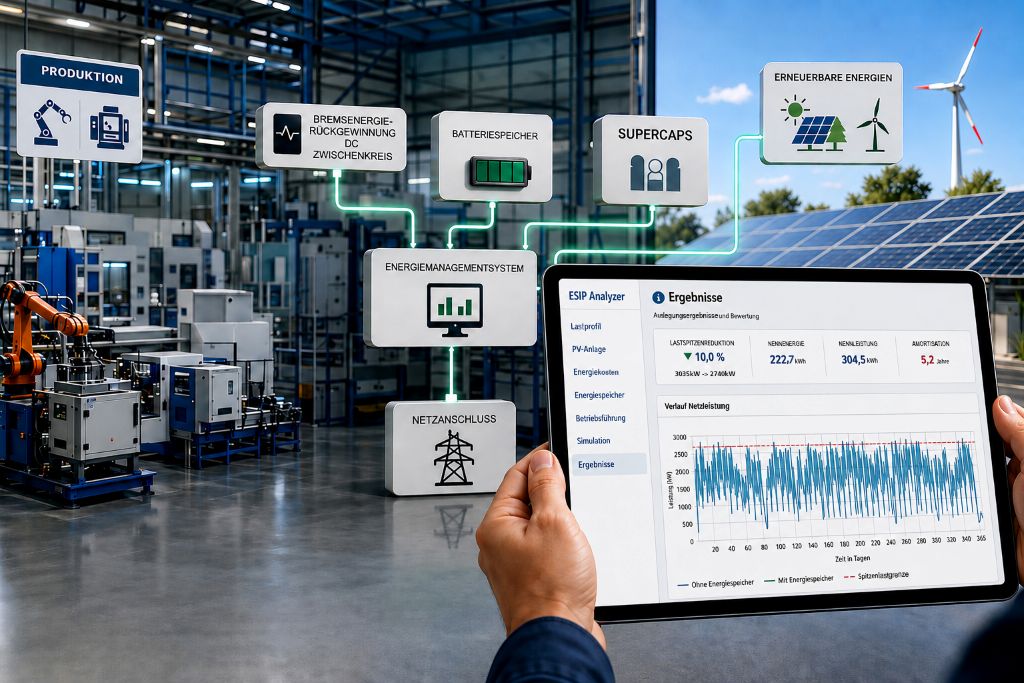
If properly planned and dimensioned, energy storage in production (ESiP) can optimally 'utilize' its own renewable energy. The ESiP Analyzer, presented at the ees Europe trade fair in 2025, has successfully passed its practical test with energy suppliers and industrial companies: The tool helps factories improve the integration of renewable energies and reduce peak loads. Previous experiences show that targeted simulations and optimized operational strategies can enable the use of nearly half of the self-generated electricity in some scenarios. The stability of the grid also benefits from the 'smoothed' consumption through the use of storage.
The ESiP Analyzer primarily supports energy management in manufacturing companies. In addition to classic peak load reduction, the tool allows for the evaluation of various application cases. It encompasses different energy storage technologies from machine to factory level and supports companies in planning, integrating, and operating individual energy storage solutions. The development of specific design procedures for different application scenarios is a core feature of the tool. Furthermore, important operational management factors such as system efficiency and specific production parameters are also included in the simulations. The goal is to support companies not only in selecting the appropriate storage technology but also in developing optimal operational strategies for long-term efficient and economical use.
Benefits and usage possibilities
The ESiP Analyzer demonstrates its capabilities particularly in real application scenarios, even with partially incomplete planning information. Missing values in load profiles or yield data can be reliably supplemented through suitable scaling and simulations, allowing for meaningful analyses to remain possible. In addition, the Analyzer opens up additional perspectives, such as in the combination of different applications (e.g., participation in the energy market, emergency power supply, or efficiency improvement using feedback energy at the machine level).
Interested companies have the choice of how they want to use the ESiP Analyzer. For a comprehensive analysis of the current status and recommendations, including consulting services from the experts at Fraunhofer IWU, individual project agreements are possible. For continuous use, licensing agreements can be concluded.
Fraunhofer IWU at 'The Smarter E Europe' in Munich: ESiP Analyzer and outlook on resource-saving disassembly of traction batteries
In June 2026, Fraunhofer IWU demonstrated the current status of its innovative design and simulation tool at the 'The Smarter E Europe' trade fair at the joint stand of the Economic Development Saxony, based on real application cases.
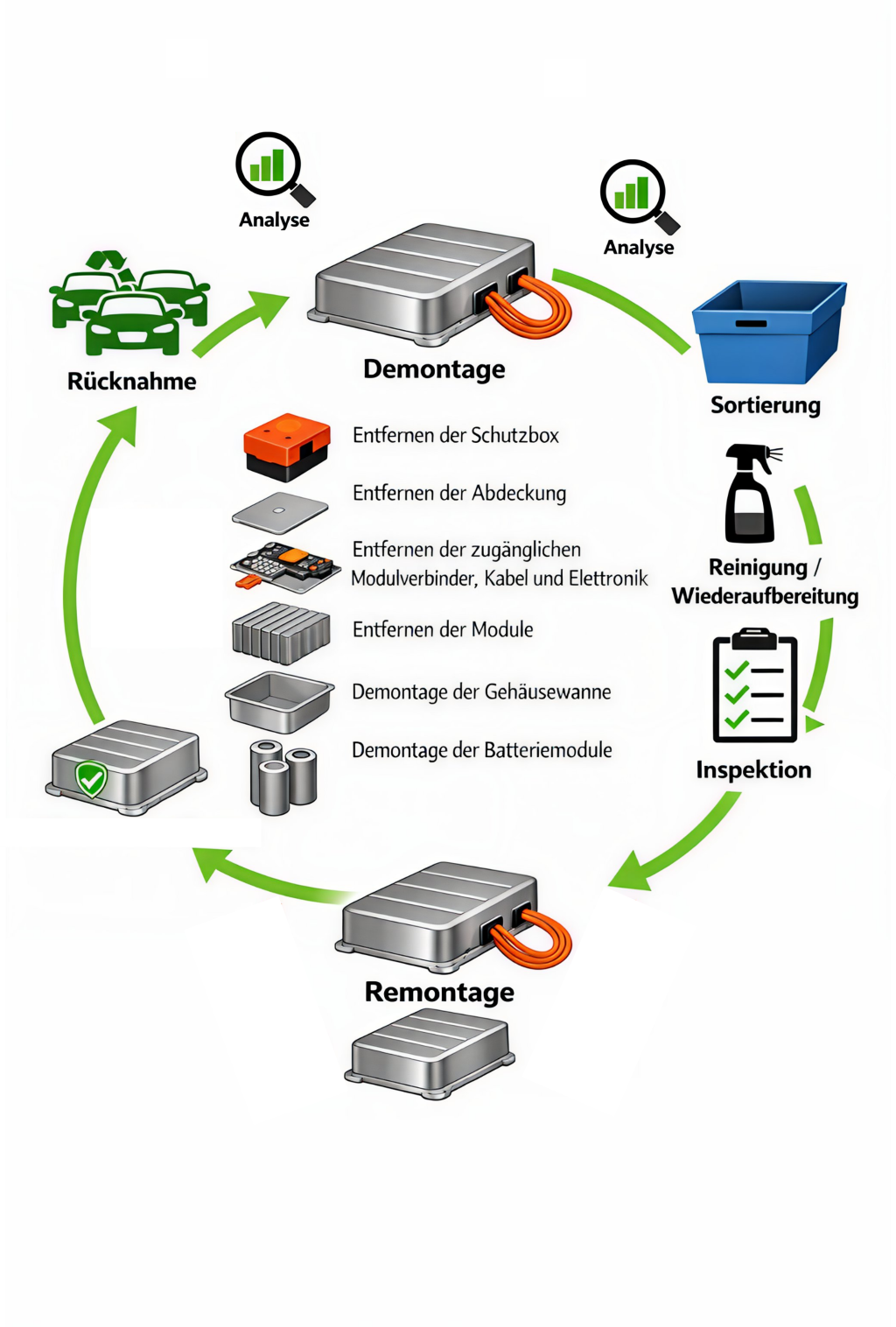
Fraunhofer IWU also provided an outlook in Munich on the pilot plant being developed in collaboration with EDAG Production Solutions, which will be able to automate the disassembly of traction batteries down to the cell level in Chemnitz in the future. Using AI technologies and an analysis module to assess their 'health status', functional components are identified and directed towards suitable reuse. The new facility will commence operations in August. It will also serve to demonstrate the economic disassemblability of new systems developed with a focus on design-for-recycling. A battery module that can be disassembled without destruction will demonstrate such a system.
Contact: