
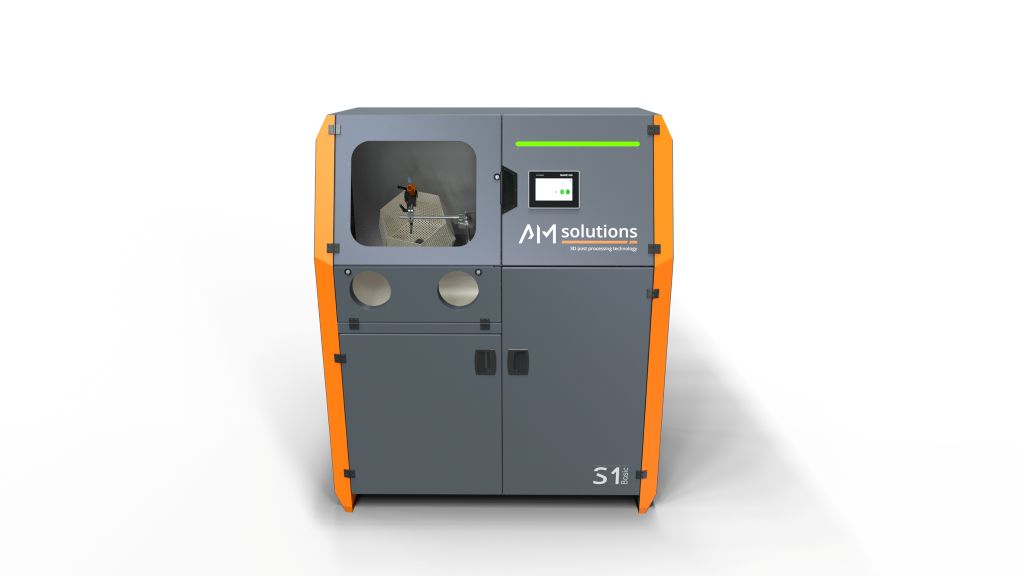
With the S1 Basic, AM Solutions expands its portfolio for the automated post-processing of additively manufactured polymer components with a compact solution, catering to the growing demand for economical and standardized post-processing solutions in the entry-level segment of additive manufacturing. The system is now commercially available and targets industrial users for smaller individual parts up to small series, thus also addressing development, laboratory, and pilot environments.
Especially for small components and flexible additive manufacturing scenarios, the demands for reproducible and economical process solutions are increasing. At the same time, manual post-processing steps are increasingly reaching their limits regarding efficiency, stability, and component quality. This is exactly where the S1 Basic from AM Solutions comes in. The compact system is designed for the automated cleaning and surface treatment of polymer-based 3D-printed components and translates these requirements into a standardized workflow.
"With the S1 Basic, AM Solutions expands its S1 family with a system for an economical and standardized entry into the automated post-processing of additively manufactured components," explains David Soldan, Head of AM Solutions. "The S1 remains the solution for more demanding industrial applications with an extended range of functions and performance. Our goal was to create a coherent system logic that sensibly covers both application levels."
Designed for powder bed-based polymer AM processes
The S1 Basic is consistently designed for applications in the areas of:
- Selective Laser Sintering (SLS),
- Multi Jet Fusion (MJF),
- High Speed Sintering (HSS), and
- Selective Absorption Fusion (SAF)
Additionally, post-processing of additively manufactured polymer components from other printing technologies is also possible, further expanding the range of applications.
The system supports small to medium component geometries and offers two operating modes. While components up to 100 × 100 × 100 millimeters can be processed in automated mode, larger parts up to 350 × 200 × 200 millimeters are possible in manual mode. The different component sizes and operating modes allow the system to be flexibly integrated into various application scenarios.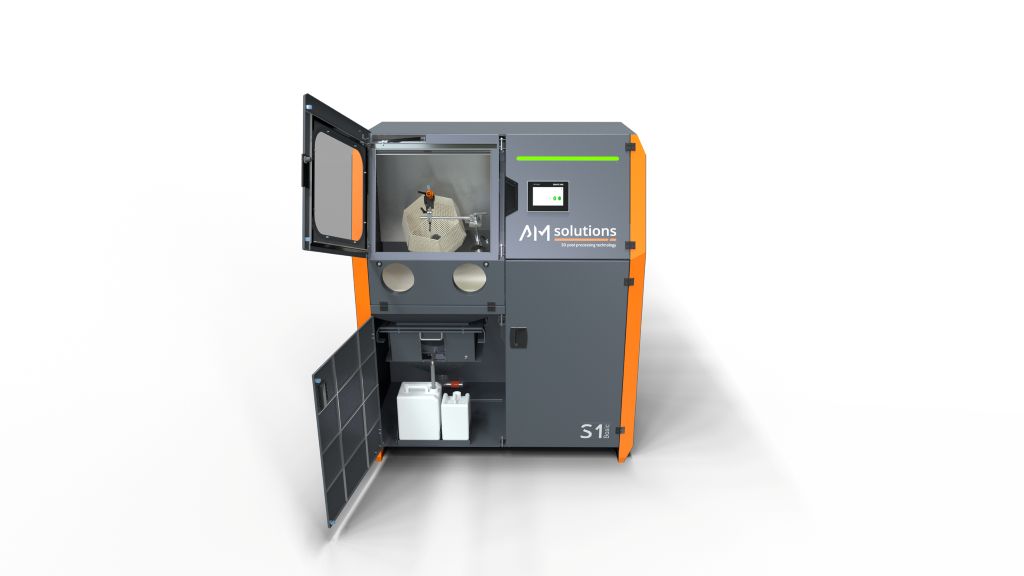
Integrated 2-in-1 process for cleaning and surface finishing
The S1 Basic is based on the typical 2-in-1 process from AM Solutions, which combines cleaning and surface treatment in a single system using only one media. This not only results in space savings but also significantly simplifies the process workflows, saving time and costs.
The seamless workflow includes the removal of powder residues as well as surface homogenization and densification. This leads to more uniform surface qualities and improves results in downstream processes such as chemical smoothing or coloring.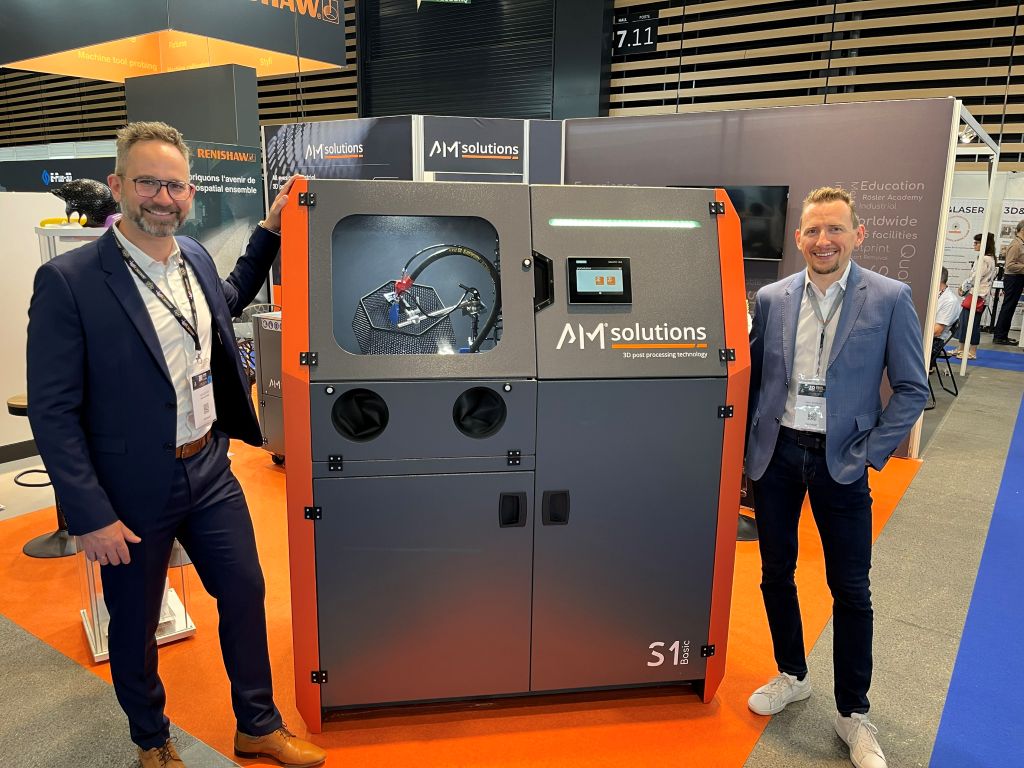
Process stability and economical operation
The integrated media recovery system with powder separation ensures consistently high media quality. This lays the foundation for reproducible results over longer operating times. At the same time, media consumption is reduced, and the need for manual intervention in the process is significantly decreased, leading to lower ongoing operating costs and increased process autonomy.
The integrated anti-static system minimizes powder adhesion both on components and within the process chamber, thereby stabilizing the overall process. Additionally, an industrial filter system ensures a consistently clean working environment – even in continuous operation.
Compact design and intuitive operation
The S1 Basic is designed for easy integration into existing production environments. A Siemens S7-1200 control system with full-color HMI allows for intuitive operation and the storage of individual processing recipes.
For better process control during operation, a large viewing window and an LED status display are provided. The complete front access also facilitates maintenance, service, and component handling, contributing to high system availability. Since the system allows for wall-adjacent placement on three sides and all relevant accesses are frontally reachable, it can also be flexibly integrated into cramped or non-industrial environments.
Thanks to the adjustable rotating basket, variably positionable media gun holder, and optional automatic or manual operating mode, the system can be individually adapted to different requirements. Additionally, an integrated blow-off gun supports post-cleaning, and anti-static gloves ensure safe manual operation. With a noise level of under 75 dB(A), the system is also suitable for production-close environments.
Positive market response to market introduction
Already at the 3D Print in Lyon, the S1 Basic met with great interest from professional visitors and industrial users, underscoring the growing need for compact, automated solutions for small component geometries up to small series. The S1 Basic complements AM Solutions' portfolio with an economical entry-level solution for reproducible and standardized post-processing processes.
Contact: