The shells of crabs, mollusks, snails, beetles, and other shellfish consist largely of chitin. It is also found in fungi. A short walk on the beach or through the forest is enough to see how common chitin is in nature. Estimates of the annual amount produced vary widely, reaching up to 100 billion tons. Thus, chitin is the second most abundant biopolymer after cellulose. As a byproduct of fishing, chitin is available at a low cost.
Its properties are also convincing: chitin is stiff, tensile, practically insoluble in water, yet biodegradable – and it inhibits the growth of bacteria. All of this makes the raw material fundamentally interesting for custom-made additively manufactured hand or finger orthoses and other medical products. However, chitin cannot currently be processed easily with established additive manufacturing methods. To make this possible in the future, stakeholders from industry and science are coordinating the material and a 3D printing process in the research project 'BUTTERFLIES'.
Binder Jetting fundamentally suitable for chitin
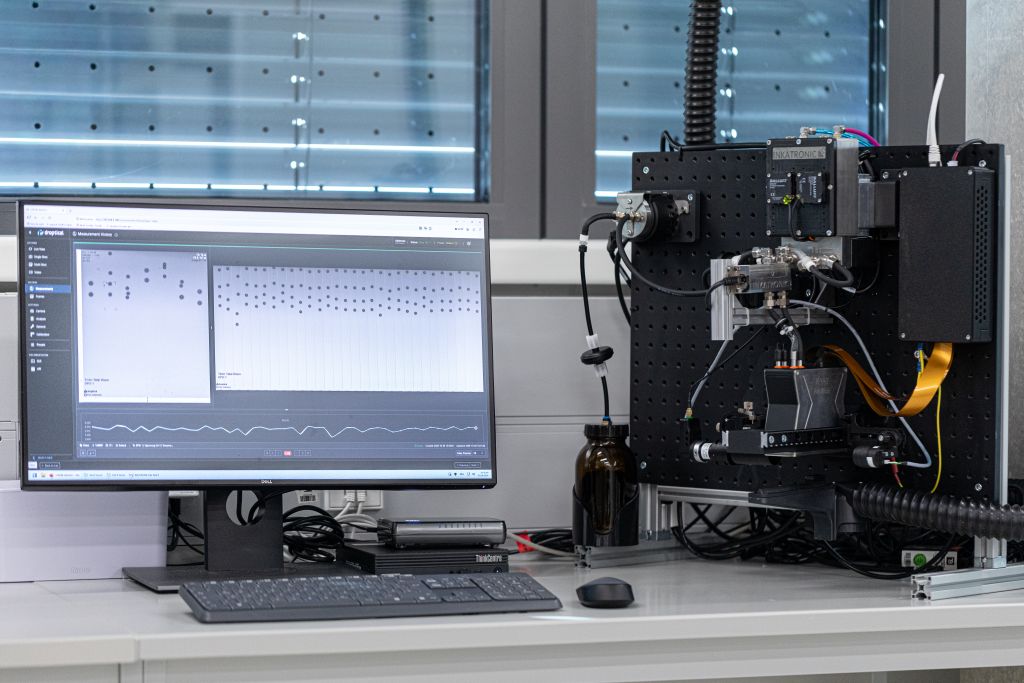
For processing chitin, the so-called binder jetting is fundamentally suitable. In this additive manufacturing process, a print head moves over a powder bed and applies binder dropwise at precisely defined locations. An infrared emitter accelerates the curing. Layer by layer, a component is created.
Chitin can also be ground into a fine powder. However, unlike conventional plastic particles, which are nearly round and can be evenly distributed like fine sand, chitin particles are flat, irregular, and sharp-edged. They cannot be evenly spread without difficulty. A research team from the Fraunhofer Institute for Production Technology and Automation IPA is therefore adapting powder application and process control to the natural material.
In search of the best binder recipe
The binder applied by the print head during binder jetting is also made entirely from biogenic material. For this, chitin is chemically transformed into chitosan. 'At this point, a conflict of goals has emerged,' says Jan Christoph Janhsen, research team leader for additive processes for photopolymers at Fraunhofer IPA. 'On the one hand, the binder must be thin enough to flow reliably through the fine nozzles in the print head. Only then does the printing process run stably. On the other hand, a more viscous binder reliably binds the powder particles into a durable component.'
To best meet both requirements, Janhsen's research team is working closely with the Swiss Federal Laboratories for Materials Science and Technology (Empa). The scientists there are developing the chitosan binder, which is then tested at Fraunhofer IPA. Janhsen's research team shares its results with the partners at Empa, who then further develop their formulation for the chitosan binder.
Artificial intelligence could facilitate this coordination process. It is planned that an AI will evaluate the measurement data from material and process development, recognize correlations between formulation, printability, and component properties, and derive new binder formulations from this.
At Formnext: Sustainability in 3D printing
But even without the help of artificial intelligence, there are now initial binder formulations that can be applied with a print head. The chitin powder has also been processed to the point where it can be applied layer by layer. While there are still no finished 3D-printed components or orthoses, initial trials with chitin and chitosan have shown that the material achieves good mechanical cohesion: a thin test structure withstood a load of about 1.3 kilograms. However, it has been shown that the material shrinks, warps, or even cracks during curing.
Insights into the research project BUTTERFLIES will be provided by the scientists around Janhsen from November 17 to 20 at the Formnext trade fair in Frankfurt am Main. At the joint booth of the Fraunhofer Society, Fraunhofer IPA will demonstrate through several exhibits how additive manufacturing can be made more sustainable: Hall 11.0, Stand D31.
Contact: