
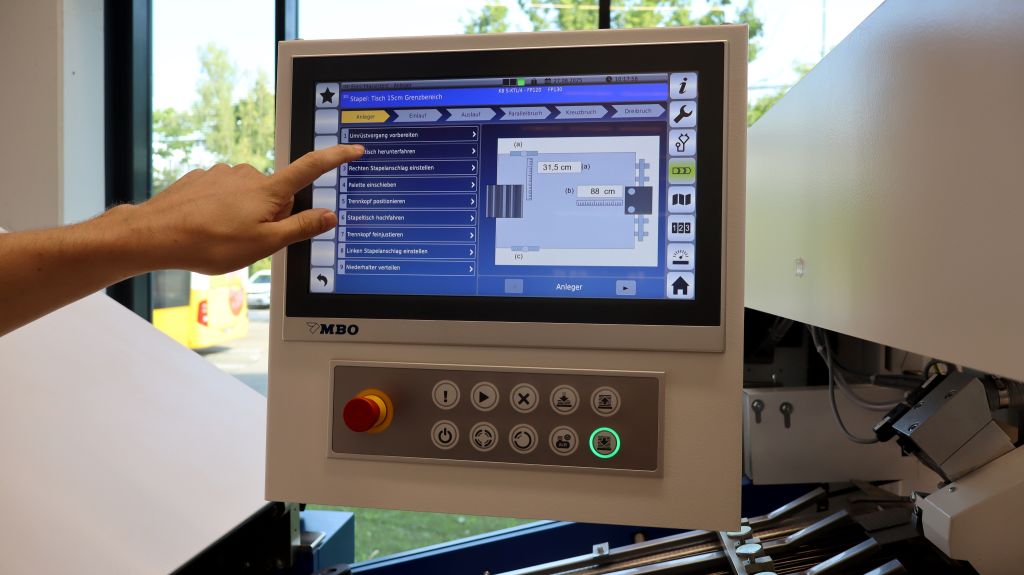
What was previously only possible for specialists will soon be achievable by career changers as well: Using the example of a folding machine, a researcher from Fraunhofer IPA has simplified the operating concept of the human-machine interface so much that even laypeople can now set up the machine. The underlying methodology can be transferred to all other machines.
Setting up a folding machine is a job for true professionals. Such a machine folds brochures, leaflets, maps, and much more in printing houses – several tens of thousands of copies per hour. Depending on the type of machine and the order, setting up can require many different adjustments, which can either be made directly at the folding machine or controlled via the so-called 'Human Machine Interface' (HMI). An experienced bookbinder can do this in 15 to 20 minutes, but this profession is threatened with extinction. Nationwide, the Central Association of German Crafts counted only 1,646 bookbinders in 2022.
In German printing houses, career changers often operate the machines. 'As long as an order is being processed, this is not a problem. But as soon as it comes to setting up, they often rely on the help of specialists or more experienced colleagues,' says Raphael Hägle from the research team Intelligent Manufacturing Processes and Interaction Systems at the Fraunhofer Institute for Production Technology and Automation IPA. 'While the setup technician is reconfiguring the folding machine, the machine operator has downtime. He could also set up the machine himself if the operating concept were designed to guide him step by step.'
Individual step-by-step instructions with arrows and drawings
That is exactly what Hägle has done in collaboration with MBO Postpress Solutions using the example of a folding machine. For this, the scientist first defined user roles. This ensures that all employees working on the folding machine are only shown the specific adjustment options they really need to fulfill their tasks on the newly designed display.
Subsequently, the researcher analyzed the workflows of all user roles. For this purpose, he asked experienced bookbinders to wear an eye-tracking glasses while they worked on the folding machine. Such glasses capture where the gaze of the wearer falls and how long it lingers there. With the help of these recordings, Hägle then divided all workflows into sub-tasks and individual steps. 'Setting up the machine, for example, includes 46 sub-tasks, which consist of 130 individual steps,' says Hägle.
For each workflow, the scientist has derived a detailed step-by-step instruction. This serves as the basis for the automatic creation of graphical content on the display of the folding machine. With arrows and schematic drawings, it shows the machine operator where he can make the individual adjustments. To be able to revise the display accordingly, MBO Postpress Solutions granted Hägle access to the source code.
HMI configuration in just a few minutes
Previously, configuring a folding machine HMI was complicated, time-consuming, and therefore expensive before the machine was delivered to the buyer. Depending on the version, each folding machine should ultimately only display those adjustment options on the display that it actually offers. 'The configuration could take over eight hours,' Hägle observed. To speed up this process as well, the scientist first divided it into sub-tasks and individual steps and then created a software tool that maps the operating logic of the entire machine. The result: A folding machine can now be configured on the computer within a few minutes, and the HMI is automatically created.
'In the future, generative artificial intelligence could help further simplify HMI development or evaluate the recordings from the eye-tracking glasses,' says Hägle. Furthermore, the scientist is considering offering his methodology for simplifying human-machine interfaces in the future not as an employee but as a self-employed service provider. His approach is fundamentally transferable to all machines and manufacturers – a huge potential market.
Contact