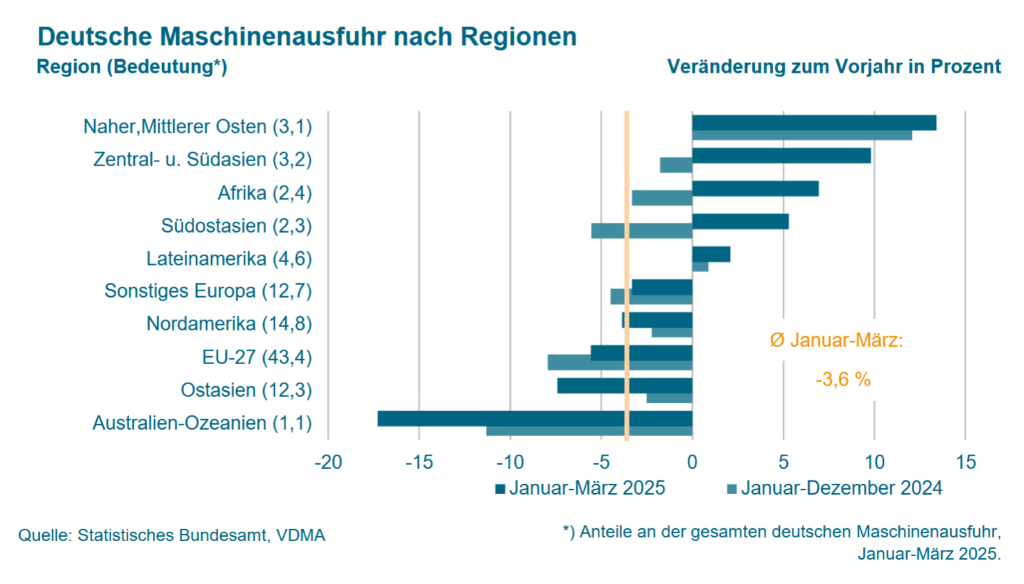
The machinery and plant engineering sector in Germany has started the year with a cautious export result. In the first quarter of 2025, exports amounted to 48.8 billion euros – a decrease of 3.6 percent compared to the same period last year. In real terms, the decline was even 5.4 percent. Nevertheless, March showed a slight upward trend: with an export volume of 17.9 billion euros, the previous year's level was nominally exceeded by 1.3 percent, marking the first small glimmer of hope in foreign trade since summer 2024. However, when adjusted for prices, the development remained slightly negative with a decline of 0.4 percent. 'March gives hope that the downward trend may weaken somewhat – but there can be no talk of an all-clear,' says Dr. Johannes Gernandt, chief economist of VDMA. 'The weakness of the Chinese market and in EU partner countries remains severe.'
Regional markets: Shift in dynamics
Exports to the EU-27 fell by 5.6 percent in the first quarter – with France suffering the strongest decline at 14.6 percent. The rest of Europe also developed predominantly negatively. Deliveries to North America decreased by 3.9 percent. In particular, the USA, as the largest single market, recorded a decline of 4.4 percent. In East Asia, the weakness continued – especially exports to China saw a significant decline of 12.2 percent. In contrast, exports to several emerging regions developed positively: they increased by 13.4 percent to the Near and Middle East, by 5.3 percent to Southeast Asia, and exports to Africa, Central and South Asia, as well as Latin America also grew noticeably. 'We see an increasing relevance of markets that have not been in focus before. This development is an opportunity, but it requires targeted political support, such as new trade agreements and more assistance with financing and market access,' says Dr. Gernandt.
New trade barriers at the wrong time
The blanket import tariffs of 10 percent on nearly all product groups announced by the US government in early April – including machinery products – create additional uncertainty in foreign trade. An increased rate of 20 percent has even been threatened for imports from the EU, which has initially been suspended for 90 days. These measures are not yet reflected in the export figures for the first quarter. However, VDMA sees the danger that the new tariff policy and especially the increasing uncertainty could negatively impact machinery deliveries to the USA in the coming months. 'The USA is our largest single market. New trade barriers come at the wrong time – the machinery sector needs open markets, not political disruptions,' emphasizes Dr. Gernandt.
Machinery sectors: Mixed picture
Within the sectors, there were partly significant declines in the first quarter: agricultural machinery fell by 14.0 percent, and construction machinery even by 18.8 percent. The drive technology (minus 5.1 percent), conveyor technology (minus 6.7 percent), and general air technology (minus 7.1 percent) also started weakly, as did the three strongest export sectors. Growth impulses came mainly from food and packaging machinery (plus 3.4 percent), process engineering machines and apparatus (plus 2.8 percent), and fluid pumps (plus 3.5 percent).
Appeal to politics: Keep markets open
The export quota in machinery and plant engineering remains at around 80 percent across all specialist areas – thus maintaining a structurally high level. Stable external economic conditions are crucial for securing this position. 'Without open trade, German and European machinery manufacturing comes under pressure. The EU must sharpen its course towards free trade, reliable trade agreements, and industrial competitiveness,' demands Gernandt.
Download: Germany_Machinery_Trade_2025_03
Contact: