
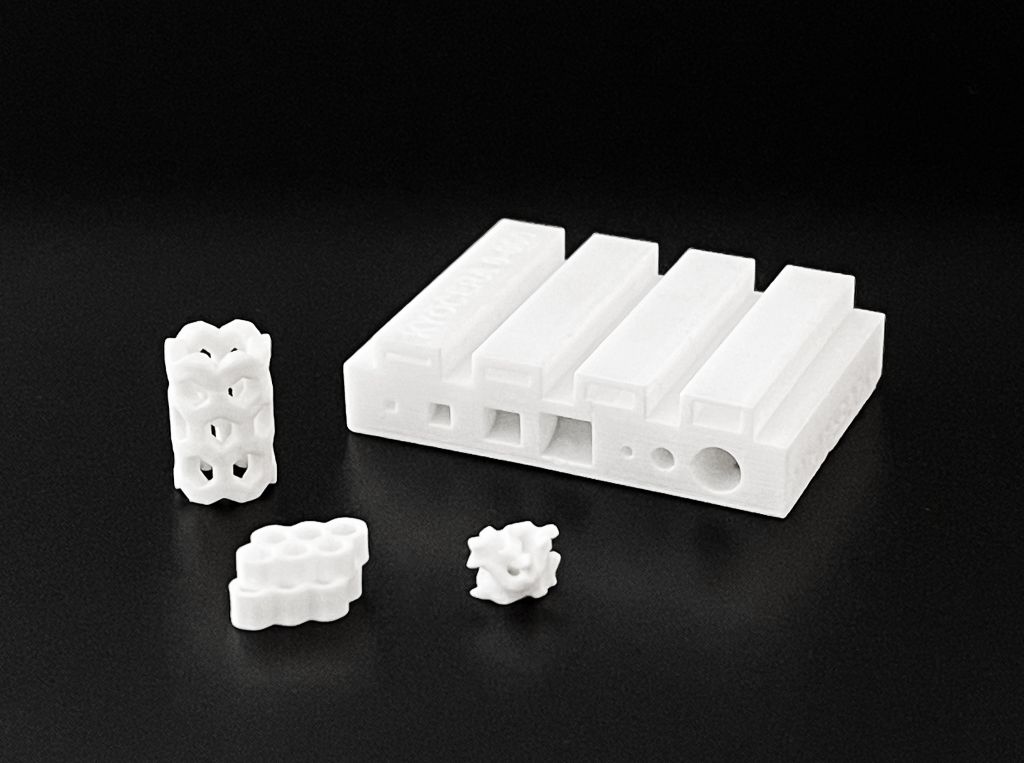
The Ceramic Additive Manufacturing offered by KYOCERA Fineceramics Europe GmbH utilizes the raw materials aluminum oxide and zirconium oxide. Products and components produced using 3D printing technology have the same material properties as products made with more traditional methods such as injection molding or isostatic pressing. However, compared to them, CAM offers the advantage of being able to realize complex geometries and almost any custom shapes.
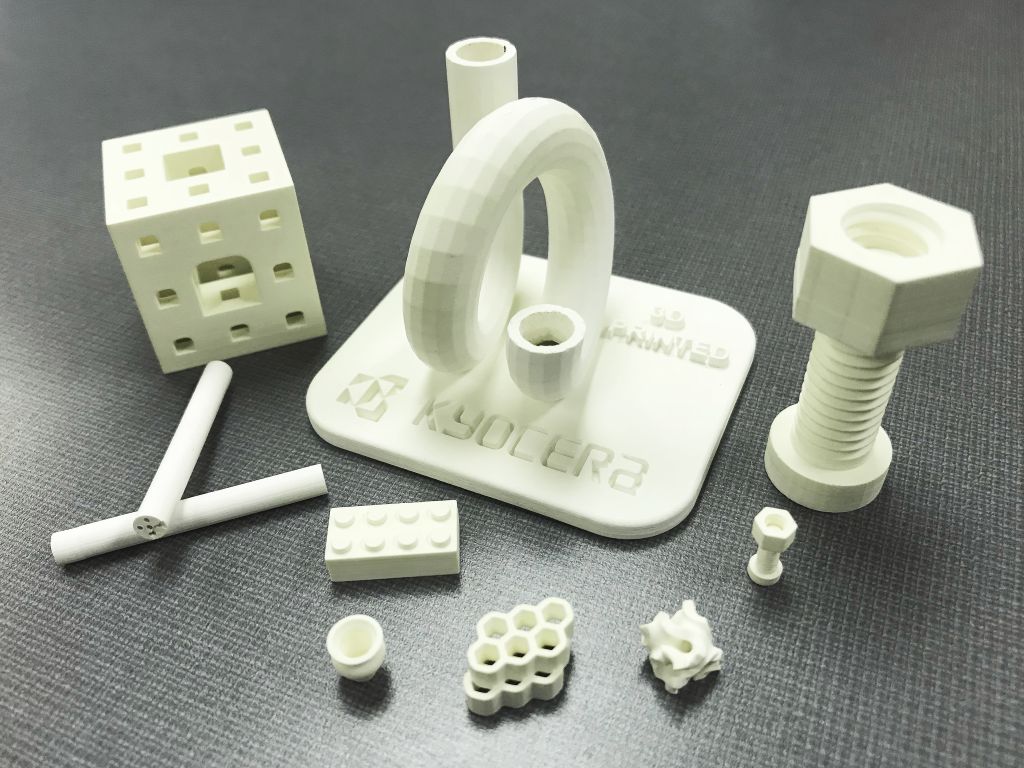
Aluminum oxide is a versatile ceramic material with high strength, stiffness, and wear resistance. Zirconium oxide exhibits high mechanical strength, fracture toughness, and wear resistance. Both materials are therefore a good choice for applications where durability is a focus. Ceramic Additive Manufacturing enables tight tolerances, narrow channels, composite shapes, and much more.
Quickly from prototype manufacturing to mass production
Prototypes can be produced with a lead time of about two weeks. The subsequent transition to mass production of up to thousands of pieces per day is possible in a very short time. Unlike other production methods, there are no costs or time requirements for the production of special tools.
Design modifications can be made in real-time through changes to the 3D CAD model. It is even possible to produce multiple iterations of a design simultaneously. The manufacturing processes for prototypes are identical to those of series production. Complex shapes such as internal channels and cavities, interconnected structures, or curved shapes are not a problem, and the integration of text, logos, labels, and serial numbers is also possible. Examples of CAM-printed components include medical implants, spray nozzles, electrical coils and insulators, components for fluid guidance, or valves and bearings.
Technical specifications: The wall thicknesses of CAM-printed objects range from 0.25 to 10 mm. The maximum size of a single object is 200 x 105 x 40 mm. The tolerances are below +/-1% (as-fired).
Comprehensive service offerings around CAM
Kyocera offers a wide range of services around Ceramic Additive Manufacturing. These include 3D design and modeling with CAD, structural and flow analyses (FEA/CFD), as well as conjugate heat transfer analysis. Moreover, CAM allows for computer-controlled machining of the parts with multiple axes.
Contact: