
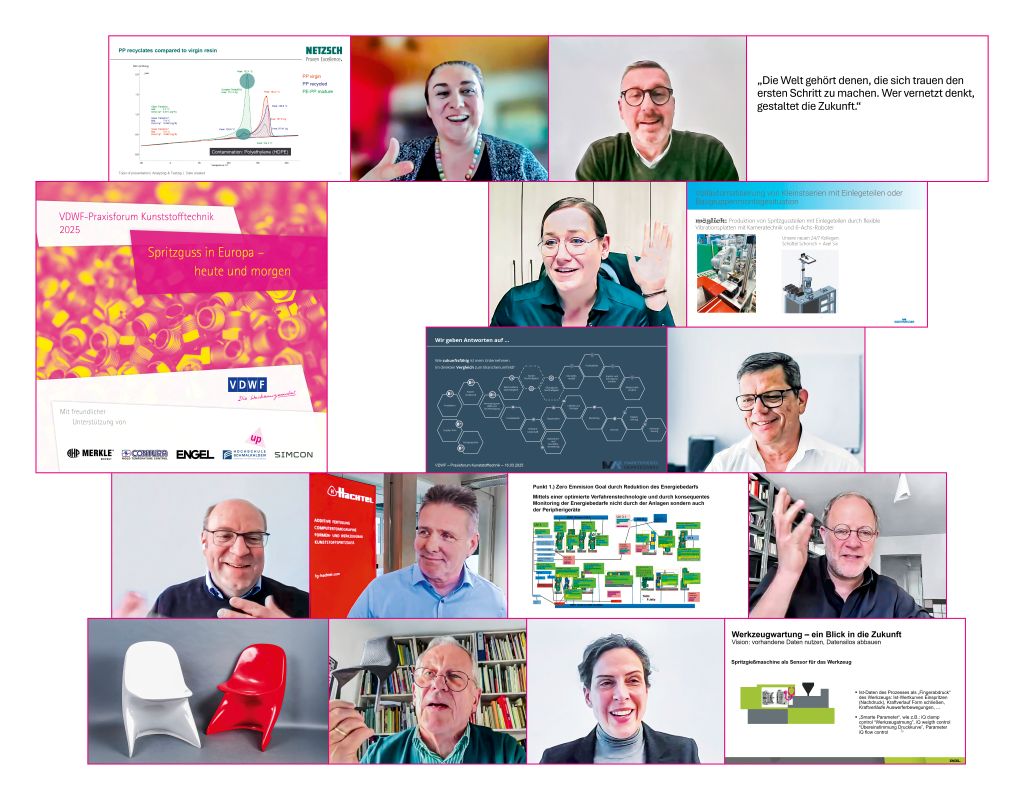
VDWF President Prof. Thomas Seul opened the practical forum with the words: “We are looking into the future and at highly interesting topics that should not be missed if one wants to be informed about the latest developments in the plastics industry.” Together with Fabian Diehr, managing director of wortundform, he guided the approximately three-hour program, in which the “phenomenon” of plastic was illuminated from various perspectives.
Impulses for the Industry: From Mindset to Design
The opening was made by Volker Faust, managing director of the plastic factory M. Faust from Glandorf. As an injection molder with roots in the New Economy and startup consulting, he brought a fresh perspective to the SME-dominated industry. Instead of secrecy under the motto “Do good and tell no one,” he advocated for more collaboration, networking, and openness – not only among injection molders but especially with toolmakers. Such a communicative “mindset” not only allows for greater impact against customers but also better communication of one’s own service portfolio, which will lead to more orders in the long run. “The most successful people and companies are those who actively build and maintain networks,” said Faust.
Dr. Wolfgang Schepers took the participants on a “discovery journey to the German Plastics Museum,” of which he is the president. Using iconic furniture designs – from the Panton Chair to the Monoblock – he demonstrated the design significance of the material plastic. His explanations made it clear that plastic should not only be understood as a mass product but also as a medium for innovative design. The exhibited items from the museum's collection in Oberhausen represent the freedom of design and the versatility of the material. They are an integral part of everyday life and design history.
Sustainability and Digitalization as Central Themes
Steffen Hachtel, managing director of F. & G. Hachtel from Aalen, highlighted the challenges and opportunities of the European Green Deal, which aims for the economy to produce no net greenhouse gas emissions by 2050. The solution is a “mosaic” of many measures. As concrete examples, the engineer showed how energy demand in manufacturing can be reduced with optimized process technologies and presented the “good cup,” a sustainable injection-molded product – a compostable, recyclable, and simultaneously machine-washable drinking cup that Hachtel developed and produces himself.
How do you determine the quality of a recycled material, and how can processes be adjusted accordingly? This question was addressed by Dr. Natalie Rudolph from Netzsch-Gerätebau in Selb in her presentation. She demonstrated how artificial intelligence can be used to analyze the thermal fingerprint of plastic recyclates and thus control processing quality.
Efficiency and Automation in Plastic Processing
Dr. Ruth Markut-Kohl, team leader of digital injection molding architecture at Engel, connected her presentation to the necessity of interconnected processes. She explained why injection molding machines, tools, and peripheral devices should not be viewed as separate systems but as a unit. In terms of process optimization and smooth sampling, she explained how seamless cooperation can be ensured, alleviating participants' concerns that such processes require an operations IT specialist.
Klaus Lemke from Marktspiegel Werkzeugbau spoke about the need for reliable data in the industry. He emphasized that conventional key figures from the free market cannot be easily transferred to tool and mold making or the injection molding business. It is all the more important to participate in the cooperative initiative to generate reliable data from and for the industry – with the aim of being able to rely on solid figures for decisions in addition to one’s own gut feeling.
Kathrin Gruber, managing director at Wartenfelser from Hemhofen, showed in her presentation “Long-Run in Small Series Production – via Robot Manufacturing” how to respond to changing market conditions: In light of the increasing individualization of products, series sizes are shrinking, requiring additional work steps – such as when using inserts that are often fed manually. Gruber demonstrated how automation and handling systems can make processes more efficient in the long term while also contributing to securing production locations in Germany and Europe.
A Look Ahead and Beyond the Horizon
The active participation of the audience, the numerous questions, and intense discussions highlighted the relevance of the topics. “This year’s diverse program also offered new approaches for the daily business of the participants, but also inspirations for looking beyond the horizon,” summarizes Prof. Thomas Seul, who is already looking forward to developing the topics for the practical forum on plastic technology next year.
A special thanks goes to the sponsors AHP Merkle, Contura, Engel, Simcom, and the University of Schmalkalden, who supported the event and contributed to its success.
Contact: