
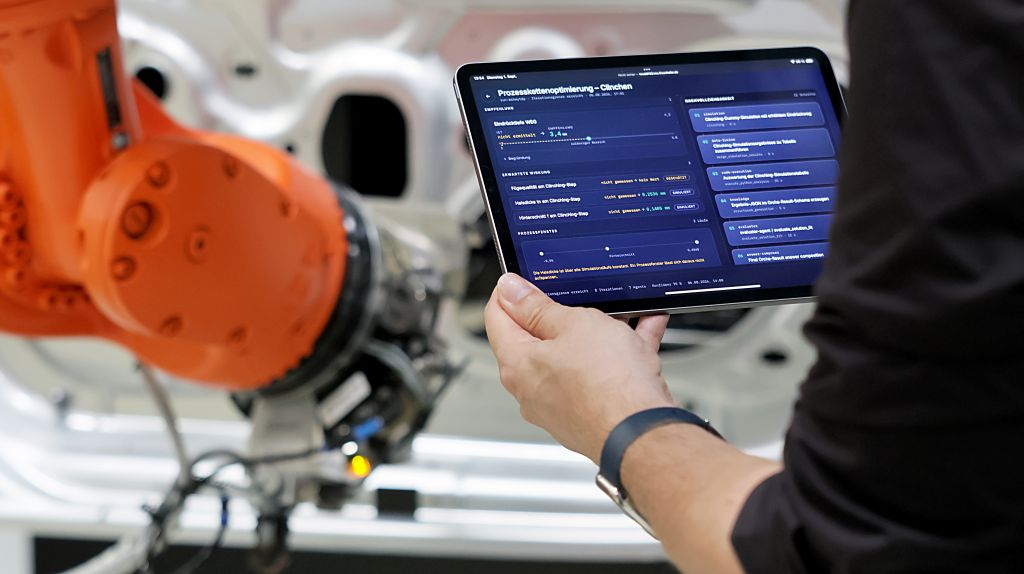
The introduction of Artificial Intelligence into production began a few years ago with image data matching. Not only, but especially for quality control, neural networks have since been trained to detect deviations (from the target) by comparing a component (actual) with reference images. Meanwhile, generative AI based on large language models supports the step-by-step solution of mostly narrowly defined questions. In an iterative process, humans provide prompts until a solution is reached. Agentic AI works quite differently: it selects the necessary AI tools (agents) for highly complex tasks and largely independently develops solutions.
Chatbots like ChatGPT already mark the transition to agentic AI in everyday life: users see that their request is broken down into several steps (searching, evaluating, summarizing), but do not see the logic by which the system selects and chains the appropriate tools. In various applications of software development, customer service, IT operations, knowledge management, and administrative business processes, agentic AI is already demonstrating its strengths – everywhere complex tasks consist of several steps and need to be coordinated across different systems.
- When used in customer service, agentic AI can independently handle large parts of customer inquiries and not only answer questions but also process complete service workflows and make independent decisions within defined rules.
- In software development: modern coding agents analyze requirements, write code, perform tests, and iteratively fix errors.
- In retail, well-orchestrated AI agents can assist with inventory management, demand forecasting, logistics, and product management. The agents are expected to independently combine information from various systems, prepare operational decisions, and partially execute them.
Orcha-3: Transfer to Industrial Production
The platform Orcha-3 developed at Fraunhofer IWU transfers this approach to production technology. Orcha-3 is designed for questions that have been poorly addressed by individual AI models so far: open questions along a process chain, whose answers do not follow from a single measurement but from many interdependent steps, where the next meaningful step is only determined once the previous one has been evaluated.
An example: In a process chain of forming and joining operations, measurement deviations occur at the end, the cause of which is unclear. Orcha-3 independently breaks down this question into individual work steps – retrieving process data from the machine and plant environment, merging time series from several stations, calculating correlations, simulating parameter variations, evaluating intermediate results – and decides after each step how to proceed. Each of these steps is executed by a specialized agent with a clearly defined task.
Crucial for deployment in manufacturing is the division of tasks between the language model and execution: The language model plans but does not access any production system itself. Database queries, calculations, and simulations run exclusively locally in the agents. Raw data does not leave the corporate network; only a curated, fully logged view of the planning situation is sent to the model. This view is deterministically generated and stored for each planning step. It can thus be verified afterwards which information actually went to the model. Process know-how embedded in manufacturing parameters is often the actual competitive advantage of a company; Orcha-3 is designed so that the use of powerful language models does not require the disclosure of this knowledge.
For the same reason, the entire execution is deterministically orchestrated (rule-based executed, every decision can be reconstructed afterwards) and seamlessly logged: Every step, every intermediate result, and every decision of the platform remains stored and traceable even after months. For a recommendation that goes into series production, this reconstructability is not a comfort feature but a prerequisite. Additionally, Orcha-3 can execute missing evaluation steps in the form of small programs even when the existing toolbox is insufficient for a question.
The platform is currently designed as a research and testing environment. The medium-term goal is to expand from the individual process chain to the production system, including questions about machine and personnel deployment, space requirements, and logistics concepts, which today can only be answered through elaborate manual analyses.
Synthesized data to represent a variety of tasks and application cases
Planning or optimizing a complex production requires a solid data basis. The chicken-and-egg dilemma at the start can be elegantly solved – using specially generated synthesized data based on virtual process chains that, for example, replicate real processes like individual forming steps. On this virtual process chain, AI can now start and identify improvement potentials. Problem and task statements can thus be varied almost infinitely.
Complexity that can only be mastered with agentic AI
In multi-stage productions, there are questions that should be clarified but often remain unanswered because their clarification would take days of data work:
- »At the end of the process chain, parts are outside the tolerance, each individual station reports 'in order'.
- »Where does the deviation come from?«
- »The material supplier has changed, the data sheet looks the same, but the process is not running as before. Which parameters need to be adjusted?«
- »The scrap rate fluctuates between shifts. There is a suspicion, but no one to check process data against for two weeks.«
Such questions cannot be answered with a single evaluation but require many: merging data from several stations, checking correlations, rejecting a hypothesis, and proposing the next one. Orcha-3 independently takes over exactly this process and makes every step traceable.
The platform is functional and tested on virtual process chains. The next step is the application to real manufacturing questions; for this, we seek discussions with companies that have such a question at hand. Together, we will assess whether this specific task can be addressed with the Orcha-3 approach, what the existing data situation allows, and what an entry point could look like.
Agentic AI / Agentische KI
Agentic AI refers to AI systems that act as autonomous agents to independently execute complex, multi-stage tasks. Unlike conventional chatbots that only respond to direct commands, these systems can process complex task statements and independently deploy tools (other agents or tools) as needed. They break down larger tasks into several logical sections, are not reliant on frequent human intermediate steps, and respond flexibly to short-term or unforeseen changes.
The Orcha-3 platform
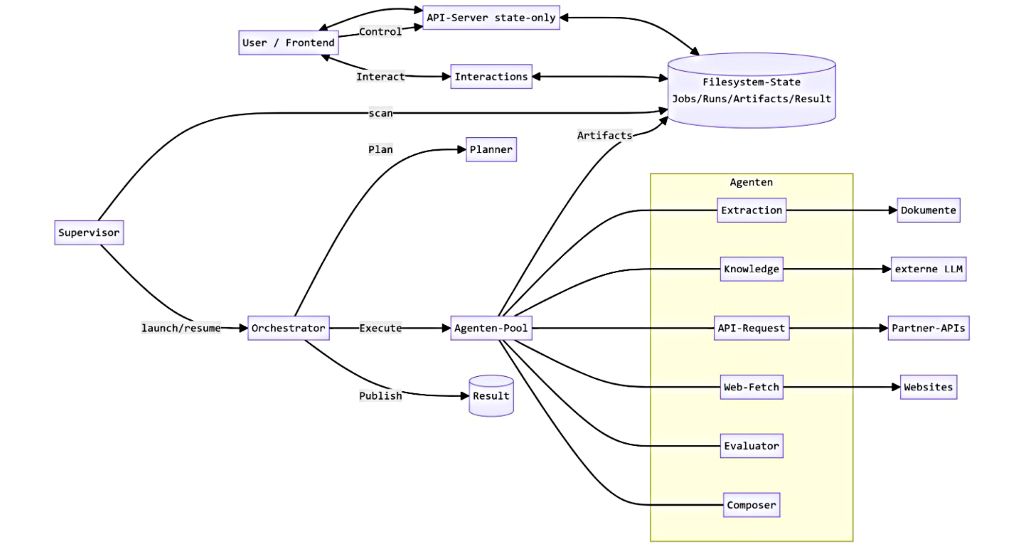
Orcha-3 processes complex tasks as so-called 'jobs' and handles them structured in multiple loops. At its core, the platform is based on a clearly separated architecture of API (Application Programming Interface), orchestrator, supervisor, and agents. Consistently state-based: All information is stored persistently in the file system, ensuring complete transparency, traceability, and resumability. The job is processed in a recurring cycle of planning and execution:
- A planner agent analyzes the current state and decides on the next steps.
- This results in tasks that are executed by specialized agents.
- Results are stored and integrated into the next planning cycle.
- The process repeats until a solution is reached or a defined termination condition is met.
Contact: