
Increasing efficiency requirements, growing production numbers, and rising cost pressure present manufacturers of heat exchangers with new challenges. The crucial question is: Which manufacturing technology will enable the highest component quality in economical series production in the future? The Fraunhofer IWU can provide tailored answers to this question. In addition to established processes such as hollow stamping (pressing) and high-pressure sheet forming (hydroforming), the institute focuses particularly on a technology with exceptional productivity potential: hollow stamping.
The special feature: All three processes are developed, investigated, and qualified for industrial applications at the Fraunhofer IWU. Companies thus receive a technology-neutral assessment of the optimal manufacturing strategy for their requirements. The underlying competencies stem from many years of development work for bipolar plates in fuel cells and electrolyzers.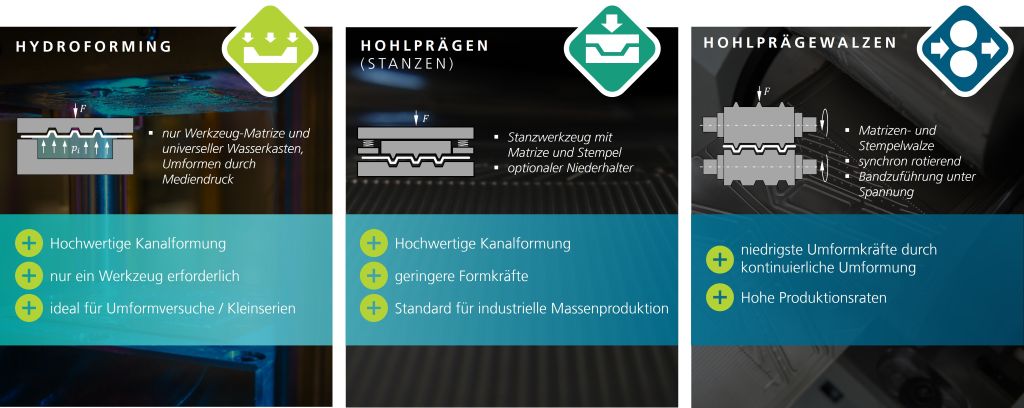
Three technologies, three strengths
Metallic heat exchanger plates require delicate channel structures, high dimensional accuracy, and reproducible quality. At the same time, investment costs, material usage, and output performance must be economically viable. For these requirements, the Fraunhofer IWU offers three different forming technologies.
High-pressure sheet forming is characterized by particularly good shaping of channel structures and high component accuracy. Since only one tool engraving is needed, tool effort and procurement times are reduced. The passive high-pressure sheet forming developed at the Fraunhofer IWU also significantly simplifies the required plant technology and shortens process times. Hollow stamping is now considered the industrial standard for producing structured metal plates. The process combines high process reliability, established plant concepts, and economical series production. For many applications, it continues to represent the industrial reference technology.
When productivity becomes a competitive advantage
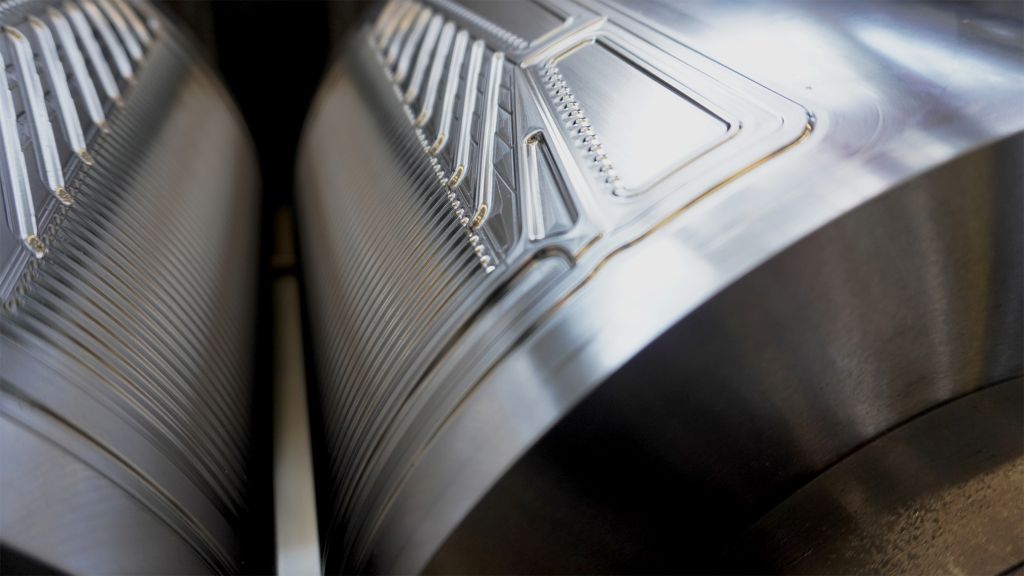
However, the greatest development boost is expected by the Fraunhofer IWU in hollow stamping. Unlike discontinuous pressing, the shaping occurs continuously between rotating forming rollers. This process kinematics significantly reduces the required forming forces and simultaneously opens up much higher production rates. While conventional methods can achieve up to 60 parts per minute, hollow stamping is forecasted to achieve production rates of well over 100 parts per minute.
This creates significant economic potential, especially for future markets with high quantities. Continuous production enables more compact plant concepts, high material efficiency, and attractive unit costs. Above all, the process opens up new perspectives for fully integrated roll-to-roll process chains.
From the coil directly to the heat exchanger
The Fraunhofer IWU pursues a holistic approach. The focus is not only on the shaping of individual plates. After continuous hollow stamping, the components can be directly separated, joined, and stacked from the strip. This creates a highly productive manufacturing architecture from coil to finished heat exchanger plate. Especially on an industrial scale, this significantly reduces investment costs per component, handling effort, and production times. Thus, the true strength of hollow stamping lies not only in the forming process itself but in its excellent suitability for highly automated production lines.
Hydrogen know-how for the next generation of heat exchangers
The technological foundation for this has already been established at the Fraunhofer IWU. In numerous research and development projects, the institute has investigated, evaluated, and qualified the production of metallic bipolar plates for fuel cells and electrolyzers. The focus was precisely on the questions that are also relevant for modern heat exchangers today: highly precise channel structures, low forming forces, high production rates, and robust process chains.
The insights gained can be directly transferred to the production of heat exchanger plates. In particular, experiences from processing thin-walled stainless steel strips, designing complex flow structures, and developing continuous manufacturing processes create a solid foundation for industrial applications in the field of heat transfer.
From the idea to the feasibility study
Companies that want to develop new heat exchanger concepts or manufacture existing products more economically can evaluate the technologies together with the Fraunhofer IWU. Feasibility studies are possible based on sample components with a width of up to about 30 centimeters, a length of up to 1 meter, and sheet thicknesses of up to 0.5 millimeters. From this, statements can be derived regarding formability, achievable component quality, the economic viability of possible process chains, and scaling into series production.
Contact:
www.iwu.fraunhofer.de