
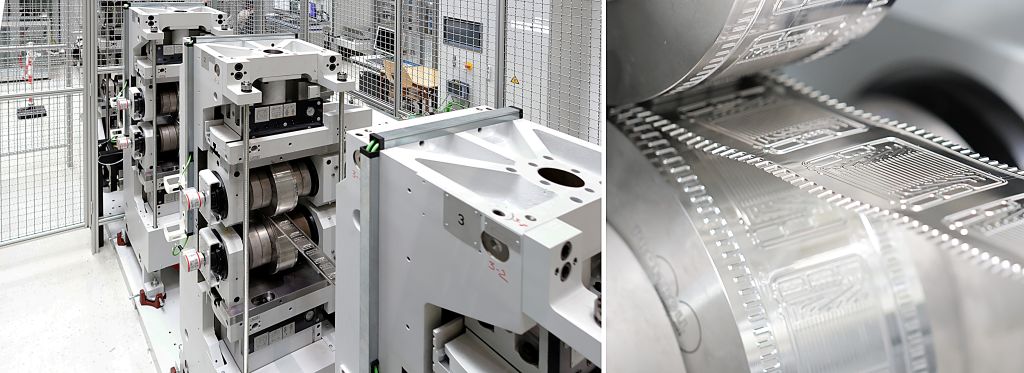
For the first time, Fraunhofer IWU systematically compares the cost-effectiveness of hollow die rolling and conventional hollow die pressing. The results are clear: In the examined reference scenario, the total cost of a metallic bipolar half-plate decreases from €1.13 to €0.82. A nearly halving of the pure manufacturing costs is possible.
Producing fuel cells and electrolyzers competitively in large quantities also means scrutinizing every cent of their individual components. An important lever is the bipolar plate, which encloses the electrochemical heart (membrane) from both sides and directs hydrogen or oxygen directly to the membrane through fine channels. Dr.-Ing. Franz Reuther and Dr.-Ing. Ricardo Trân have therefore investigated at Fraunhofer IWU how economically metallic bipolar half-plates can be produced using continuous hollow die rolling. The reference is conventional hollow pressing. The result: For industrial mass production, hollow die rolling offers a significant and demonstrable economic advantage across different cost scenarios.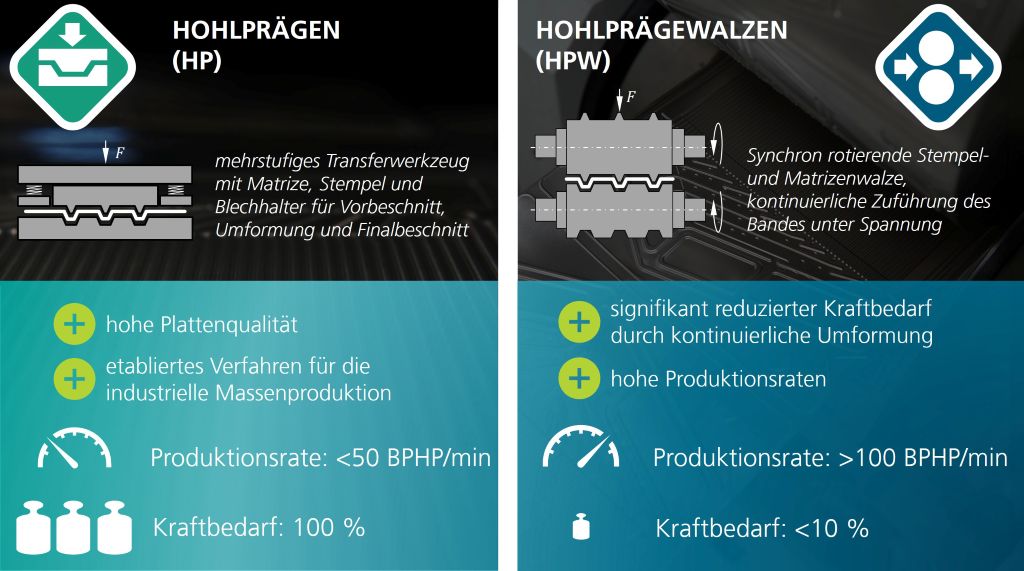
82 instead of 113 cents: The cost advantage becomes visible at the component level.
For the reference scenario, the researchers determined total costs of €1.13 per bipolar half-plate for hollow pressing. For hollow die rolling, it is only €0.82. This reduces the total costs by about 30 percent. The difference is even more pronounced in the pure manufacturing costs without material: they decrease from €0.77 to €0.47 per plate, a reduction of about 39 percent.
This cost jump is not due to a single optimization step, but rather a fundamentally different process characteristic. In hollow die rolling, the thin metal strip is continuously and stepwise reshaped between profiled rollers. Process times for strip feed and closing movements of a press are eliminated. At the same time, the forming forces, according to the study, are ten times lower in total. This allows for more compact plant designs and reduces the required drive power. The calculations show significant differences in investment, operating, and maintenance costs: for the examined reference scenario, these cost blocks can be reduced from €0.26 to €0.05 per bipolar half-plate through hollow die rolling, an 80 percent reduction. Proportional investment, operating, and maintenance costs account for only 6 percent of the total costs per bipolar half-plate when using hollow die rolling.
More than twice as many good parts per minute
This significant cost reduction is also based on a considerably higher throughput: Taking into account downtimes, output reductions, and scrap, hollow pressing achieves a corrected throughput of 35 bipolar half-plates per minute in the examined scenario. Hollow die rolling, despite more conservative assumptions for availability and quality, reaches 82 plates per minute. This corresponds to an increase of about 134 percent.
It is noteworthy that the calculations do not favor the newer process: Due to the currently limited experience with hollow die rolling in industrial mass production, the study assumes, among other things, higher unplanned output losses and a larger scrap rate. Nevertheless, the economic advantage remains significant.
Less material usage brings additional cent advantages
The difference in material consumption is smaller but still relevant in a highly scaled production. The reference component achieves a material utilization rate of 77.9 percent in hollow pressing, while in hollow die rolling it is 82.0 percent. This reduces the adjusted material costs from €0.36 to €0.34 per bipolar half-plate. One reason is that no surrounding holding surface is required during rolling, and the plates can be placed directly next to each other in the rolling direction.
Even under less favorable assumptions, a significant gap remains
Production cost calculations stand and fall with their assumptions. Therefore, the authors of the study do not only consider an ideal or reference point but also vary, due to the ever-present uncertainties, tool costs, tool life, material prices, throughput, and plant investment.
Across the examined fluctuation ranges, hollow pressing yields an expected cost range of €0.65 to €2.16 per bipolar half-plate, while hollow die rolling ranges from €0.50 to €1.36. According to the study, this results in a realistic saving of 20 to 40 percent in total costs. The pure manufacturing costs are on average 40 percent lower with the rolling process.
Even a very unfavorable assumption for hollow die rolling shows how large the calculated cost advantage is: The tool costs of the rolling process could increase from €0.42 to €1.00 per plate, more than doubling, before cost parity with hollow pressing is reached.
Why hollow die rolling is also interesting for other products
Hollow die rolling is particularly interesting for the production of metallic electrolyzer plates. In addition to the described cost advantages, the significantly lower force requirement for the process is especially noteworthy: Numerical investigations show that the required rolling force can be less than ten percent of the corresponding pressing force, depending on the plate design. This opens up the possibility of economically manufacturing large-area electrolyzer plates with comparatively compact plant technology. Similar advantages are expected for large-format heat exchanger plates, where conventional pressing processes also require high forming forces and correspondingly large plants.
Contact: