
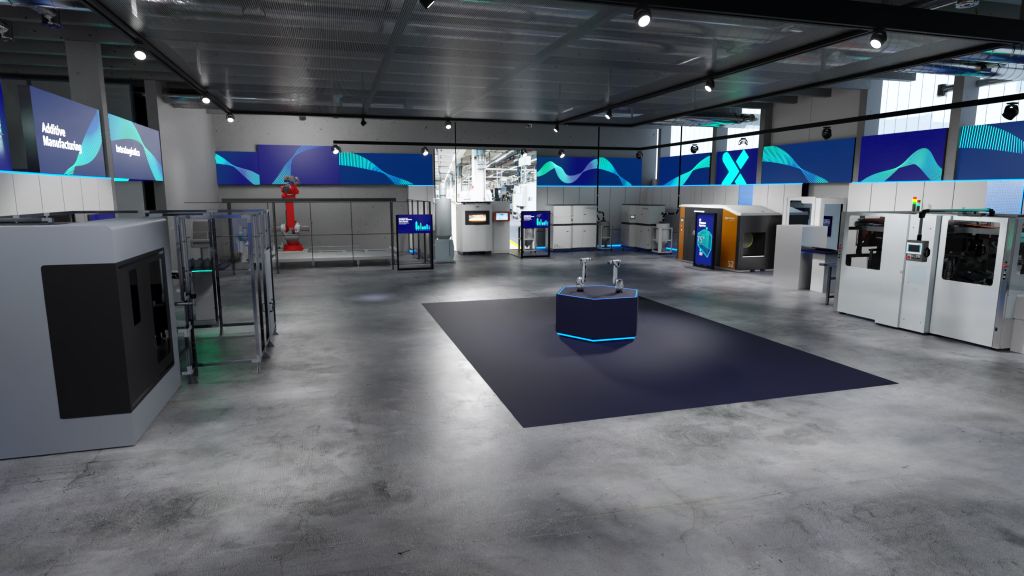
Siemens creates a continuous digital thread with Industrial AI for adaptive product development and production in additive manufacturing. For the first time, the company links agentic, prompt-based engineering with an adaptive production environment. Individual product requirements can thus be seamlessly implemented from design to manufacturing. An agentic AI workflow orchestrates engineering steps from design adjustment to virtual validation and manufacturing preparation. In an adaptive production cell, this approach will be continued from engineering to manufacturing in the future.
From manual design to prompt-based engineering
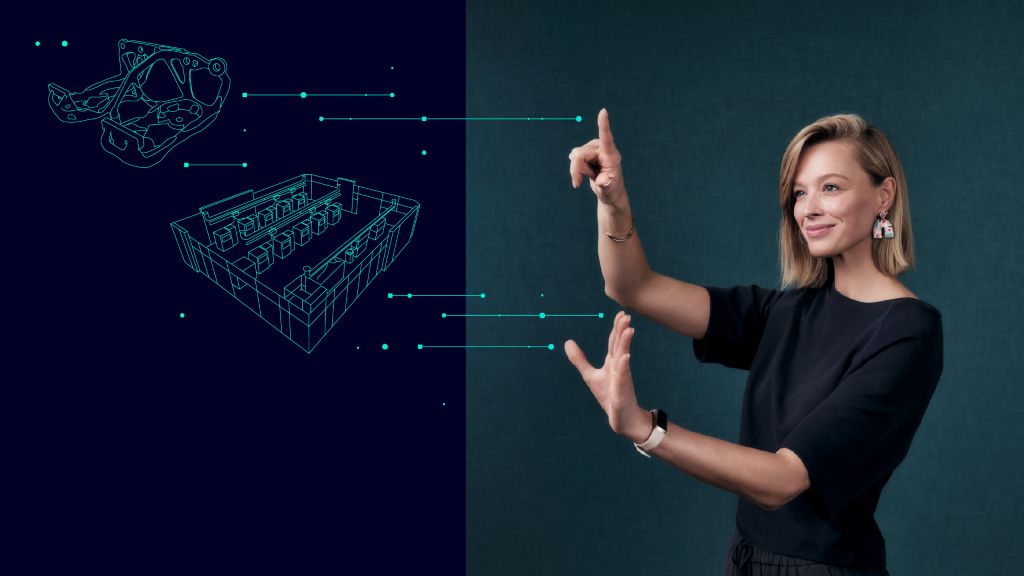
How engineering changes through the interplay of Industrial AI and additive manufacturing is demonstrated by Siemens together with AGIBOT using the example of a gripper for a humanoid robot. Instead of manually adjusting the gripper step by step for each new application, the user first describes the object to be handled and the desired task. Based on this input, an agentic AI workflow orchestrates the necessary engineering steps. A suitable gripper type is selected, the geometry is adjusted in Siemens Design Center, simulated, and subsequently validated regarding the robot interface and handling. Through an MCP integration, the AI agent can access functions of the engineering software and orchestrate the required work steps. Finally, the workflow prepares the data for additive manufacturing.
This shifts part of the engineering process from manual design to prompt-based engineering. The result is a gripper tailored to the specific application, whose design can be virtually verified and prepared for additive manufacturing before production. This approach can make complex engineering workflows accessible to a broader user base, as direct work with individual engineering tools and process steps is less frequently required. 'Industrial AI fundamentally changes how we develop and produce products. Instead of painstakingly constructing variants manually, agentic workflows can orchestrate engineering tasks based on a concrete requirement. Additive manufacturing is the ideal complement because it can flexibly translate individual designs into physical components. The next step is production that can also flexibly respond to this variance,' says Karsten Heuser, Vice President Additive Manufacturing at Siemens.
From adaptive engineering to adaptive production
While Industrial AI can accelerate the development of individual components, the increasing variety of variants poses new demands on subsequent production processes. To ensure that individual designs can not only be developed but also efficiently produced, manufacturing must be able to flexibly adapt to different components and process requirements. Siemens transfers this approach from engineering to production with an adaptive production cell for additive manufacturing. Together with EOS and AM Solutions, a production environment is being created at the Siemens device plant in Erlangen, where additive manufacturing, automation, and software are intended to work together in a seamless process chain. The goal is to flexibly represent different components and production requirements while simultaneously creating the conditions for repeatable and scalable production processes. 'The next development stage of Industry 4.0 is Industrial AI: the step from connected and automated factories to intelligent, adaptive manufacturing. By combining Siemens' expertise in industrial automation, software, and AI with EOS's expertise in additive manufacturing, we want to shape this transformation. Together, we want to advance an independent European approach for the future of manufacturing and translate technological excellence into industrial competitiveness, resilience, and sovereignty,' says Marie Niehaus-Langer, CEO of EOS.
Post-processing of additively manufactured components also plays a central role in the seamless process chain. Therefore, it should be integrated into the concept of the adaptive production cell from the outset. 'The industrialization of additive manufacturing does not end with the printing process. Only when the downstream processing steps are seamlessly integrated into the production chain can additive components be manufactured efficiently and reproducibly on a larger scale. With the adaptive production cell, we want to demonstrate how additive manufacturing and automated post-processing can be connected into an integrated industrial process,' explains David Soldan, Head of AM Solutions – 3D Post Processing Technology, AM Solutions.
Seamless data as a foundation
The prerequisite for the interplay of adaptive engineering and adaptive production is seamless software and data chains. They connect design and simulation with manufacturing preparation, production, and operation. Industrial AI can access this data and help link individual work steps throughout the entire process. Quality, traceability, safety, and human responsibility remain central prerequisites for industrial use.
Structured entry into Industrial AI for additive manufacturing
The AM I Navigator enhanced with Industrial AI supports companies in identifying and prioritizing suitable application fields for Industrial AI in additive manufacturing. Both applications in design and engineering as well as in AM production can be considered. Based on this, concrete pilot projects can be defined and a roadmap for further scaling of Industrial AI can be developed.
Contact: