
The 16th German Mechanical Engineering Summit took place on November 10 and 11, 2026, under the guiding theme "Producing the Future." Organized by the Association of German Machine and Plant Manufacturers (VDMA) together with the trade magazine Produktion from mi-connect, the summit brought together top representatives from industry, research, and politics. The focus was on industrial policy, the role of Europe, the competitiveness of Germany as a location, and the future of industrial production.
In the session "Physical AI/Embodied AI: When AI Comes into the Machine," central questions for mechanical and plant engineering were at the forefront: What role does the industry take on in the era of embodied, i.e., AI combined with physical systems? Are machines evolving into learning actors? And how close is this future, really? Gerd Hoppe, Corporate Management at the automation specialist Beckhoff Automation, answered these questions not with visions of the future but with observations from ongoing projects. His conclusion: Physical AI has already arrived in concrete applications – in AI-supported development, in the analysis of process and diagnostic data, as well as in image processing and real-time decisions directly in machine control.
"The crucial question is no longer whether AI works in mechanical engineering. It is: Where do we start, what context do we provide, and how do we validate the results?" says Gerd Hoppe. "Those who pilot real applications today create the decisive experience advantage – not by waiting, but by implementing."
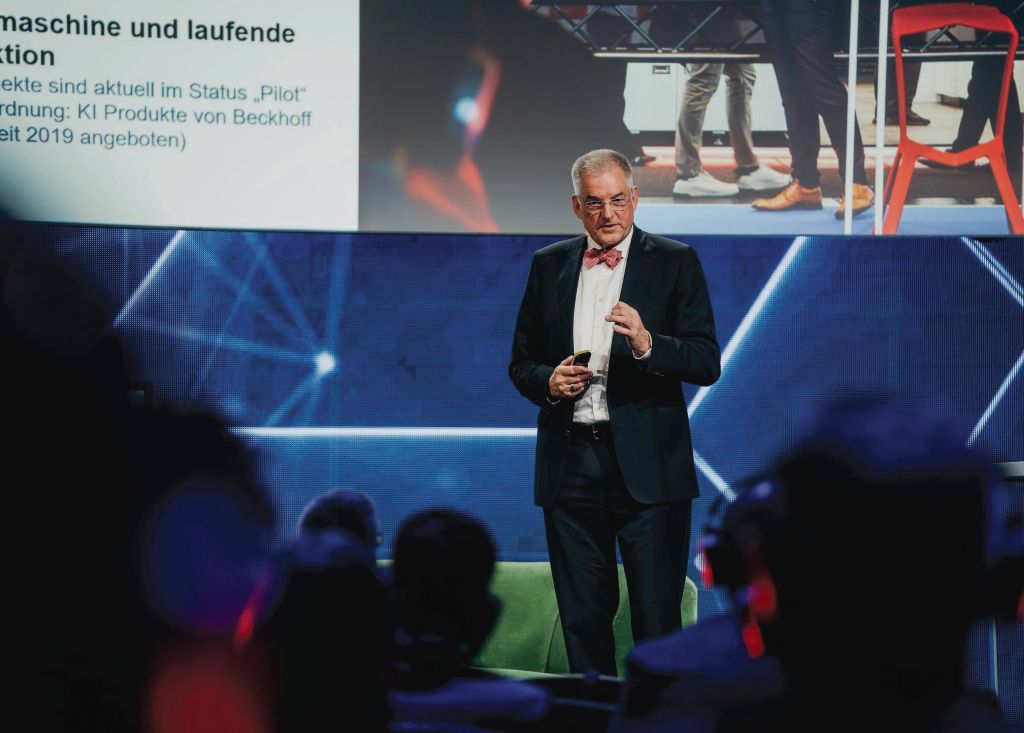
Gerd Hoppe, Corporate Management, Beckhoff Automation as a speaker at the Mechanical Engineering Summit
Gerd Hoppe, Corporate Management, Beckhoff Automation: "Despite all the advantages of AI, the engineer remains indispensable. He describes the desired function, provides the application context, checks the results, and is responsible for approval, machine safety, and commissioning."
AI works in the machine – not just beside it
Physical AI connects AI models with the physical world of the machine. It processes images, sensor and process data, internal control variables, and technical documentation and can derive actions in the machine process within clearly defined limits. This transforms AI from an isolated tool into an integrated part of automation.
What matters is not just the performance of a language or image model. Impact occurs where AI receives complete context: access to control, process, engineering data, and machine knowledge. Only if it understands the real machine and its processes can it provide reliable support in engineering, diagnostics, or operation.
"The last mile to the machine process becomes the decisive factor," says Hoppe. "AI unfolds its benefits not through the most general answer possible, but through complete and verifiable access to the automation context."
From AI-supported engineering to agentic machines
The fields of application range from AI-supported code generation to training and executing deterministic machine learning models to agentic engineering workflows. AI can take over repetitive tasks, analyze existing automation projects, generate code suggestions, prepare configurations, and identify errors in extensive diagnostic information.
Using concrete applications, Hoppe demonstrated among other things:
how existing plants can be efficiently modernized based on existing circuit diagrams, PLC programs, and operating information,
how AI supports the migration of automation projects and structures engineering artifacts, how multimodal quality checks can be executed directly in real-time processes, how AI agents can find sporadic errors in large log files faster and create analysis reports, how service agents can make machine knowledge available with locally operated language models without releasing it from the company, how agentic models can directly influence the process flow through interaction with the machine control.
The engineer remains indispensable. He describes the desired function, provides the application context, checks the results, and is responsible for approval, machine safety, and commissioning. AI does not displace engineering work from the process; rather, it creates space for more demanding, creative, and value-adding tasks. Openness and local operation ensure room for maneuver.
For machine builders and operators, data sovereignty, the protection of process knowledge, and the avoidance of new dependencies are central prerequisites for the use of AI. Beckhoff therefore relies on open interfaces, model-agnostic architectures, and the ability to operate AI models locally on the industrial PC.
This allows companies to decide for themselves which models they use, where they are executed, and which data is available for the respective applications. Sensitive machine and process knowledge can remain in-house; at the same time, the selection of AI models and operating forms remains flexible.
"Sovereignty does not arise from a fundamental rejection of AI or cloud offerings," says Hoppe. "It arises from an architecture that preserves choice: in models, in the place of operation, and in access to one's own data."
Implementation speed becomes a competitive factor
The innovation cycles of AI are developing significantly faster than traditional investment and decision-making processes in mechanical engineering. Hoppe sees a risk for the competitiveness of Germany as a location in this. Companies that quickly engage in concrete applications gather data, experience, and process knowledge – and thereby build an advantage that goes far beyond access to individual models.
Especially mechanical engineering has a strong starting position: deep process and domain knowledge, integration competence, and proximity to real production. These strengths must now be combined with a higher implementation speed. "It is not technology that is the bottleneck," summarizes Hoppe. "The bottleneck is the decision to start now."
Contact: