Following the recent expansion of the portfolio to include the ACTIVE Shuttle from Bosch Rexroth, this is another step in NEURA's strategy: to bring together different robots and applications on a common Physical-AI infrastructure, thereby transforming intelligence from individual machines into a scalable platform.
ADLATUS has been developing autonomous cleaning and sweeping robots for industry, logistics, healthcare, as well as commercial and public spaces for years. The company has hundreds of systems in the market, its own navigation software, and extensive knowledge of real cleaning processes.
From autonomous cleaning robot to intelligent Physical-AI system
With the acquisition, this foundation is to be further technologically developed. The goal is to equip ADLATUS systems in the future with additional sensor and AI capabilities and gradually connect them to the Neuraverse.
This means that a cleaning robot should no longer just follow a predetermined route, but increasingly understand its environment: recognizing different surfaces and types of dirt, interpreting situations, selecting appropriate cleaning strategies, and learning from real deployments. Through the Neuraverse, various AI models, sensor information, and capabilities can be integrated. Thus, a specialized autonomous device will gradually become an intelligent agent within a larger Physical-AI ecosystem.
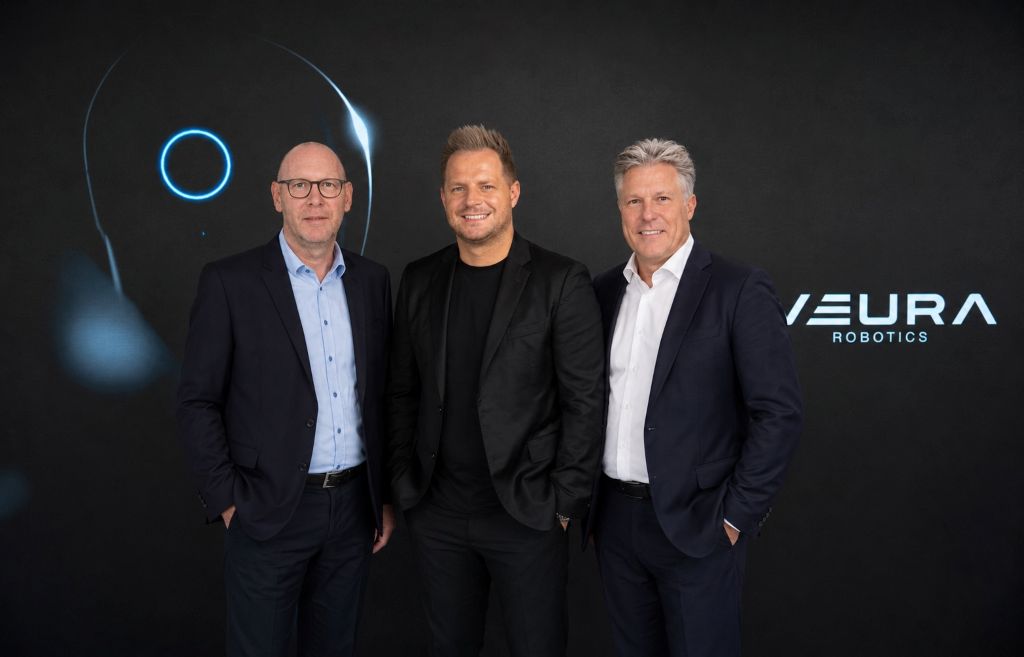
David Reger, founder and CEO of NEURA Robotics, says: 'We are not acquiring ADLATUS simply to add another cleaning robot to our portfolio. We want to give machines like this a new brain. Cleaning is a huge global labor market and at the same time a perfect example of what Physical AI can change. When a robot not only navigates its environment but understands what it sees, feels, and needs to do, a completely new generation of machines emerges. That’s exactly what we are building the Neuraverse for.'
An open platform instead of a closed ecosystem
The integration of ADLATUS explicitly does not mean a departure from collaboration with other manufacturers. NEURA aims to establish the Neuraverse as an open Physical-AI infrastructure for different robots, manufacturers, and form factors. Manufacturers of cleaning robots, mobile robots, and other autonomous systems should also eventually have the opportunity to connect their machines with technologies, AI models, and capabilities from the NEURA ecosystem. ADLATUS will thus serve both as a product platform and a real application space for the further development of Physical AI. Reger: 'Physical AI will only truly grow if an ecosystem emerges from it.'
Industrial know-how meets AI and scaling
ADLATUS will benefit from the production expertise, international sales structure, and technological platform of the NEURA Group. At the same time, the team brings deep industry knowledge, established customer relationships, and years of experience from real cleaning deployments.
This connection is crucial for Physical AI. Unlike classical generative AI, Physical AI requires data and experiences from the real world. Machines must learn how physical tasks are actually performed.
The installed base of ADLATUS provides a valuable foundation for developing, validating, and subsequently making new capabilities available at scale under real conditions.
Andreas Lindemann, managing director of NEURA Mobile Robots GmbH, adds: 'Our ambition is to think mobile robotics beyond classic material transport. Autonomous cleaning is a logical next step. In the future, we want to integrate the solutions into our Fleet Manager as well, enabling additional applications for existing and new customers. With ADLATUS, we are laying the groundwork to strategically expand this business and establish it long-term with its own product family as a fixed part of our AMR portfolio.'
Another building block of a European Physical-AI industry
With its recent portfolio expansions, NEURA is pursuing an overarching industrial strategy. Europe has decades of knowledge in mechanical engineering, automation, sensor technology, and industrial processes. This knowledge is to be connected with modern artificial intelligence to build a new generation of intelligent machines from Europe. It is not about replacing successful European technologies, but about connecting them and further developing them for the next technological generation.
'Europe has an incredible amount of industrial knowledge. We don’t need to reinvent everything; we need to connect the best that already exists with artificial intelligence and scale it much faster,' says Reger. 'That’s exactly what we are doing. Companies like ADLATUS bring decades of experience from the physical world. NEURA provides the Physical-AI infrastructure for that. When we combine these strengths, we can build a completely new industry from Europe.'
Collaboration already successfully tested
NEURA Robotics and ADLATUS have been collaborating since September 2025 as part of a strategic partnership. The first joint public appearance took place at the CMS in Berlin. Culturally, both companies share a common understanding of robotics. 'ADLATUS' means 'helper' in Latin. Since its founding, the company has aimed to develop machines that assist people in everyday and demanding tasks.
This fits directly into the mission of NEURA Robotics since its inception: 'We serve humanity.' Robots should not replace humans for their own sake, but take over dangerous, monotonous, and physically demanding work, thereby giving human capabilities new space.
Contact: