
In strenuous, ergonomically unfavorable, and repetitive tasks, robotics can relieve employees. However, especially in assembly, many factors must be considered before automation solutions can be economically implemented – and ultimately create relief for the personnel 'on the line'. Such implementation examples are currently being tested by a project team from Fraunhofer IWU and Volkswagen Sachsen GmbH at Fraunhofer IWU: as a hybrid-autonomous assembly system (HAutoMont), which enables economical and partially autonomous assembly of car underbody covers. The team is developing recommendations for an automation-friendly further development of assembly processes and components.
Underbody covers (UBV) are often assembled in overhead work or in strenuous body positions under the vehicle, leading to strain on shoulders, neck, and back. Large, flexible components with complex shapes can also only be positioned with considerable effort. Clips or screws are usually used for fastening, which are not readily available but must be picked up and carried. Especially large components require a second person for screwing, and the available space is not always generously sized. So, does everything speak for automating these tasks? Unfortunately, it is not that simple…
UBV: a special challenge for automation
…because humans have strengths that technology lacks. They are not reliant on any sensors or even a line stop to position the component accurately. They are also time-flexible and do not require a precisely assigned time window for a (partial) task within a cycle. They can easily grasp and transport soft (technically: flexible) parts. If the parts differ, this does not pose significant challenges for humans when grasping, fixing, or fastening. The combination of positioning, fixing, and fastening often takes a lot of time in automation solutions. If a clip does not snap in immediately, it often means rework – for which there is hardly any time buffer within the limited cycle time. Another challenge is the voluminous, bulky, and sometimes difficult-to-stack components with their significant space requirements, which further restrict surface options for machine handling. Additionally, revisions to the product (model maintenance measures) often increase the variety of variants, specifically: the number of parts that must be considered in a mounting cycle over the entire product lifecycle. Special operating resources for such parts would need to be produced in large quantities and possibly revised or replaced after a relatively short time.
Meaningful start: one model, one component, flexible assembly solution
The project team early on settled on a component for the Volkswagen ID.3 – from the 13 underbody cover components, a shielding component was created that improves the vehicle's aerodynamics, 'the race'. Such components are also sometimes further developed over the model's lifespan; thus, it makes sense to also address the challenge of sequential variance.
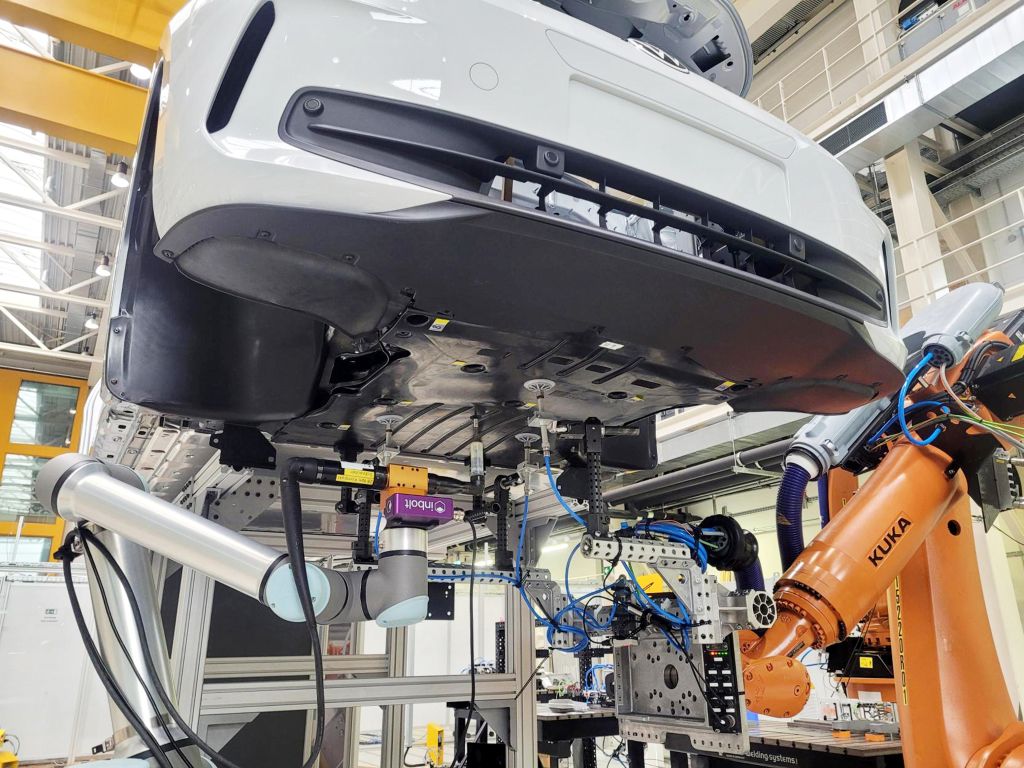
In the experimental investigation, handling and screwing robots are now used as a flexible automation solution. Suction cups pick up the component at three points to minimize deformations on this 110 cm long, 88 cm wide, and only 2 mm thin polypropylene product with correspondingly low inherent stiffness. A screwing robot recognizes at each screw through which hole in the component it must be guided. It feeds the screws and tightens them. This automated subprocess could be embedded in a manufacturing section with otherwise manual tasks – as a hybrid-autonomous solution.
Experiences from the installation of this component are used to make future component generations and manufacturing processes even more automation-friendly.
Recommendations for an automation-friendly adaptation of components and manufacturing processes
- Early consideration of automation requirements in product development facilitates the manufacturing-friendly design of components and production processes.
- Machine-mountable components should be easy to grasp at defined points, handle with low torsion, and allow for simple positioning. They should be designed to support, for example, a problem-free snapping in or
- Positioning and aligning. They should allow for as deformation-free handling as possible. Adjustments to these components during the model's lifespan should not impair the achieved level of automation. Geometrically simple parts are easier to assemble – for both humans and machines.
- Low tolerances in the positioning of other underbody components, such as the front bumper, facilitate automated assembly processes.
- The combination of two very compliant components complicates screw connections.
- The less variance in the connection technology and the lower the variety of screws and clips, the fewer special operating resources (tools) are required. Tool changes are not feasible in short cycle times.
- Space remains a scarce resource in final assembly; automation solutions occupy more floor space than employees – when people work in directly adjacent or overlapping workspaces with robots, the space requirement increases additionally due to safety measures.
- Human sensitivity ('feel') when fitting parts is often difficult to replace. Therefore, automation should be applied in the assembly of components where the greatest effects can be achieved in terms of economy and ergonomics.
Partners in the HAutoMont project are Volkswagen Sachsen GmbH, Müller and Pfeiffer GmbH, Stella Systemhaus GmbH, and Fraunhofer IWU.
Contact: