

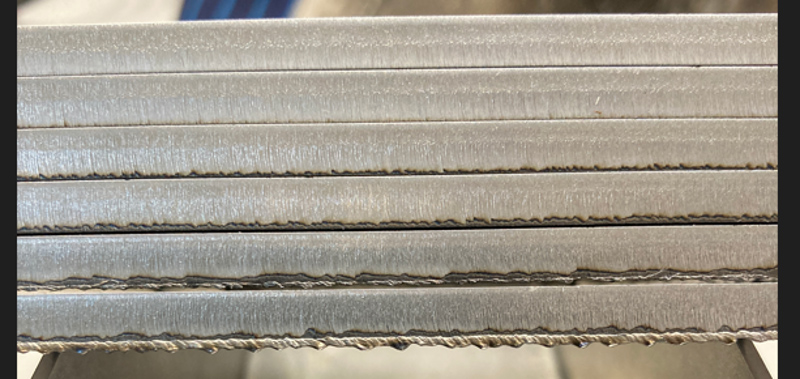
For many years, Fraunhofer IPA has been developing AI-based solutions for direct use in production together with Trumpf in the lab 'Flexible Sheet Metal Manufacturing'. Now, the team presents an important result in a publication to automate the optimization of machine parameters for laser-based sheet cutting.
For high product quality and efficiency in manufacturing, it is crucial that the parameters of production machines are set appropriately. This is especially important when it comes to material fluctuations or specific material qualities. Often, the adjustments are still made manually. Knowledge is thus tied to the specialist and their individual expertise. Manual adjustments are also time-consuming, causing poorly set machines to remain inefficient for too long. Additionally, due to complex production processes, not all relevant correlations are often recognizable. These factors lead to lower quality of cutting edges, lower productivity, and high production costs.
Automated Parameterization through Transfer Learning
Artificial Intelligence (AI) offers the possibility to automatically set the parameters of production machines, thus overcoming the disadvantages of manual procedures. The research team from Fraunhofer IPA and Trumpf has made a significant breakthrough in this regard. Because if one wants to set the machine parameters automatically, it previously meant a lot of effort: An iterative process was necessary, analyzing the production of an object and its quality and relating them to each other.
By using AI, however, the necessary iterations are significantly reduced. With the help of machine optimization algorithms, existing machine data can be utilized through objective quality parameters, and based on that, transfer learning can be applied. This allows the optimal parameters to be determined with a minimum of iterations. 'Our developed AI algorithm successfully utilizes prior knowledge from already collected data. At the same time, it quickly suggests new parameter configurations that can significantly improve product quality compared to manual settings,' reports Philipp Wagner, a research associate at Fraunhofer IPA.
Practical Validation in Sheet Metal Manufacturing
The results achieved were directly validated in the production of Trumpf. The tests were conducted during laser cutting of sheets with a laser flatbed machine. The AI method successfully improved the machine parameters automatically with little effort. This allows Trumpf to further enhance the quality of its products, especially for varying material qualities, and reduce production costs for customers. Additionally, machine operation is simplified. Last but not least, there is less scrap, which also contributes to the company's sustainability goals. Philipp Leube from Trumpf explains: 'With our new product, optimization can be done directly on the customer part. This saves the optimization on test parts, for which material must be reserved or additionally laid out and subsequently disposed of.'
Another advantage of the developed solution is that the quality of cutting edges can also be quickly automated and objectively assessed. The basis for this is merely a quick image capture and the AI-based evaluation of the image. For the evaluation, criteria from the corresponding DIN EN ISO 9013 can also be included.
Further Application Possibilities
The developed solution is not only applicable for laser cutting of sheets but is also prospectively possible for many other production processes with high variability, such as injection molding, automated cable harness assembly, or battery cell production.
Contact: