
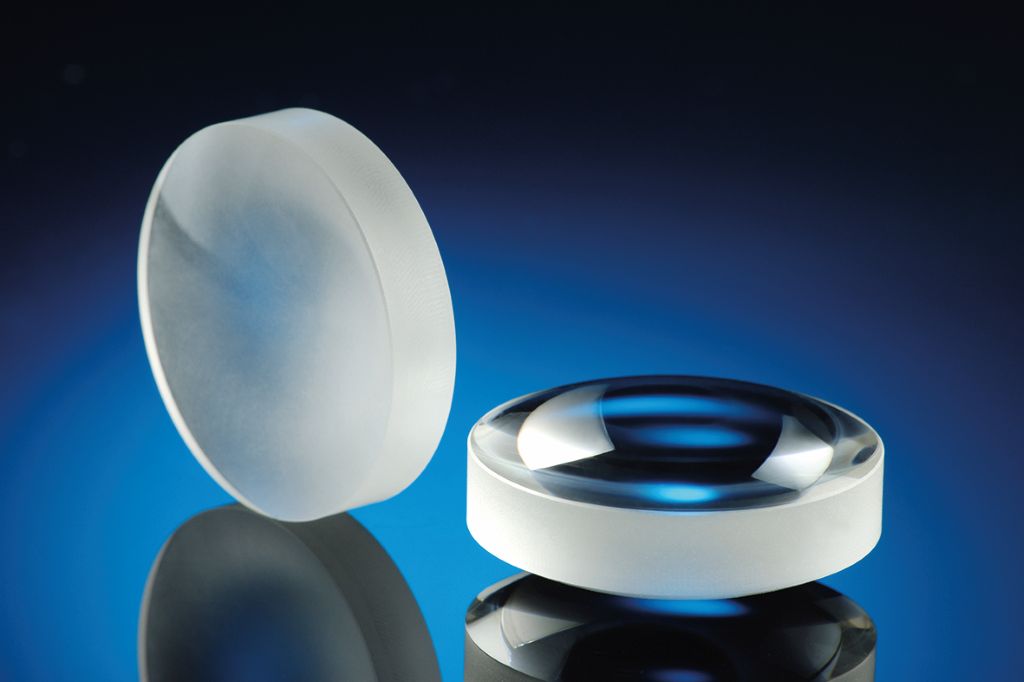
Whether in medical technology, quantum technology, or semiconductor manufacturing – optical systems are indispensable in many high-tech applications. To ensure that lenses, mirrors, or other components meet the highest requirements, manufacturing processes that combine precision, efficiency, and flexibility are necessary. With laser-based optics manufacturing, shape-accurate and functional components with low roughness can be produced – from prototypes to series, from micro-lens arrays to macro optics, from spheres to free-form optics.
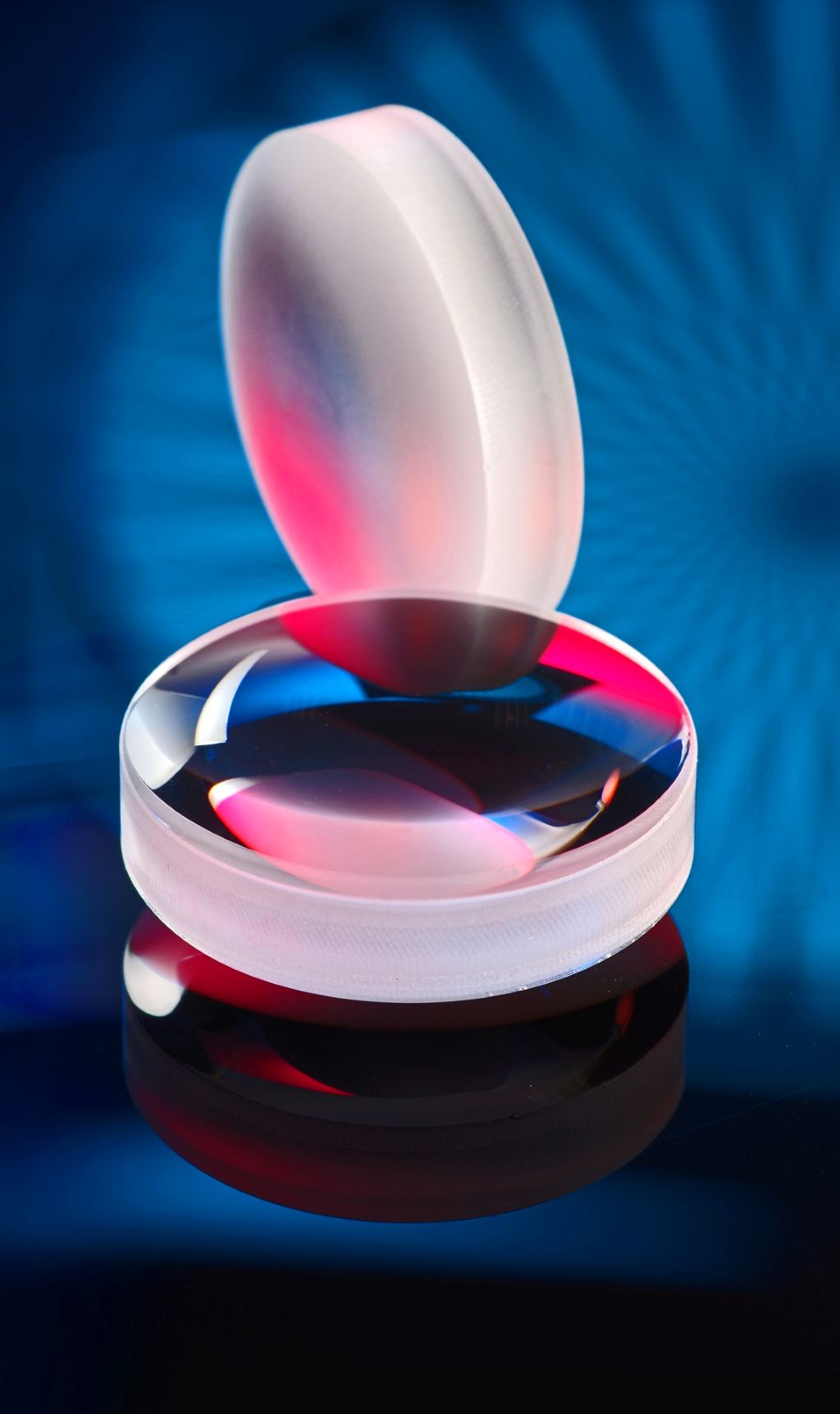
At Fraunhofer ILT in Aachen, lasers are not just used for cutting or welding – they take over the complete manufacturing of optical components. With selective laser-induced etching (SLE), for example, components like lenses can be processed on the front and back as well as on the edge in a single setup.
Another method is laser ablation. Here, a precise laser beam selectively removes material. This creates highly complex shapes from simple, inexpensive blanks like spherical glass bodies – for example, aspheres or free-form optics that are used in cameras or sensors.
"With our laser processes, we bring optics directly into shape – without detours, without re-clamping, quickly and cost-effectively," says Dr. Edgar Willenborg, who has significantly contributed to the development of optics manufacturing at Fraunhofer ILT. "Especially when not just simple spheres are required, we achieve the highest efficiency."
After shaping, the refinement follows: Lasers polish surfaces that are still rough from previous processing. The laser heats the surface so sensitively that the smallest unevennesses melt together – within seconds, completely without mechanical contact.
For particularly high requirements for shape accuracy, Willenborg and his team are researching the so-called Laser Beam Figuring (LBF). Here, the smallest shape deviations in nanometer layers are selectively removed and corrected – that is, millionths of a millimeter – which is crucial for high-performance optics.
In addition to shaping and polishing, Fraunhofer ILT also develops processes for the assembly of optical systems. This includes precise bonding or soldering of components so that they remain stable under load and function reliably over long periods.
"Whether aspheres, free forms, or classic lenses: We demonstrate that laser-based processing not only works but also makes economic sense," explains Christian Vedder, head of surface technology and shape removal.
Versatile areas of application – from research to series production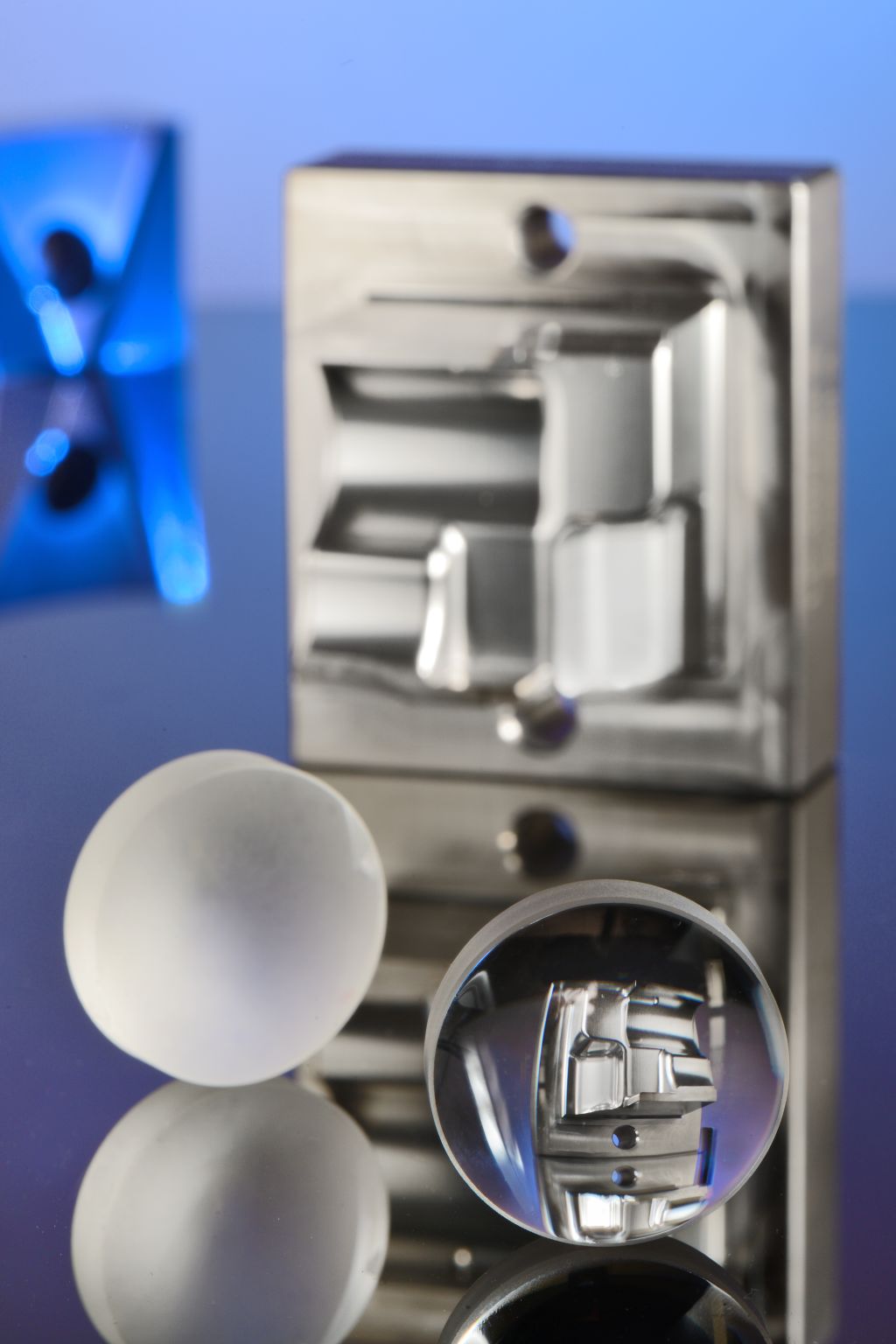
The laser-based optics manufacturing at Fraunhofer ILT is not only technologically exciting – it also shows in practice what is possible. The developed processes can be used wherever medium precision, high efficiency, and automation are required, such as in medical technology, where tiny lenses for endoscopes or diagnostic devices are needed, or in quantum technology, where complex glass structures are created that guide and manipulate light. Such optical components also play an important role in the semiconductor industry – for example, in the production of fine structures on microchips.
Another advantage: The technologies can be flexibly adapted – depending on the material, shape, or quantity. Whether a single piece for a research laboratory or a larger series for industrial applications – through the combination of various laser processes, a modular system is created that can be precisely tailored to the application.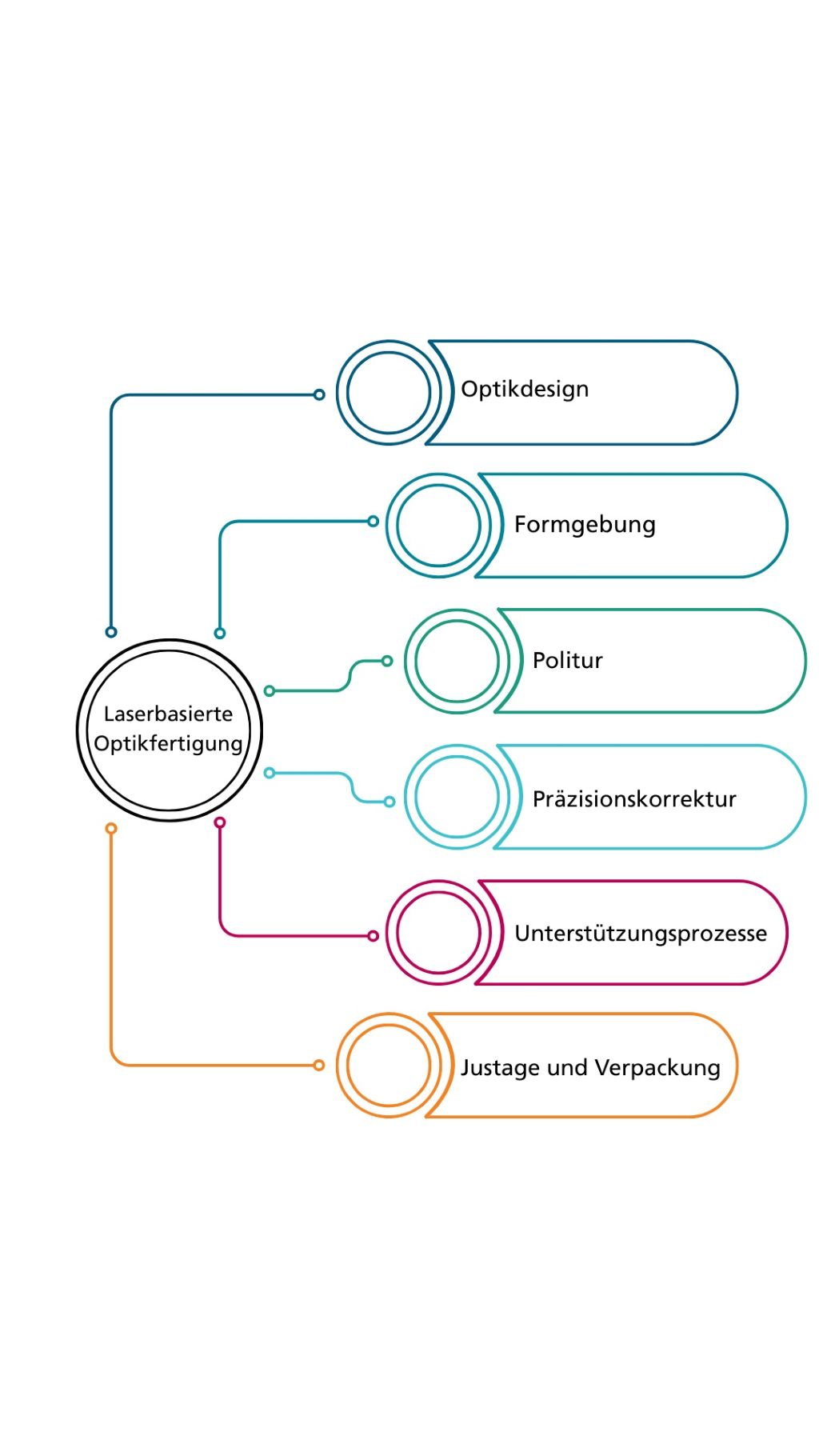
Supporting processes such as laser-based marking and labeling of optical components or separating glass, for example, in wafer-based manufacturing, are also included. This allows all steps along the value chain to be represented – from the first idea to the finished product.
"Our technologies are particularly in demand when conventional methods reach their limits – for example, with aspherical optics and complex geometries made of glass," says Edgar Willenborg.
Research and collaboration – rethinking optics manufacturing together
The demands on optical components are constantly increasing – in precision, complexity, and quantity. At the same time, the need for flexible, economical solutions that can be quickly adapted to new applications is growing.
In an interdisciplinary team, more than 15 scientific staff continuously develop new approaches to make laser-based manufacturing of optical components even more precise, faster, and versatile. This involves not only fundamental research but especially the transfer to industrial manufacturing.
An important part of this work is the close cooperation with industry partners. Together with companies from various sectors, researchers test new processes and process chains, adapted and made usable for production. Often, customized solutions for specific tasks emerge.
In the future, it will not only be about refining known methods but also about exploring new materials and designs. The combination of digital manufacturing-friendly optics design and laser-based manufacturing methods opens up completely new design possibilities. This allows components to be created that would be difficult or very labor-intensive to produce using classical methods – such as particularly compact or integrated optics for wearable devices or for use in space.
The integration into automated manufacturing processes and the connection with modern measurement techniques will also be further expanded. This allows quality and efficiency to be even better combined – in line with sustainable and future-oriented production.
"The combination of digital design and laser-based manufacturing will enable much more in the future – especially for individualized products," believes Edgar Willenborg. Soon, the Aachen team wants to achieve the highest requirements for precision with the process chain for laser-based optics manufacturing. Lasers are the perfect tool for this.
Fraunhofer ILT at the LASER World of PHOTONICS in Hall A3, Stand 431.
Contact:
www.ilt.fraunhofer.de