
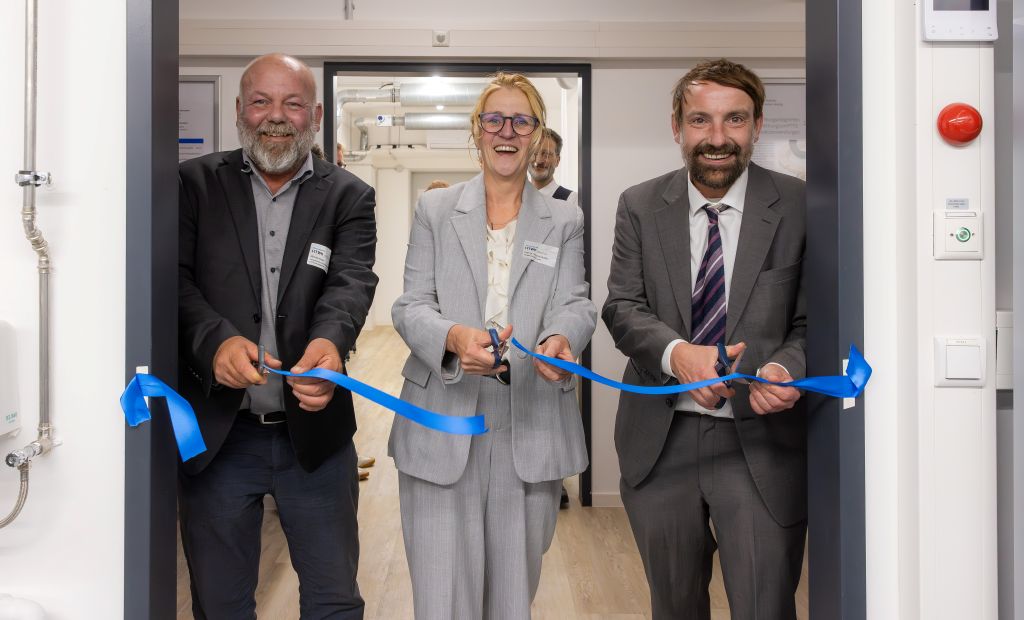
For many years, researchers at the Leipzig University of Applied Sciences (HTWK Leipzig) have been advancing additive manufacturing in numerous research projects across various disciplines. The manufacturing process, also known as 3D printing, builds three-dimensional objects from digital design data through a layer-by-layer material application, rather than cutting them out of a block or casting them into shape. Recently, HTWK Leipzig introduced its new degree program '3D Printing & Functional Surfaces', which will start in the winter semester of 2026/2027. Yesterday, a new research laboratory was inaugurated: As part of the networking event 'Research Meets...' and the accompanying symposium 'Additive Multimaterial Manufacturing' (AM³), the new AM³ laboratory was ceremoniously opened.
The AM³ laboratory, funded by the German Research Foundation (DFG), forms the basis for research on fully integrated manufacturing processes with various materials – with applications in industries such as mechanical and plant engineering, printed electronics, or medical sensors and diagnostics. The centerpiece of the new research environment is a state-of-the-art bio-printer. 'This printer opens up completely new possibilities in functional 3D printing because it can combine multiple materials and processes simultaneously,' explains Ingo Reinhold, Professor for Coating Processes at HTWK Leipzig. With various interchangeable print heads, different materials can be precisely placed within a single layer – a prerequisite for intelligent, multifunctional components. 'We are no longer just printing geometries – we are printing functions,' summarizes Reinhold the innovation.
In addition to the bio-printer, the new AM³ laboratory houses two other large research devices funded by the DFG: On one hand, a highly flexible powder-based polymer 3D printer, which is extremely flexible due to the combination of powder and ink properties and is suitable for the development of new material combinations and processes. On the other hand, a powder shear cell, an analysis device with a climate chamber for the precise determination of material properties of powders. Together, the three large devices form a seamless process chain from material development to the finished component.
Another building block in HTWK infrastructure
More than 200 guests from business, science, politics, and society attended the presentation and opening of the new AM³ laboratory. Prof. Dr.-Ing. Jean-Alexander Müller, Rector of HTWK Leipzig, emphasizes: 'HTWK Leipzig has enormous competencies in materials science, generative manufacturing, and their optimization through digital processes. The AM³ laboratory as a new component of the university's research infrastructure expands our opportunities to explore the potentials of materials such as metals, semiconductors, and ceramics, as well as conventional and biodegradable plastics and implantable materials. Particularly promising for the transfer to practice is the development of innovative composite materials and processes that can manufacture functional components, for example, with integrated sensors. One of the main goals is always to enable more efficient use of resources and contribute to sustainable development.' By enabling even more intensive research on material innovations and advanced materials at HTWK Leipzig, it actively contributes to the development of modern, digitally supported process technologies and thus supports the goal of the Federal Government's High-Tech Agenda to make Germany a leading and sovereign location for new technologies.
The opening of the new research environment was also appreciated by industry: Among those congratulating at the opening were Hans-Werner Theobald, head of the 'Additive Manufacturing' working group for the Leipzig district at the Association of German Engineers (VDI), and Rainer Gebhardt, speaker for the 'Additive Manufacturing' working group at the Association of German Machine and Plant Engineering (VDMA).
Investment in a future technology
At the subsequent ceremonial opening, Michael Mayer, responsible head of the Leipzig II branch of the State Enterprise Saxon Real Estate and Construction Management (SIB), added: 'Our branch has supported this important research project of HTWK Leipzig through a user-specific conversion with high technical requirements. Through a so-called 'room-in-room solution', constant laboratory conditions can be ensured, enabling the fundamental research of HTWK Leipzig in the area of hybrid and generative manufacturing technologies. The SIB and HTWK Leipzig are thus jointly investing in a future technology that allows for individualized, automated manufacturing of components and workpieces for various applications, aiming to work faster and more resource-efficiently. Especially in the construction industry, 3D printing of building components could reduce construction times and costs.'
Special program and 'Research Meets...' with symposium, award ceremonies, and laboratory tours
In the morning, the corresponding symposium of the AM³ research area of HTWK Leipzig took place, which was organized in collaboration with the University of Graphic and Book Art. To generate new ideas, competencies, and needs, the symposium focused on systematically connecting science and business as well as art, culture, and education. The approximately 80 guests of the symposium took the opportunity to learn about various areas and aspects of 3D printing, including powder- and inkjet-based processes and material extrusions, as well as to exchange and network with experts from Leipzig and the region.
In addition to the presentation and ceremonial opening of the new AM³ laboratory, award ceremonies also took place as part of the subsequent networking event 'Research Meets...': The HTWK Foundation awarded the dissertation prizes 2025 and 2026 for outstanding doctoral theses at HTWK Leipzig, the HTWK start-up consulting honored innovative products with the first idea prize, and the research department announced the winning images 2025 of their photo competition 'Research Perspectives'. Additionally, laboratory tours took place in several buildings on the central campus in Leipzig-Connewitz, providing insights into materials, analytics, process development, and quality assurance for various AM processes.
Contact:
www.htwk-leipzig.de