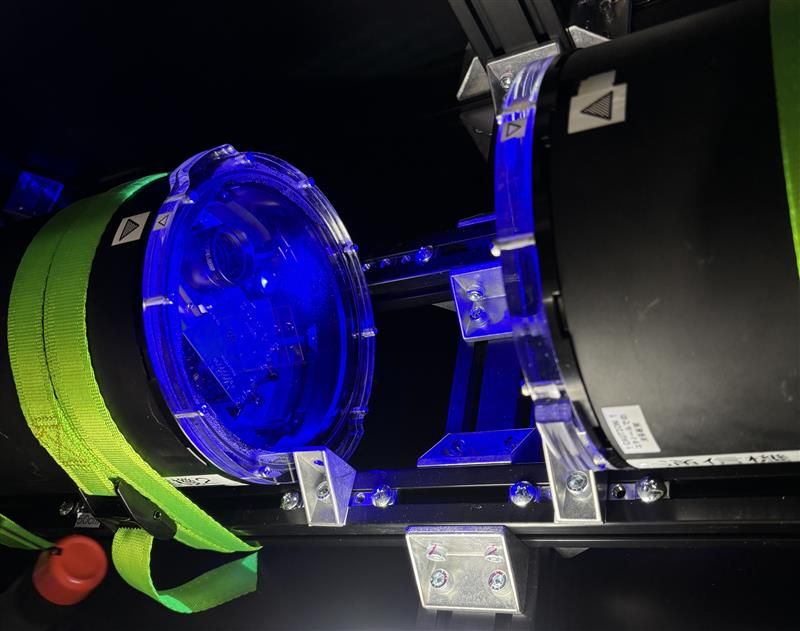
Kyocera Corporation has achieved wireless optical underwater communication (UWOC) with a speed of 750 Mbit/s without latency. This is the highest speed achieved worldwide in a prototype system using Kyocera SLD GaN lasers. The offshore trials took place near the city of Numazu in Shizuoka Prefecture, Japan. The goal is to realize a speed of 1 Gbit/s to advance the most robust communication for various underwater applications, including underwater drones for marine research and smart aquaculture.
Background of the Offshore Trials
Recently, numerous organizations have intensified the use of maritime resources. Industry leaders expect the deployment of intelligent, AI-controlled aquacultures and underwater drones, as well as AUVs (Autonomous Underwater Vehicles) for inspecting and monitoring underwater infrastructure. Electromagnetic waves in the radio frequency range are significantly dampened in water.
The acoustic communication commonly used by professionals transmits large amounts of data such as images or videos only slowly. In contrast, underwater communication using light is subject to minimal attenuation and enables fast data transmission. Kyocera focuses on this optical transmission method and is developing the UWOC technology using GaN lasers, which allow for fast, high-capacity communication with low latency. In January 2025, Kyocera achieved a communication speed of up to 1.8 Gbit/s in indoor tests. Regarding practical implementation, Kyocera conducted offshore tests and confirmed the viability of the technology. Despite these advancements, the range and effectiveness of the system can be affected by water turbidity and power supply limitations. Understanding these limitations is crucial for deployment in different marine environments.
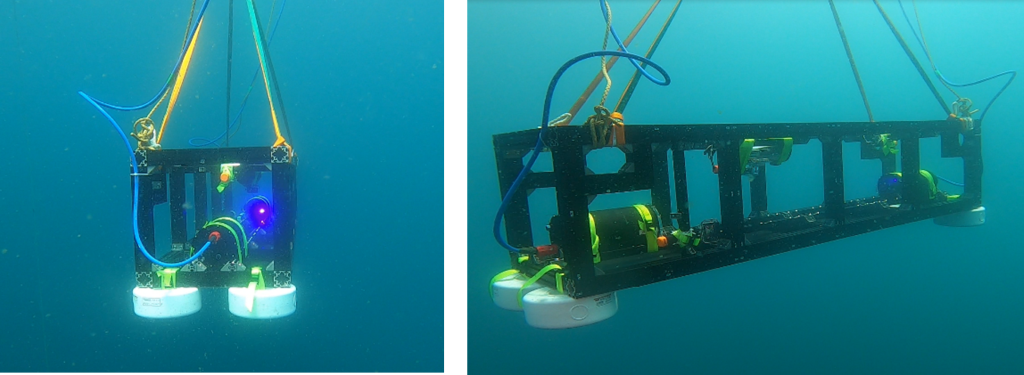
Overview and Demonstration of Kyocera's UWOC System
Kyocera has developed a Gbps-based high-speed UWOC system without latency. The system utilizes semiconductor lasers based on gallium nitride (GaN), a material that efficiently emits blue light. Tests have confirmed that Kyocera's system, designed for a maximum data transmission rate of 1 Gbps, can stably achieve 750 Mbps even under harsh marine conditions over short distances. The laser-based system was only minimally affected by turbidity, currents, and ambient light, achieving the expected transmission speeds in both freshwater and real offshore conditions.
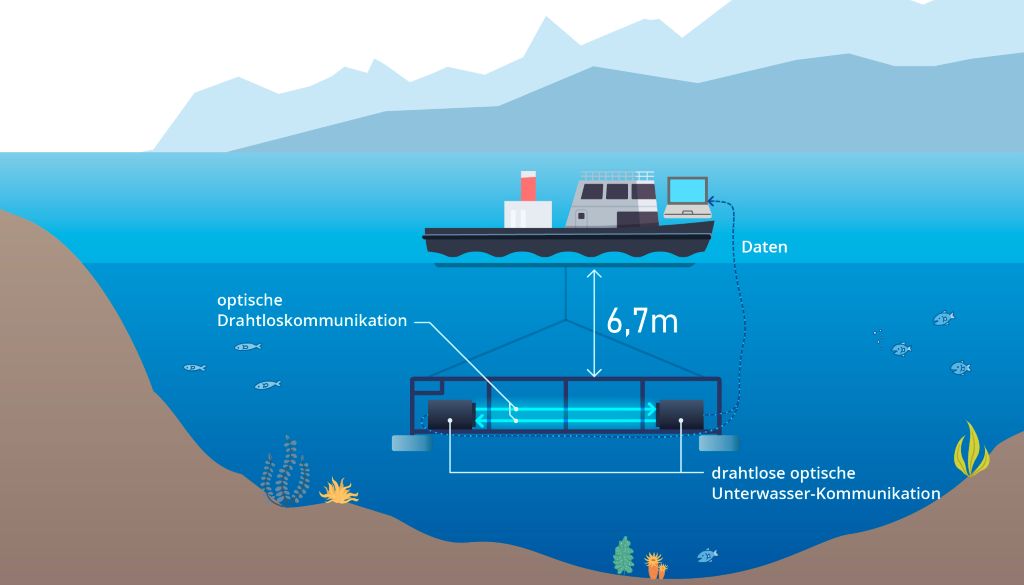
The test was conducted over a distance of 6.7 meters in an offshore saltwater environment with a communication range of 15 cm to 1.5 m and moderate water turbidity to assess system stability and performance under various conditions. These tests are essential to ensure that the technology enables smooth transmission of high-resolution video and sensor data.
Test Details
| Location: | Offshore Numazu City, Shizuoka Prefecture, Japan |
| Date: | August 19 to 21, 2025 |
| Environmental Measurement: | Detailed measurements of marine environmental parameters such as turbidity, water temperature, chlorophyll concentration, salinity, and external stray light (ambient light) |
| Measurement of Communication Speed: | Verification of the relationship between communication distance and communication speed |
| Assessment of Stray Light Influence: | Verification of communication performance with and without shielding and under sunlight |
Future Developments
This technology enables a next-generation underwater IoT. With conventional data transmission techniques, this has not been possible until now. The optical technology supports ultra-fast communication of underwater drones and robots, the up- and download of large data volumes from marine observation devices, and the use of large-scale underwater sensor networks for smart aquaculture. Kyocera is working to establish communication in the range of gigabits per second (Gbps) in offshore environments. The goal is to industrialize such optical underwater communication systems by 2027. With this technology, Kyocera aims to develop a maritime business sector, create new opportunities for global marine monitoring and resource management, thus contributing to a sustainable future society. To achieve this, the company plans several pilot projects to test the system's capabilities under various marine conditions. Currently, collaborations with industry leaders and key players in the maritime sector are being established to gain regulatory insights and optimize market entry. In the context of implementing industry standards and exploring applications of the technology, Kyocera is interested in further partnerships.
This demonstration trial is a preliminary report based on the results of a presentation given at the 43rd Annual Conference of the Robotics Society of Japan (RSJ2025) in September 2025.
Contact: