
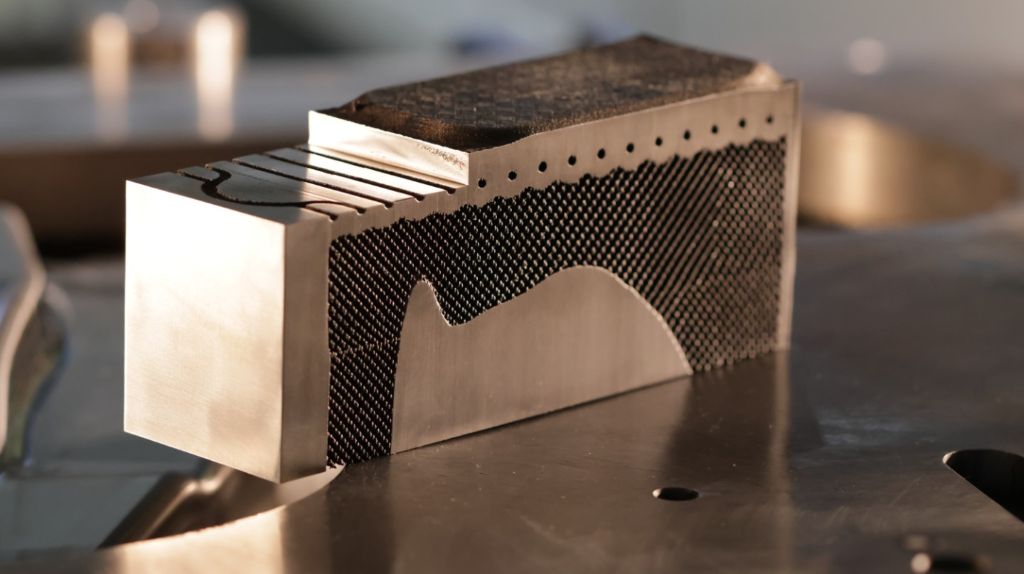
Additive manufacturing, especially the Laser Powder Bed Fusion (LPBF) process, opens up new avenues in toolmaking thanks to great design freedom. The Fraunhofer IWU is exploring this potential in two research projects, 'AdTopoTool' and 'EWAM'. The goal is to develop and produce more efficient tools for sheet metal warm forming and injection molding more quickly. This also benefits the quality of the component, which can be produced in a shorter time with such tools.
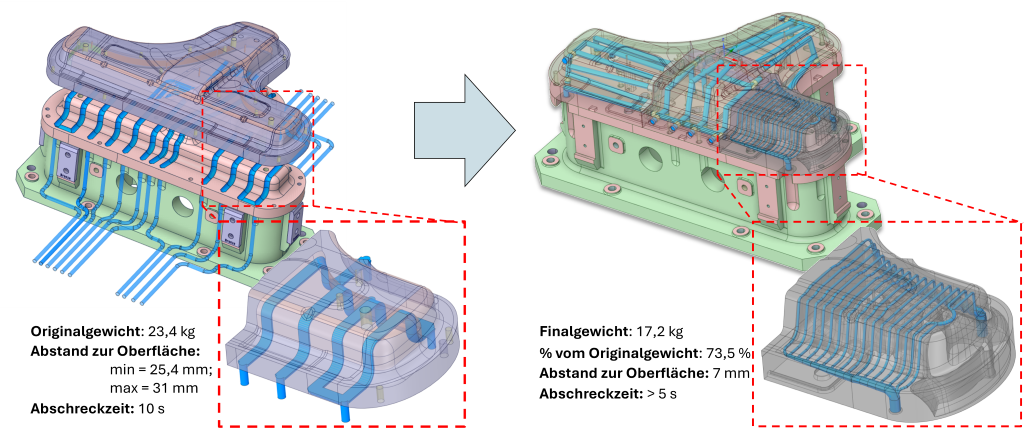
AdTopoTool: Efficient material distribution in the tool reduces weight by about 30 percent.
In many toolmaking companies, conventional manufacturing processes and experience-based designs are still used today. This usually comes with geometric constraints and a very high tool weight.
As a result, manufacturing times and component quality often suffer from inadequate temperature management. In the AdTopoTool research project, the project partners Fraunhofer IWU, Werkzeugbau Winkelmühle GmbH, and H+E Produktentwicklung GmbH demonstrated that additively manufactured tools with topology- and cooling channel-optimized geometries provide significant added value - despite high demands on the thermomechanical load capacity and temperature management of the tool. Topology optimization means designing the tool for minimal weight and maximum stiffness through intelligent material distribution or improved geometric design of cooling channels.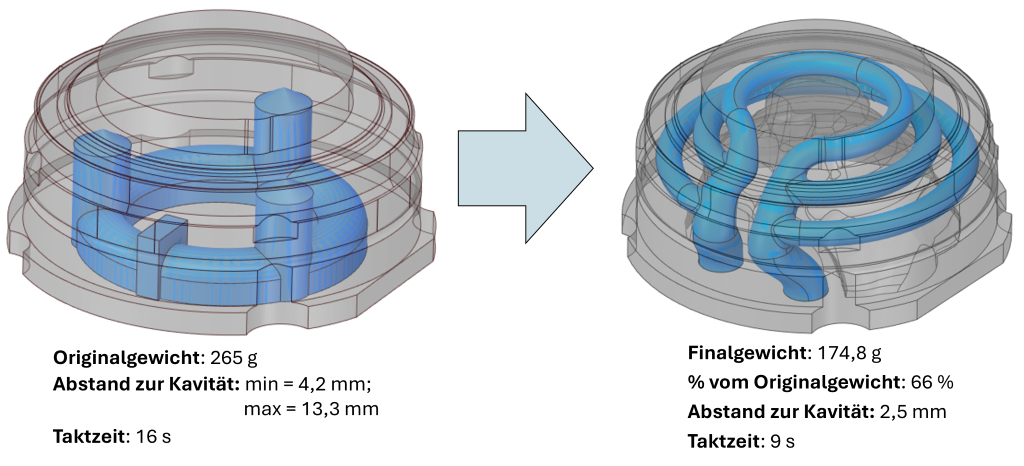
Using the example of the production processes of injection molding and press hardening, a numerical method was developed that reliably predicts the load and structural behavior of thermally highly stressed tools. This method was used for the topology optimization and design of the cooling channels of a demonstrator tool for injection molding as well as for press hardening.
The researchers also validated the optimized and additively manufactured tool geometries in the laboratory. The result: a weight reduction of the injection molding tool by about 34 percent and of the press hardening tool segment by about 28 percent, without compromising the requirements for shape stability.
Through more efficient tempering systems, the cycle times of the injection molded components can be reduced by 60 percent and the heat treatment of the press-hardened components by almost half. In some cases, an improvement in the quality and dimensional accuracy of the end products can even be achieved.
EWAM: Automatic tempering channel design for additively manufactured tools
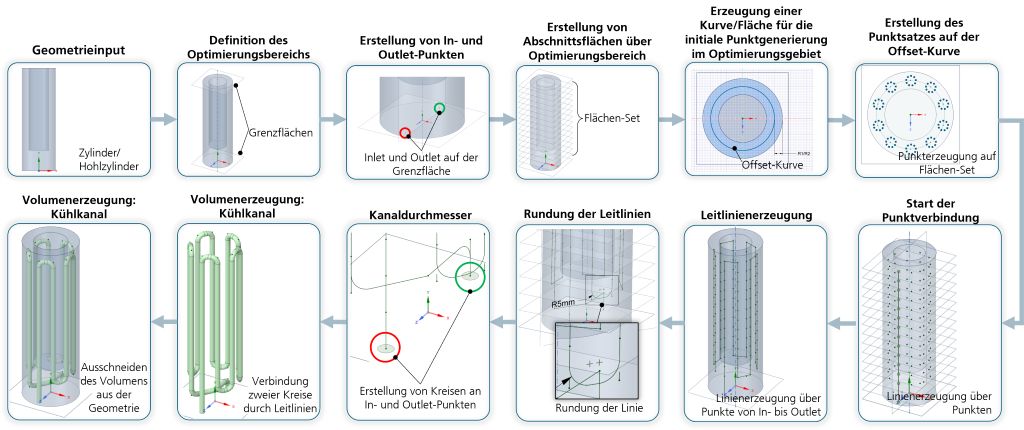
However, a lack of experience with additive manufacturing, a labor-intensive design of the tempering systems, and incomplete design guidelines have so far hindered the widespread use of this technology. To overcome such hurdles, the Fraunhofer IWU is developing a script-based, automatic tempering design in the current EWAM project (Efficient Toolmaking with Additive Manufacturing).
Less manual effort and a shortened development time for the tool are expected to lead to a significant increase in efficiency. The goal is a software plug-in for the automatic design of additive tempering systems, taking into account the specifications of additive manufacturing as well as the results of thermal, fluid dynamics, and load analyses. To ensure that the plug-in can spread quickly after its market launch, it will be created in a universal programming language and be compatible with various 3D CAD programs.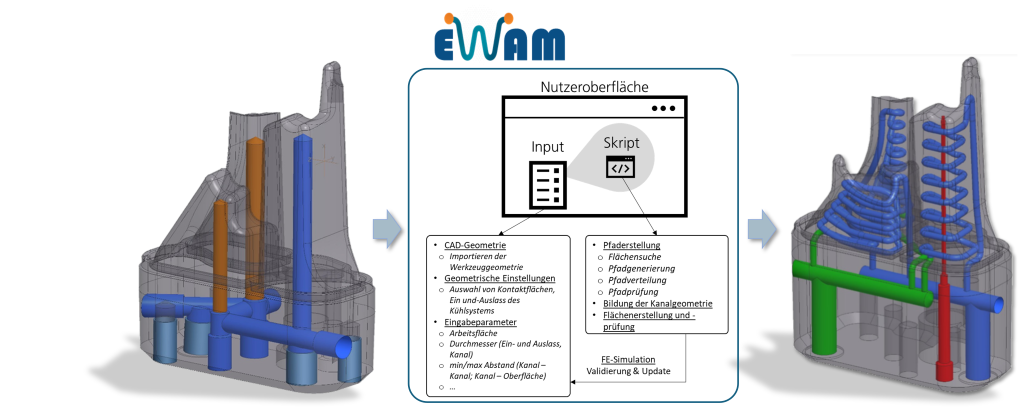
The application of the Laser Powder Bed Fusion process, an optimized tool geometry that considers actual process loads, and intelligent tool cooling create real added value for medium-sized tool manufacturers. The Fraunhofer IWU has set itself the goal of establishing new standards for quickly implementable, resource-efficient, and high-quality tool solutions.
Joint stand of the EFB at Blechexpo in Hall 5
Contact: