
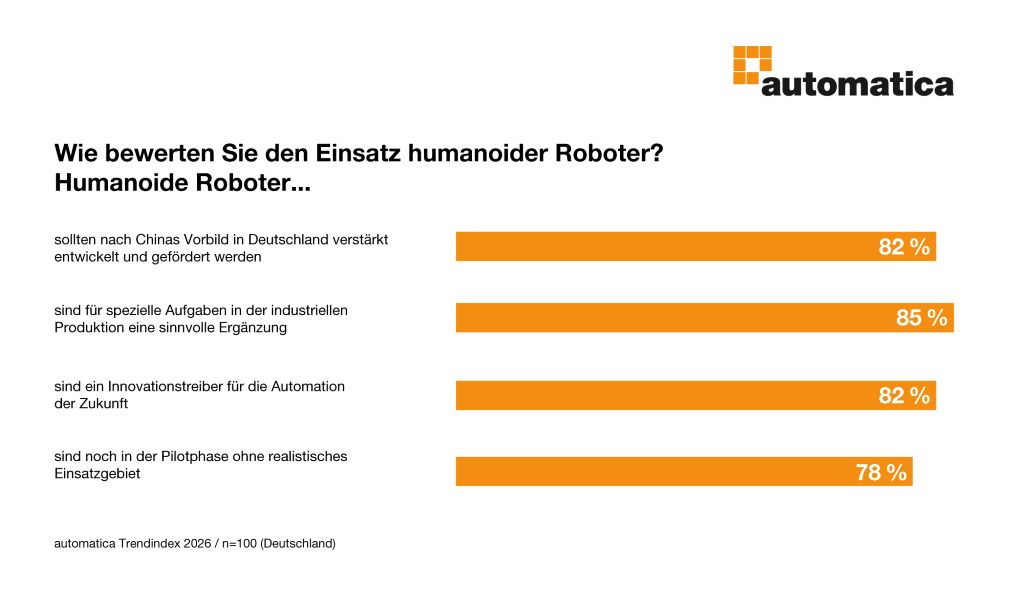
The vast majority of industrial decision-makers in Germany view humanoid robots as innovation drivers for the automation of the future. 82 percent of respondents believe that Germany should increasingly develop and promote humanoid robots based on the Chinese model. This is the conclusion of the automatica Trend Index 2026. For the survey, a total of 100 specialists and executives in Germany were interviewed on behalf of automatica, who decide on the use of robotics and automation in their companies.
“China has been consistently pursuing a national robotics strategy for years to systematically leverage the opportunities of modern automation,” says Patrick Schwarzkopf, Managing Director of the VDMA Robotics + Automation Association. “The five-year plan recently presented by Beijing places intelligent robotics at the center of development goals. With humanoid robots, a new chapter is being opened: the aim is to develop an ‘embodied intelligence’ that connects AI software with physical robotics. Completely new practical applications of AI for automation in industry and business are planned.”
Robotics and automation essential for competitiveness
Intelligent robotics is also considered a central field of innovation in Germany: 78 percent of respondents are convinced that the use of AI in robotics and automation is essential for the competitiveness of the German industry. According to the automatica Trend Index, humanoid robots are already an important addition in industrial manufacturing (85%). And this is despite the fact that for 68 percent of respondents, they are still predominantly in pilot projects without a broadly established area of application.
“Certainly, humanoid robotics is a particularly catchy example of Physical AI, as here AI interacts with the real world in human-like form,” says Anja Schneider, Exhibition Director of automatica. “Even now, we can say that Physical AI and humanoid robotics will be the top topics at automatica 2027.”
Good conditions: Germany among the top 3
Humanoid platforms exemplify the automation of the future, where competencies from different disciplines come together: the know-how of classical mechanical engineering combines with modern control technology, sensors, and AI-based software development. For so-called physical AI, realistic manufacturing data captured and processed via sensors is crucial. Germany has excellent conditions with its highly developed production sites. With 449 installed industrial robots per 10,000 employees, Germany has one of the highest robot densities in the world and ranks third according to the International Federation of Robotics (IFR), behind South Korea and Singapore.
Contact: