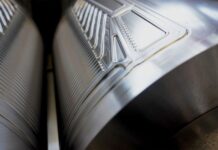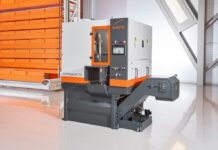

Electrochemical machining (ECM) enables the high-precision deburring and rounding of workpiece edges through electrolysis. A pre- or post-cleaning ensures the stable function of the process and ensures that the surface quality meets defined cleanliness requirements. A manufacturer of ECM solutions therefore integrates ultrasonic cleaning modules into its custom-made systems.
Initially, VULIC ECM GmbH & Co. KG, founded in 2007, focused on the development and manufacture of custom fixtures (tools) and spare parts for electrochemical machining (ECM). Seven years later, the first self-developed ECM system, the machining center V 500, followed, and the established service portfolio was expanded to include contract machining. The modularly designed standard and special systems, as well as services of the company based in Ottobeuren, are now in demand internationally by customers from the automotive and defense industries, aerospace, and medical technology.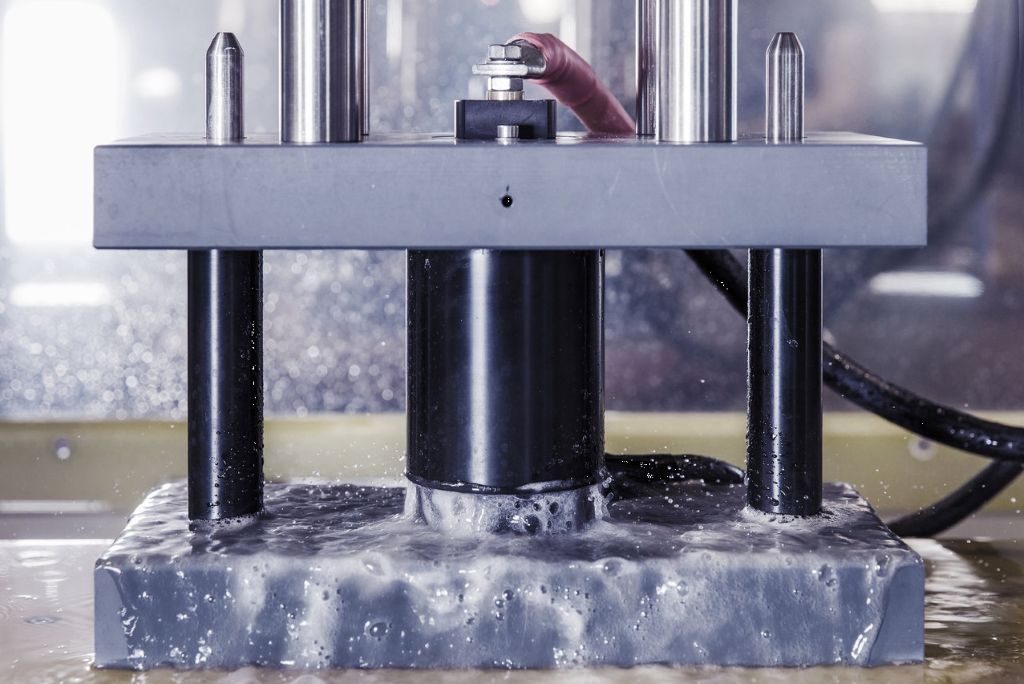
Integrated Ultrasonic Cleaning for Stable ECM Processes and High Cleanliness
In ECM technology, burrs can be efficiently removed and edges rounded with high precision, even in hard-to-reach areas such as blind hole drillings, hole intersections, and pockets. For the contactless process, the tool is connected as a cathode (negative) to a DC power source, and the workpiece is polarized as an anode (positive).
The charge exchange occurs in a saline electrolyte solution, whereby the burrs are completely dissolved and transported away by the electrolyte from the working gap.
"For the quality and precision of ECM processes, it is crucial that the parts to be processed are free of oil and grease," specifies Sascha Haushammer, Sales Manager at VULIC ECM. "Moreover, significantly increased cleanliness requirements usually necessitate a cleaning after the ECM process, where residues of the electrolyte and possibly adhering particles on the workpiece are removed." For these reasons, the system manufacturer has been offering its machines with integrated modules for pre- and post-cleaning since 2018, for example with ultrasound, and also uses these in the service sector. VULIC ECM manufactures the cleaning tanks custom internally, now also for applications without ECM. For the ultrasonic equipment, a powerful partner was sought.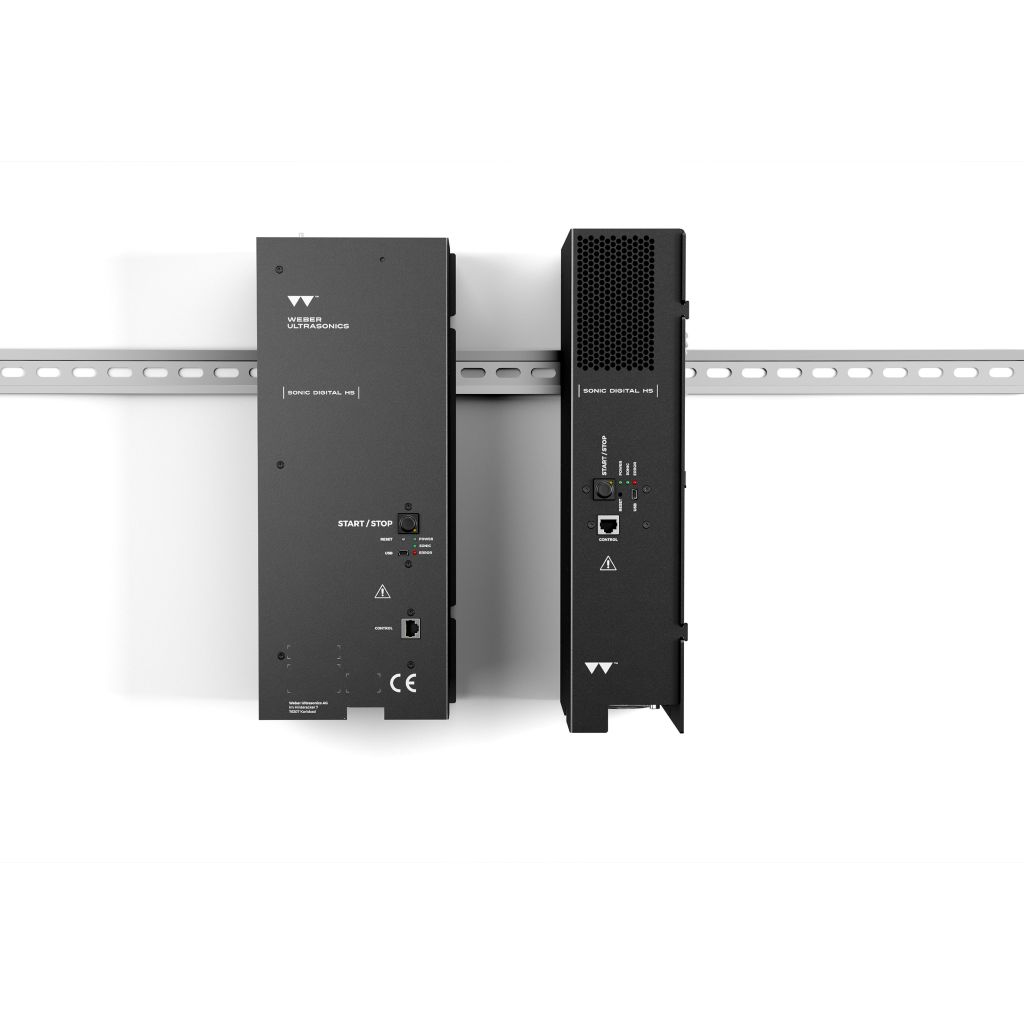
Ultrasound Customized for Each Application
A company for cleaning media recommended Weber Ultrasonics AG. The internationally active company develops and produces ultrasonic components for cleaning, welding, and cutting. The generators for component cleaning are available in different frequencies, including as multi-frequency systems. They enable the construction of compact, individually tailored cleaning solutions based on the workpieces and cleanliness requirements in combination with frequency-matched plate, immersion, and rod oscillators.
"At that time, we also spoke with other manufacturers, but the collaboration with Weber Ultrasonics worked so well from the start that we did not bring any other provider on board," reports Sascha Haushammer. "We receive excellent advice and have been able to build up a certain know-how in ultrasonic cleaning over the years. Today, we only really need the expertise of Weber Ultrasonics for special projects."
Edge Rounding and Cleaning of Kilometer-Long Metal Strips
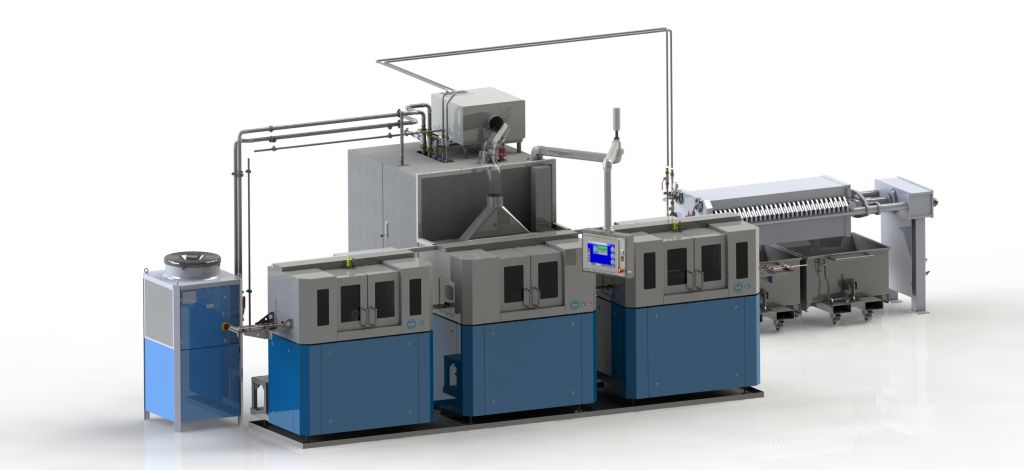
One such project was the development and manufacture of a complete solution for processing steel strip of varying widths and thicknesses, several kilometers long. The task sounded simple: a defined edge rounding should be produced on one side of the parts and they should be prepared for subsequent customer-side conservation. "Moreover, process speed was an important factor," explains Sascha Haushammer. VULIC ECM designed a modular continuous system with the stations pre-cleaning, ECM processing, and post-cleaning including ultrasound.
The module for post-cleaning consists of three separate zones. The middle area is equipped with a 25 kHz Sonosub exchange oscillator with a power of 500 watts on the bottom side. The laser-welded capsule of the oscillator is extremely smooth, minimizing deposits. The performance-adjusted Sonic Digital HS3 generator digitally generates and regulates the frequency of 25 kHz through a 32-bit microcontroller, and it is monitored. The power can be adjusted in the range of 10 to 100 percent in 1% steps, allowing for optimal adaptation to part-specific cleaning programs.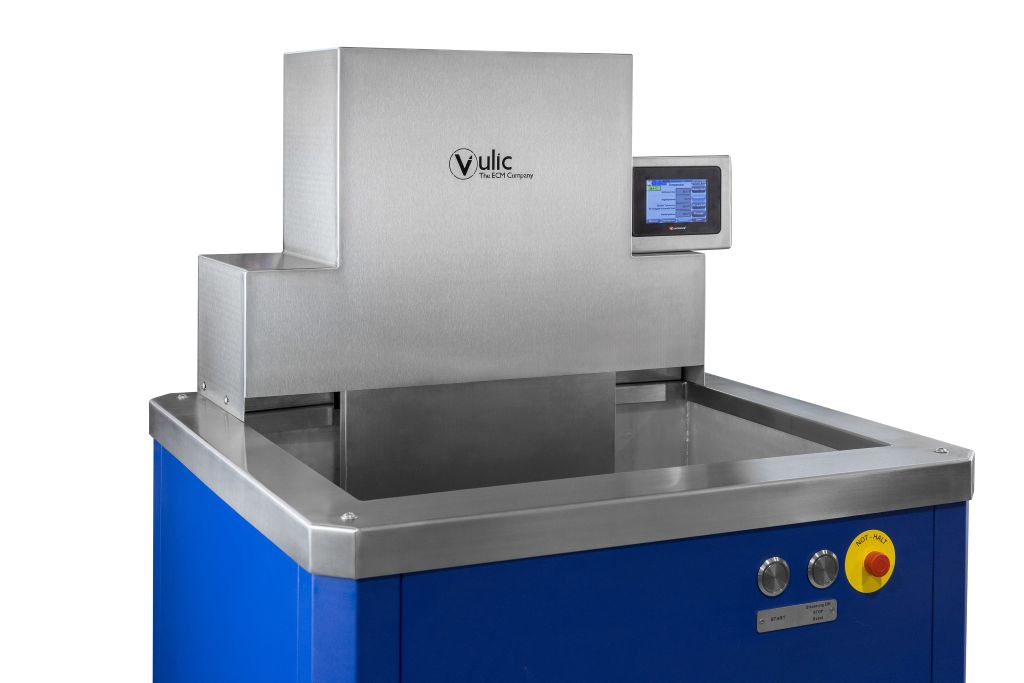
Processing and Cleaning at High Process Speed
The slightly oil-contaminated strips are unwound from the reel on the entry side and undergo a combined spray and brush pre-cleaning in the first station. In the middle module, the edge rounding occurs. At the post-cleaning station, the steel strip is sprayed off in the first zone and pulled completely into the tank filled with cleaning medium in zone 2 via a roller.
In this liquid bath, ultrasonic waves exert their effect through acoustic cavitation: The immersion transducer transmits the electrical signals generated by the generator into the liquid, creating a cycle of underpressure and overpressure. During the underpressure phases, microscopic cavities form, which collapse (implode) during the subsequent overpressure phase. This generates shock waves with significant energy, which 'blast away' particulate and film-chemical contaminations. At the same time, micro-currents develop that wash away detached or loosened impurities. Through another role, the bands enter the zone equipped with hot air drying, are subsequently protected from corrosion in the customer's conservation, and then rolled up again.
Contact: