Pain, muscle tension, fatigue – for many employees, these are everyday companions. Exoskeletons relieve the body during strenuous activities, such as overhead work. They enable people to tire less and work without discomfort. Schmalz expands its portfolio in manual handling with two versatile models.
About 18 percent of all absenteeism in Germany is caused by musculoskeletal disorders. Employees suffer from pain that limits their work capacity or often leads to absences. Companies need to compensate for this. The use of exoskeletons can significantly reduce complaints and absenteeism, as they relieve the workforce. Ergonomic workplaces have been proven to be a crucial factor for fewer sick days and thus higher operational efficiency. Powerful exoskeletons transform physical burdens into almost effortless movements while drastically reducing the risk of injury.
Two solutions, many applications
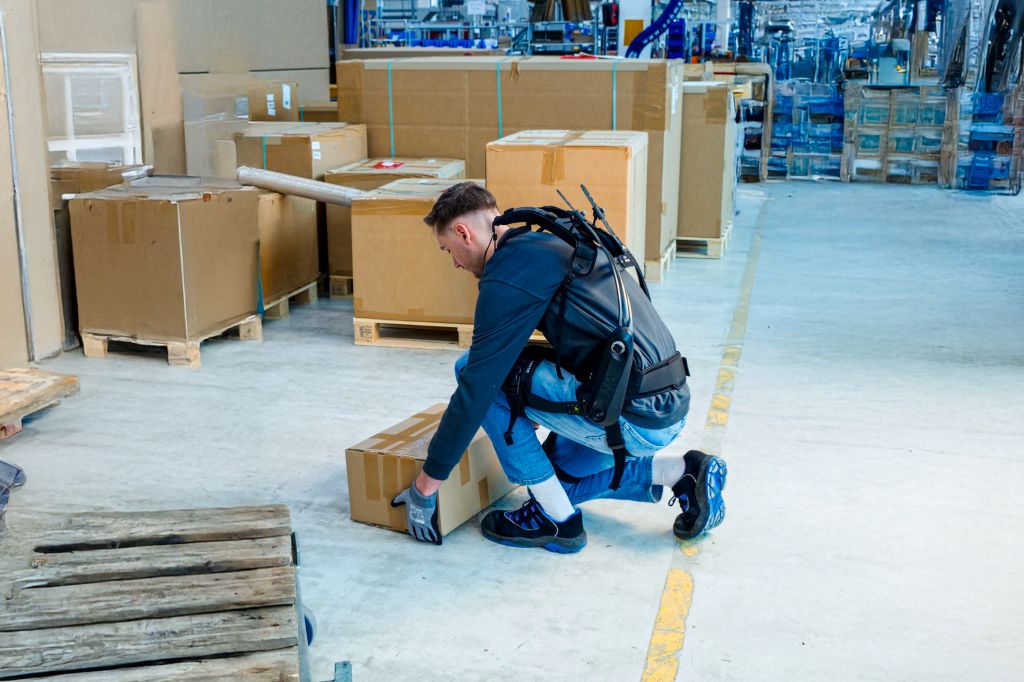
Schmalz expands its handling portfolio with two exoskeleton models for typical lifting tasks in logistics and manufacturing. The torso-bending exoskeleton MATE UBA supports the lower back when lifting and placing goods – especially during repetitive tasks, such as when employees pick from deep shelf locations. Another example is the loading and unloading of sheet metal processing machines.
For this, employees must place heavy plates on pallets or pick them up from there. Thanks to the intuitive on/off function, employees can quickly and easily operate the exoskeleton and deactivate it just as easily after completing their work.
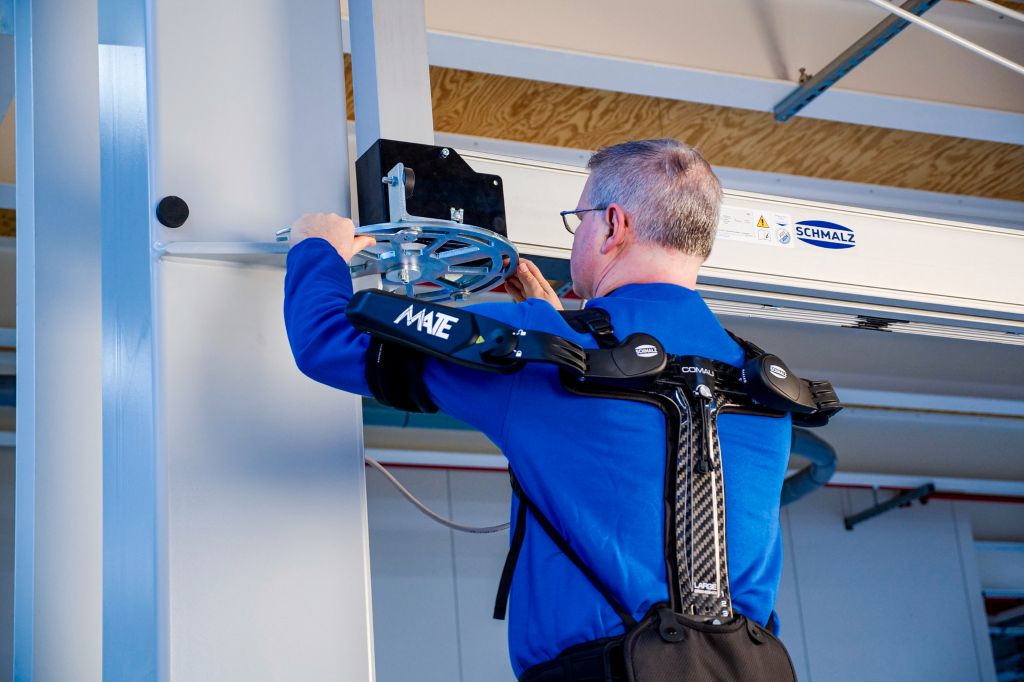
The upper body exoskeleton MATE UTA facilitates overhead tasks such as mounting drywall on ceilings or loading and unloading higher stacked freight containers. It specifically relieves the shoulder and neck muscles, supports arm lifting, and distributes forces evenly. The highlight: The lightweight yet extremely durable carbon fiber structure ensures an ergonomic and fatigue-free posture.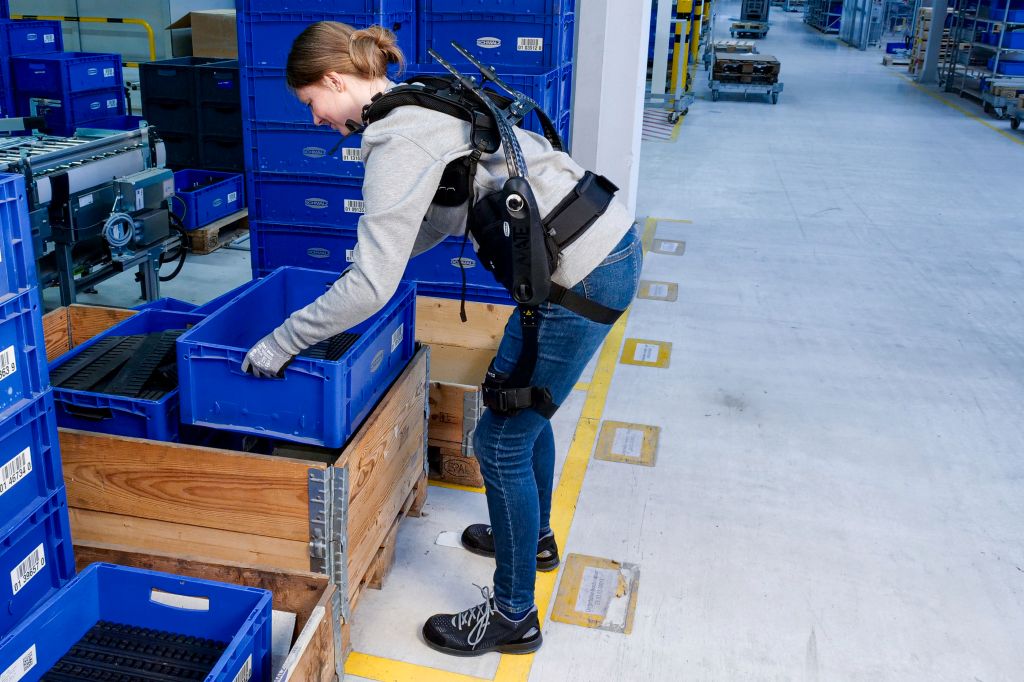
The core mechanism in both systems is the so-called Torque Generating Box (TGB), which stores and converts potential mechanical energy to facilitate rotational movements. Unlike conventional handling solutions, the exoskeletons do not require an external power source. They are lightweight, mobile, suitable for outdoor use, and support the body purely mechanically. The textile elements are washable, which maintains the longevity of the system, allows for hygienic multiple use, and increases the wearing comfort for the user.
Back health as a competitive advantage
"In not every production environment are large, automated handling devices practical or economically sensible," emphasizes Mattias Lindh, head of the handling business unit and member of the management board. "Exoskeletons, on the other hand, are flexibly deployable, individually adaptable to different users, and allow for natural freedom of movement." The lightweight design and breathable materials ensure high wearing comfort without restricting mobility. The "MATES" keep their wearers' backs free in every challenge. Thus, the human as a workforce remains the focus – strengthened, not replaced.
With the exoskeletons, Schmalz expands its portfolio in manual lifting technology. This further strengthens the company's position as a comprehensive provider of ergonomic handling solutions – from dynamic lifting systems to precise process automation to body-worn lifting solutions – offering one of the most comprehensive portfolios on the market. "Our goal is to provide the best possible handling solution for every application and thus sustainably strengthen the competitiveness of our customers," explains Mattias Lindh. "With the expansion of our portfolio, we will better meet this goal in the future."
The proven vacuum lifters and manipulators already ensure efficient workflows today, and now there is an additional relief for physically demanding tasks. "Thanks to the combination of technology, ergonomics, and productivity, companies receive comprehensive solutions from a single source – for more efficiency and less strain in everyday work," summarizes Mattias Lindh.
Schmalz at:
- LogiMAT: Hall 7, Stand C05
- BAUMA: Hall B4, Stand 325
Contact: