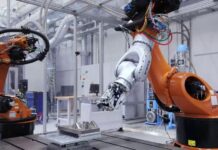
Robots are storming the healthcare market. Nowadays, robotic systems are transplanting hearts, six-axis robots are working in cell and gene therapy, cobots are assisting in rehabilitation or laboratories, and now mobile robots are advancing into aseptic areas. The development is spectacular – visitors will experience how spectacular at the leading trade fair automatica from June 24 to 27, 2025, in Munich.
All growth forecasts for robotic systems in pharmaceuticals, medicine, and healthcare point in only one direction: steeply upwards. According to Mordor Intelligence, an average annual growth of over 16 percent is expected until 2029. Although forecasts can be fraught with uncertainties, one thing is certain: the health tech sector, with all its facets, is a massive market of the future.
The topic will also be in focus at automatica 2025. At the MedtecLIVE Healthtech Pavilion in Hall A4, various exhibitors from the medical technology supply sector will present the complete value chain. The initiative will be accompanied by the MedtecSUMMIT on the second and third days of the fair in Hall B4, as well as a curated selection of relevant exhibitor solutions.
Inspired by the activities of automatica, many exhibitors will showcase proven robotics, cobot, and mobile robot solutions for health tech applications, as well as innovative assembly systems for medical devices. Stäubli Robotics is considered one of the pioneers in automation solutions for medicine and pharmaceuticals. The Swiss company introduced the world's first Stericlean robot in 2008. This groundbreaking development paved the way for the use of robots in aseptic environments.
Robots for aseptic areas
Today, Stäubli offers a complete portfolio of hygienic robots, including four- and six-axis models that meet the stringent requirements of isolators, RABS, and freeze dryers of GMP Class A and B. 'Our robots are used in nearly all areas of medical technology. For the pharmaceutical sector, we have developed a complete offering consisting of three different robot series: the latest, accessPharma, for non-aseptic applications, Stericlean for aseptic areas, and Stericlean+ for use in isolators,' says Peter Pühringer, Managing Director of Stäubli Robotics Bayreuth.
Robots that can work in sterile environments are used, for example, in cell and gene therapy (CGT), biotherapy, API research and production, laboratory automation, and other areas of the pharmaceutical industry. The range of robotic solutions for aseptic areas is still limited to a few premium providers.
H2O2 decontamination for robots is no problem
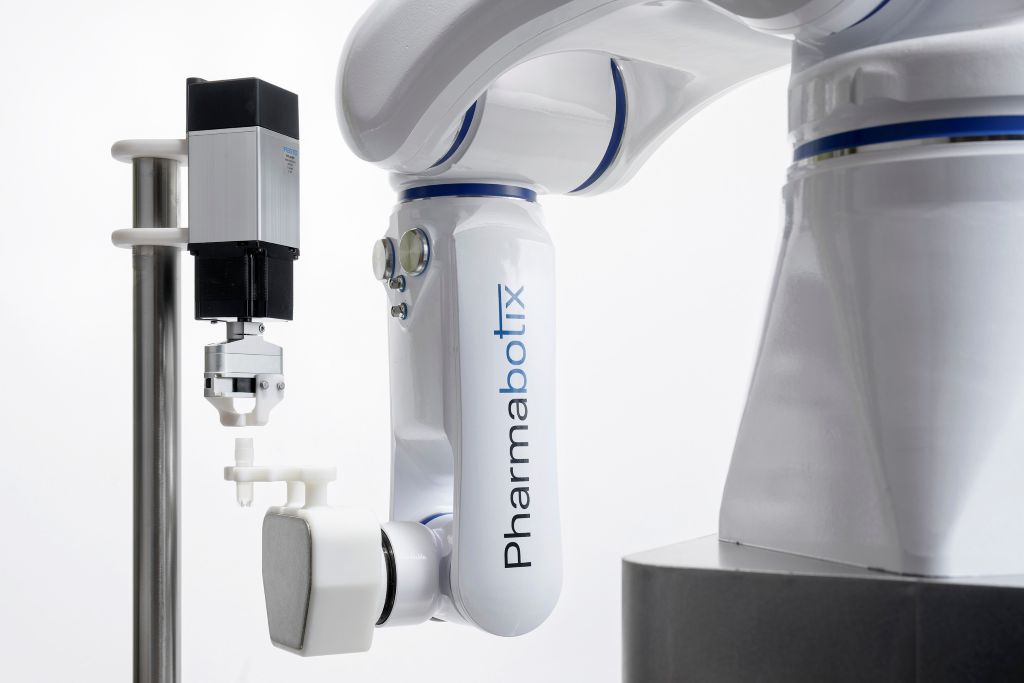
One manufacturer that is keeping up is Yaskawa. The Japanese company offers hygienic high-performance robots with the models Motoman HD7 and HD8, developed in close collaboration with the Fraunhofer Institute for Production Technology and Automation (IPA). These six-axis robots are suitable for use in GMP Class A environments.
The machines have already arrived in practice, as evidenced by a look into Switzerland. Here, Pharmabotix uses a Motoman HD8 in its CryoFiller module for the automated filling of vials for the cell and gene therapy sector. The hygienic six-axis robot handles the vials and meets the requirements for cleaning and decontamination with hydrogen peroxide very well.
Cobots and AI conquer laboratory automation
Collaborative robots also find a wide range of applications in health tech areas. Cobots are gaining increasing importance in laboratories, rehabilitation, and many other fields. The use of AI makes them highly efficient, flexible, and the perfect support for researchers, therapists, and laboratory or clinical staff.
An example of this is the Cobotta from Denso Robotics, which opens new perspectives for robot-based automation in laboratories. The Cobotta is at the center of an innovative laboratory concept from the Hamburg startup bAhead.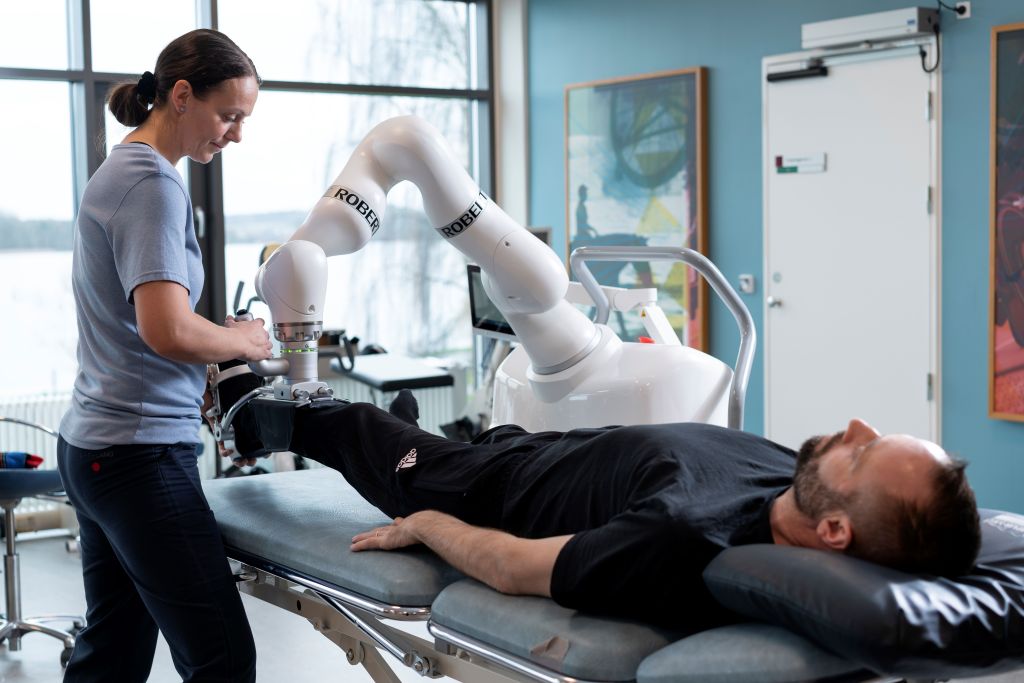
'For the first time, we are combining three disruptive technologies in the laboratory sector – cobots, drones, and AI. All components of the system are cost-efficient, multifunctional, and precisely coordinated and centrally managed through swarm intelligence,' explains bAhead founder and CEO Rainer Treptow. 'This creates a completely different dynamic than with conventional laboratory automation, especially for laboratories that need to automate despite small sample sizes.'
Rehabilitation robot Robert relieves caregivers
A completely different mission is pursued by the robot Robert®. He is responsible for mobilizing patients after surgical procedures or strokes. The groundbreaking solution from the Danish manufacturer Life Science Robotics features an LBR Med from KUKA, which, thanks to its medical pre-certification, is ideally suited for integration into the medical device. 'With our solution, we want to help mobilize patients faster and more efficiently while relieving caregivers,' says Keld Thorsen, CEO of Life Science Robotics.
And this is how the robot works simply: The caregiver connects the robot arm, for example, to the patient's leg. A press of the start button and Robert lifts the leg slightly. Now the caregiver can manually perform the therapeutically meaningful movements. Robert records this movement and subsequently performs it exactly according to the specification independently and repeatedly.
Even more flexible manufacturing of medical devices
But not only robots dominate the scene in the medical and pharmaceutical sector. At automatica, renowned providers who are dedicated to the series production of medical devices also present themselves. Inhalers, injection pens, autoinjectors, or syringes – the production of such products remains the domain of specialists due to the requirements for patient safety.
In addition to Teamtechnik, BBS Automation, Kahle, and Hekuma, all four of which are now under the roof of Dürr AG, Mikron Automation is also one of the established providers of Medtech platform solutions. Where the development is headed is underscored by Mikron with the assembly platform Maia. While the Swiss were previously known for developing powerful assembly solutions for mass production, they are responding with this semi-automatic platform to the market's demand for more flexibility. With Maia, different medical products from a product family, such as pen injectors or autoinjectors, can also be efficiently assembled in smaller batches.
Mobile robots are advancing into aseptic areas
Various application fields in healthcare can only be automated with mobile robots. These include supporting people in need of assistance, as well as new concepts for transport and handling tasks in the pharmaceutical factory of the future.
Exhibitors at automatica also demonstrate groundbreaking AGV and AMR solutions for such tasks. It only becomes problematic when mobile robotic systems are to be used in sterile environments, as there has been no solution for this until now. That is changing now: Stäubli Robotics has introduced the platform solution Sterimove. This is a completely encapsulated vehicle, the only one of its kind in the world, certified for sterile environmental conditions.
Contact: