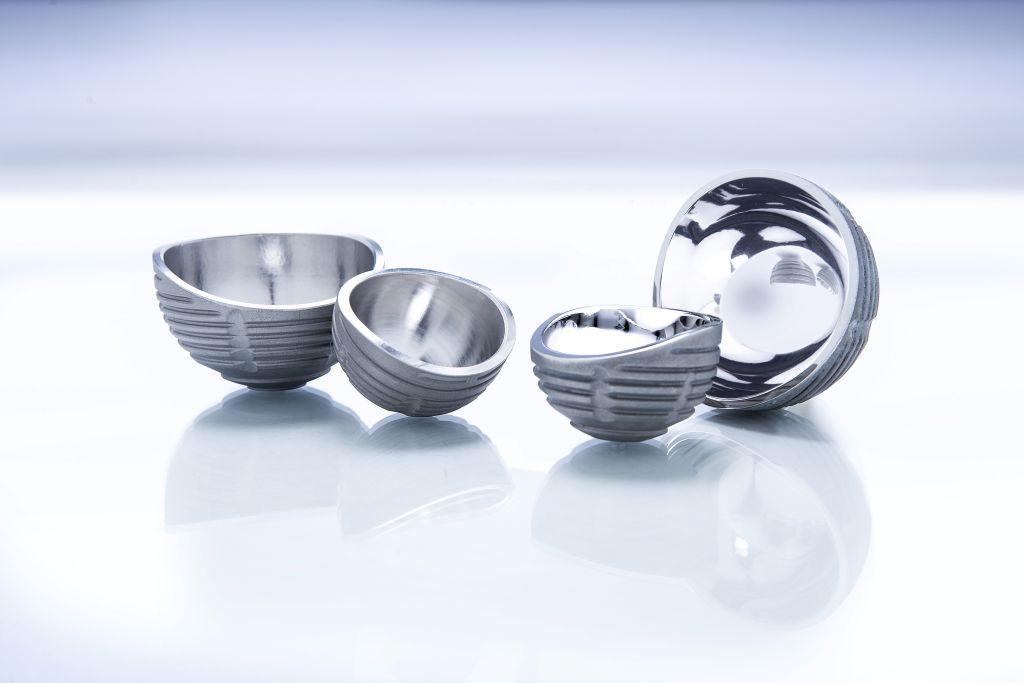
For most manufacturers, CNC-based processes are still the first choice for grinding and polishing the inner areas of acetabular cups. However, with the use of vibratory finishing in a vibratory machine and a specially developed clamping device for this application, a significantly more economical process is available that is less labor-intensive and easily and reproducibly achieves the required roughness values. Rösler Surface Technology has developed a two-stage process that allows up to 35 acetabular cups to be processed simultaneously. This is made possible by a specially designed workpiece holder.
Acetabular cups or acetabular cups for 'Dual Mobility' applications are typically made of cobalt-chromium or titanium, manufactured through machining, and then receive an initial surface treatment through fine grinding or fine turning. After this machining process, the Ra value of the raw parts usually lies in a range between 1 and 0.6 µm. However, for use in the human body, the roughness value must be significantly lower, namely at a maximum of 0.05 µm. Only in this way can it be ensured that the acetabular cup functions optimally, is sufficiently lubricated with body-own lubricants, and no increased friction occurs between the PE insert and the metal cup.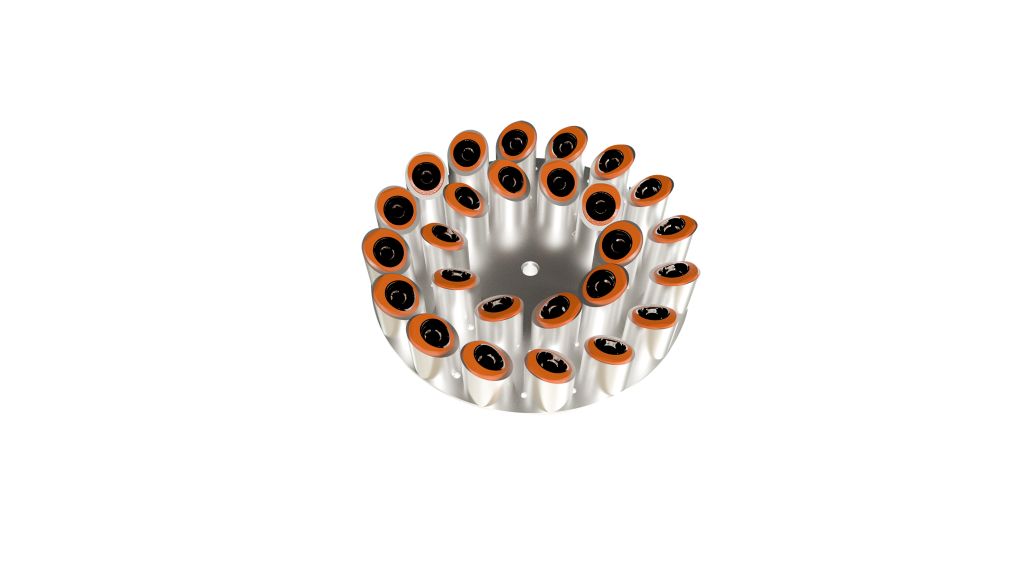
Grinding of inner surfaces as a processing challenge
For the vibratory finishing technique, the particular challenge in this processing case is not in achieving the required roughness value, but in the critical position of the surface to be processed inside a hemisphere. This represents a so-called scooping geometry, which the grinding media cannot actively follow.
With free movement of the workpieces in the processing container, the inner spaces would fill with grinding media; however, effective processing would only occur on the outer surfaces, as no sufficient relative movement occurs inside.
In this specific case, Rösler can leverage its complete experience in surface processing and specifically in vibratory finishing and also benefits from in-house development and manufacturing. 'We process the acetabular cups in a vibratory machine in a dome-less design. These systems were originally developed for the aerospace industry, where high-quality and complex components must be processed particularly gently on the material while achieving high removal rates. This special design of the processing container differs from a classic vibratory machine in that the motor is not located in the center dome of the processing container but on the outside of the working container. This creates space inside for a clamping device with a unique inlay, in which the acetabular cups can be securely fixed,' explains Michael Striebe, Global Sales and Process Expert at Rösler. Thus, the relative movement is also transferred to the inner areas of the acetabular cups, and the grinding and polishing process can be started.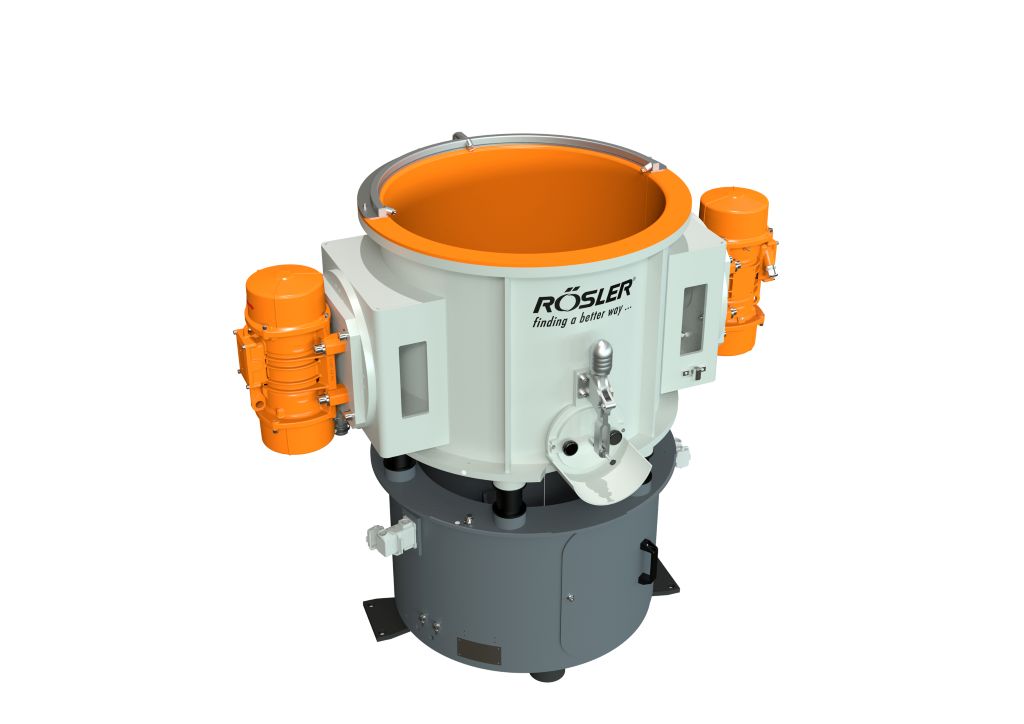
As processing media, Rösler uses specially developed plastic grinding media for medical technology as well as a dry polishing agent. The grinding media are designed so finely that very low surface roughnesses of under Ra 0.05 µm can be achieved in pre-grinding. The homogeneous and fine structure thus provides the perfect surface for final polishing. The roughness is then improved to 0.02 µm or below. The processing time depends on the base material used and the condition of the raw part.
Vibratory finishing as a more economical alternative to robot finishing
While polishing and grinding of acetabular cups by robots is generally fast, significant effort arises from programming, process monitoring, and wear compensation for each individual component. Robot polishing means that each workpiece must be individually picked up and clamped. A separate, precisely defined robot program is required for each part size. Additionally, there is tool wear: whether polishing tool, brush, or other special tools, the removal rate changes continuously, and this wear must be taken into account in the process. The robot itself cannot compensate for this, as it merely follows a predetermined path. The same applies to manual finishing, which, while also fast, is completely uneconomical. The risk of irregularities in quality is another risk, as the operator cannot always maintain the same processing parameters, and experienced personnel for these processing tasks are becoming increasingly difficult to find.
In contrast, with vibratory finishing in a dome-less vibratory machine, after loading the system, only the processing time needs to be defined; the machine takes over the rest of the process itself. No operator or additional automation is required – the system only needs grinding or polishing media, water, and electricity. The wear of the grinding medium has no impact on the processing result in this method. Only the fill level in the system must be kept constant.
'The result is a more consistent and overall higher surface quality with more uniform structures,' explains Michael Striebe, who has been supporting medical technology customers for about ten years in his role as Global Sales and Process Expert at Rösler: 'From experience, I believe that the vibratory finished surfaces are finer and of higher quality, which is particularly evident in that we regularly significantly undercut the required roughness values. Depending on the initial roughness, surface results of Ra 0.01 µm are possible – while adhering to all shape tolerances. An extraordinary quality that underscores the efficiency and effectiveness of this process.'
Process monitoring and efficiency increase through digitization
In surface processing processes in medical technology, especially when it comes to implants, not only the economic efficiency of the process and the consistent adherence to defined roughness values and shape tolerances are in focus. In addition to the reproducible achievement of the required surface quality, the entire processing process must also be fully traceable and completely documented in its creation, stability, and repeatability. Comprehensive part and process monitoring is a central requirement for validated and audit-compliant manufacturing processes.
These requirements can be fully met with the current version of the digitalization software Rösler Smart Solutions (RSS) Comfort. The software automatically monitors and digitizes the process water quality, independently takes samples at defined intervals, documents the measurement results, and automatically compensates for deviations through the targeted addition of defined additives. This ensures a permanently stable process water quality, supports the reproducibility of processing results, and guarantees consistently high quality of the processed components. If the system identifies additional action needed, it informs the operator and provides a clear, documentable course of action. All subsequent adjustments are also documented and can be traced at any time.
Future-proof solution, tailored for the industry
With the development of this efficient grinding and polishing process in the bowl-less vibratory finishing machine, Rösler offers an economical alternative to traditional robot or manual polishing. The high personnel requirement for manual polishing is reduced by about 70-80% in vibratory finishing, with only the loading still needing to be done manually. High reproducibility, outstanding surface quality, and the possibility of digital process monitoring and control through Rösler Smart Solutions (RSS) Comfort make this process a future-proof solution for the precise machining of die-cast pans. 'In developing the machining process, we closely examined the pain points of conventional methods and tailored our solution precisely to these,' explains Michael Striebe. 'This was only possible due to the combined expertise in mechanical engineering, process development, and tool production, which are all united under one roof at Rösler. The future of die-cast pan machining lies in the bowl-less vibratory finishing machine.'
Contact: