
Whether in medical technology, telecommunications, or aerospace: the demand for high-performance lasers is increasing in many industrial sectors. Users are focused on the cost-effectiveness and stability of the systems. The Fraunhofer Institute for Laser Technology ILT has now made significant progress in the development of efficient and stable high-power diode lasers. Essentially, it has transferred the writing of fiber Bragg gratings from the world of fiber lasers to diode lasers. Dr. Sarah Klein developed the process as part of her doctoral thesis and recently won 3rd place at the prestigious Hugo-Geiger Prize.
Using fiber Bragg gratings (FBG), the complexity of fiber laser systems can be significantly reduced. When the optical gratings are inscribed directly into the fiber, they can replace external resonator mirrors. This eliminates the need for complex mirror alignment. While system complexity, susceptibility to interference, and costs decrease through direct fiber integration, the brilliance of the emitted laser radiation increases.
Concept for Fiber Integration
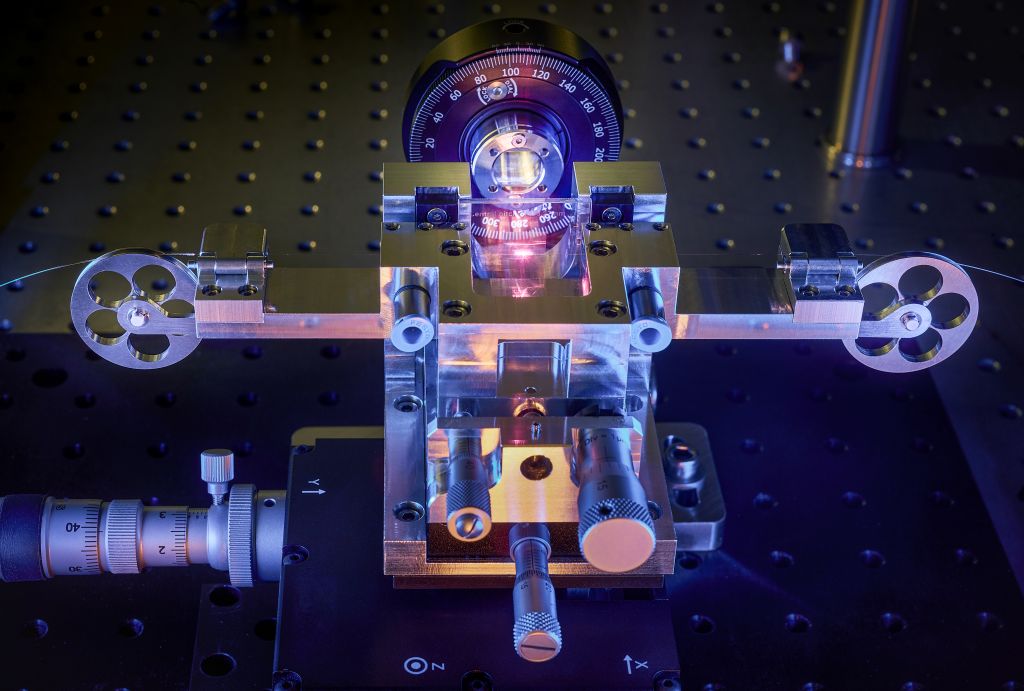
The established method for introducing FBG into the interior of optical fibers with a core diameter of six micrometers was further developed with significant involvement from Fraunhofer ILT in 2019 as part of the BMBF funding project EKOLAS. Coordinated by Laserline, the consortium succeeded in writing fiber Bragg gratings using UKP lasers into quartz fibers with a core diameter of 100 micrometers: The material briefly melts under the influence of the ultrashort laser pulses, cools down very quickly, and changes its optical properties in the processed volumes. The introduced structure is based on an interference pattern designed for this purpose of overlapping light waves.
A single FBG with a diameter of 100 micrometers is sufficient to integrate the previously external resonator mirrors into the fiber and optimize multimode fiber lasers in many respects. This method, further developed by Dr. Sarah Klein, has also been transferred to fiber-coupled diode lasers as part of her doctoral work and was awarded 3rd place in the prestigious Hugo-Geiger Prize for her research on February 19, 2025, which is awarded annually by the Free State of Bavaria and the Fraunhofer Society.
Same Concept – New Objective
In her work, Klein also addressed the optimization of diode lasers needed for pumping solid-state lasers, which changes the objective. Unlike fiber lasers, the FBG in this application serves to improve the spectral properties of the diode laser radiation. Background: To raise the energy level of the laser-active medium during optical pumping, it is excited with a specific wavelength. Only then can the medium optimally absorb this radiation.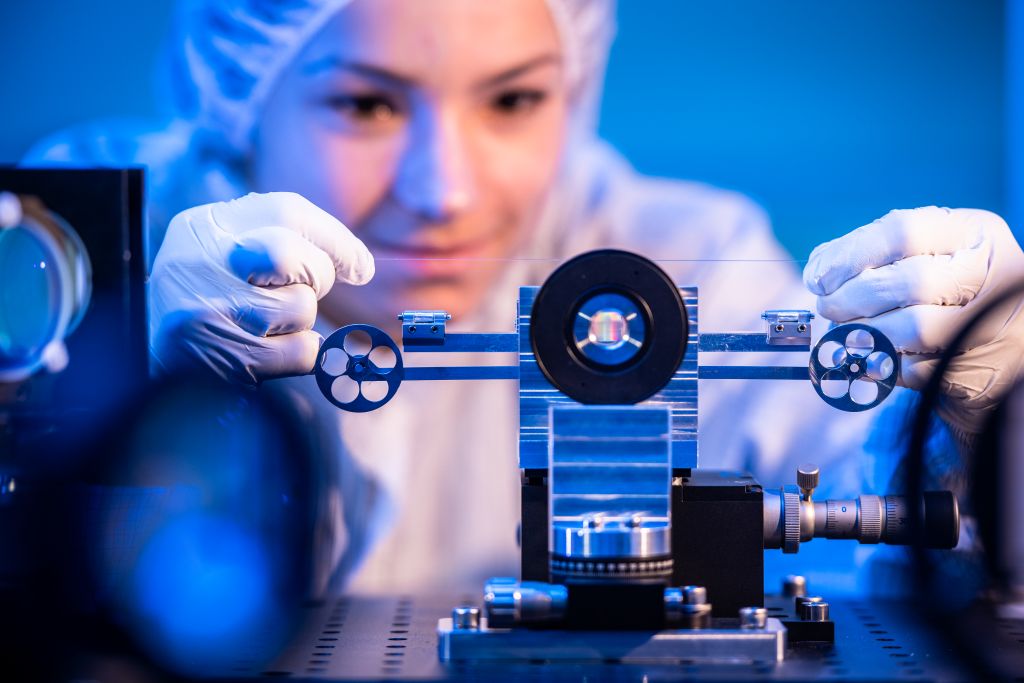
However, diode lasers emit broadband. Therefore, the researcher developed a concept to specifically reduce the bandwidth and stabilize the wavelength of the laser radiation. Central to this approach is again a directly inscribed fiber Bragg grating. It ensures that the high-power diode lasers used only emit the desired wavelength. This increase in brilliance makes the energy input into the solid-state laser significantly more efficient and thus more cost-effective. An enormous advantage for industrial applications, where cost-effectiveness and energy efficiency play an increasingly important role!
Complex Integration
Klein advanced the development of the method as part of a self-initiated project of the Fraunhofer Society. Here, as in the EKOLAS project, it was also necessary to inscribe the optical gratings into multimode fibers used as waveguides for diode lasers. 'Normally, laser technology is about miniaturization. In my research, it was exactly the opposite,' she explains. She had to transfer the UKP process from six micrometers core diameter to up to 100 micrometers. The challenge lay in the details: the seamless and precise alignment of the FBG segments was extremely complicated to implement. Energy management was also very challenging. To inscribe the many gratings into the significantly larger multimode fibers in one step, she would theoretically have had to multiply the energy input. However, this option was ruled out from the outset.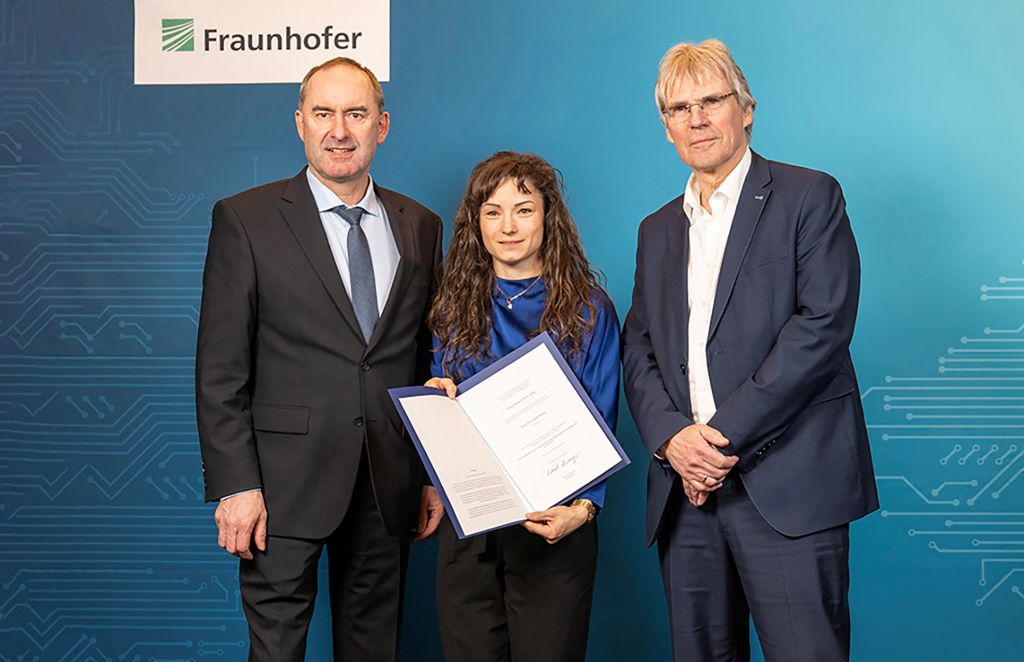
Klein mastered the challenge by sequentially inscribing over a dozen FBGs, each only six micrometers in size, in several exposure processes. It was crucial to work seamlessly. 'The writing process would have been much easier with a square core geometry,' she reports. Inscribing the FBGs to the outermost edges was extremely complicated in the required precision. However, for maximum reflectivity of the grating for an efficient resonator design of the fiber laser, this seamless precision was indispensable.
When transferring this concept for the frequency stabilization of diode lasers, the focus was on designing the FBG properties so that the diode laser only emits a desired wavelength. In this case, Klein no longer aimed to maximize the FBG reflectivity. Instead, she specifically adjusted the FBG properties to optimize the spectral characteristics of the diode laser radiation, for example, for pumping applications.
Awarded the Hugo-Geiger Prize

For multimode lasers, the optical design of FBGs and their direct inscription in the UKP laser process have been scarcely researched until now. The newly minted Hugo-Geiger Prize winner changed this once and for all with her dissertation 'Fiber Bragg Gratings for the Frequency Stabilization of Multimode High-Power Laser Diodes and Fiber Lasers'. 'I am very pleased about this important award! It shows me that I was right with my idea to transfer the established concept for single-mode fiber lasers to other laser sources,' Klein explains.
In addition to this confirmation from the prestigious award, she also receives full recognition for her research at her institute. 'We congratulate Dr. Sarah Klein on this award, which underscores the high scientific quality of her work. Based on the insights gained, external optical elements can be eliminated in the future for multimode diode lasers, thereby reducing system complexity, assembly efforts, susceptibility to interference, and costs. At the same time, the new possibility for spectral stabilization of these light sources expands their application potential – whether as highly efficient pump sources or as light sources for communication technology, sensor technology, and direct laser material processing in industrial production,' says Dr. Jochen Stollenwerk, acting head of Fraunhofer ILT.
WORLD of PHOTONICS CONGRESS 2025 in Munich
Interested parties can learn more about the latest developments in high-performance diode lasers at the WORLD of PHOTONICS CONGRESS from June 22 to 27, 2025, in Munich. Dr. Klein will moderate the Application Panel 'High-Power Diode Lasers – new milestones in power, spectrum and efficiency' on June 26 starting at 3 PM.
Contact: