
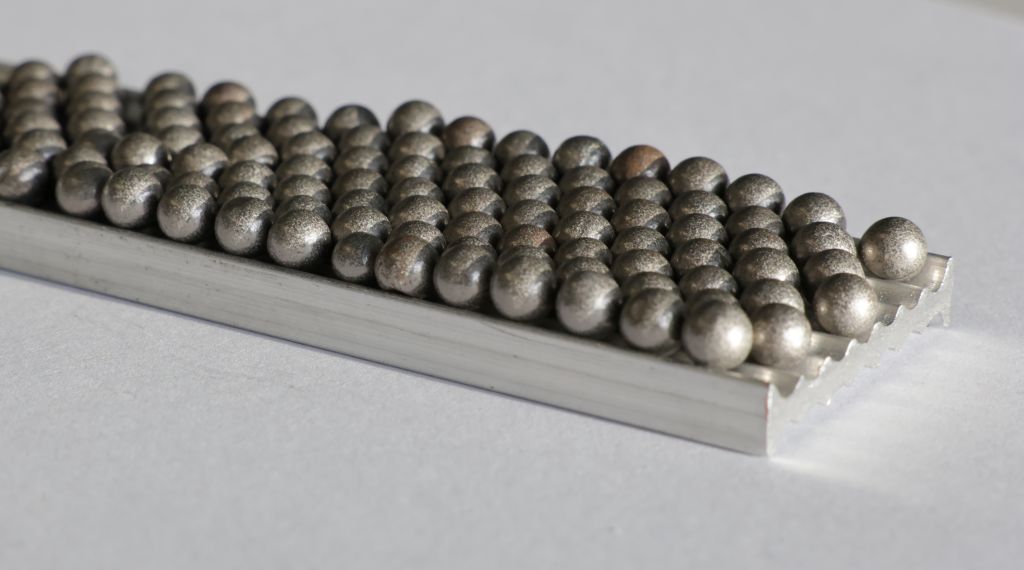
The Fraunhofer Institutes for Machine Tools and Forming Technology IWU and for Manufacturing Technology and Applied Material Research IFAM have achieved a breakthrough in material research: The composite material HoverLIGHT sets new standards for the construction of machine tools. By combining aluminum foam and particle-filled hollow spheres, HoverLIGHT achieves an unprecedented mix of properties in terms of lightness, stiffness, and vibration damping. In a joint project with an industrial partner, it has now been demonstrated for the first time that HoverLIGHT dampens vibrations in series machines by a factor of 3 better. And this with a weight saving of 20 percent compared to the original assembly.
Lighter, more precise - the advantages of HoverLIGHT
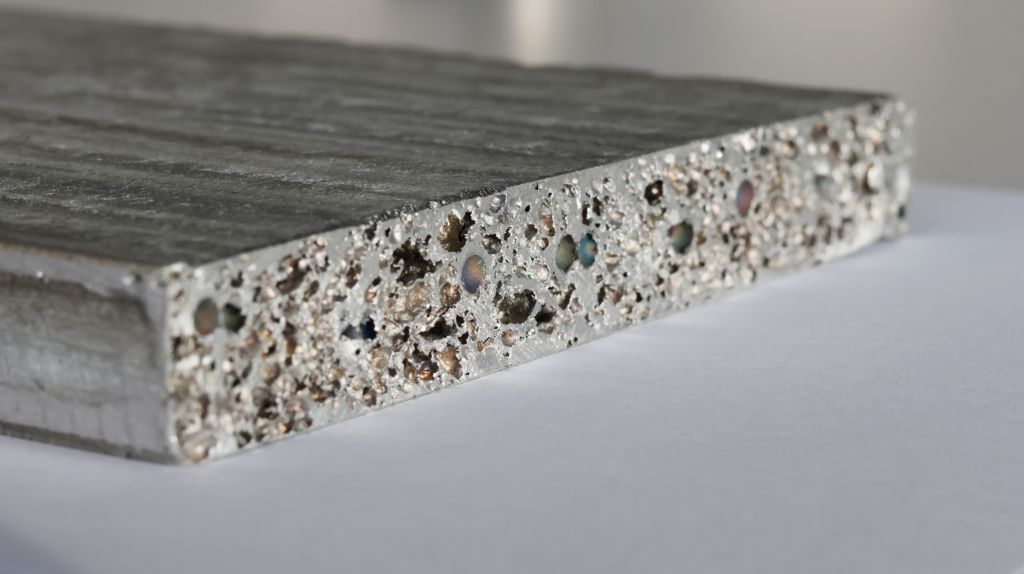
HoverLIGHT is a composite of metal foam and hollow spheres and can serve as a core for sandwiches. The sandwich principle results in significant weight reduction, and the HoverLIGHT core guarantees high damping: The aluminum foam with the integrated hollow spheres dampens vibrations significantly more than previously used material composites. This leads to higher precision in machining and a longer lifespan of the machine.
The sandwich construction also allows for significant weight savings - this enables higher dynamics in the machining processes. HoverLIGHT can be adapted to the specific requirements of various applications.
Successful application in practice
In a joint project with the Chiron Group SE, HoverLIGHT has already been successfully used in the cross beam of a milling machine. The results are impressive:
- Weight reduction of 20 percent: The cross beam made of HoverLIGHT is significantly lighter than the comparable assembly made of conventional materials.
- Significantly higher damping: Vibration damping has been increased threefold, leading to higher precision and longer tool life.
- Increased productivity: Due to higher speed and precision, machines equipped with HoverLIGHT cross beams can produce more parts in a shorter time.
Dr.-Ing. Jörg Hohlfeld, responsible for the metal foam research area at Fraunhofer IWU: "With HoverLIGHT, we have developed a material that pushes the boundaries of what is possible in vibration damping. We resolve the conflicting goals that arise from the actually opposing requirements of a rigid design of modern machine tools, lighter moving assemblies, and effective vibration damping."
In machine tools, all moving assemblies are predestined for the use of HoverLIGHT, such as machine slides. However, there are also numerous application possibilities outside of mechanical engineering - where lightness, stiffness, and precision are particularly important.
-
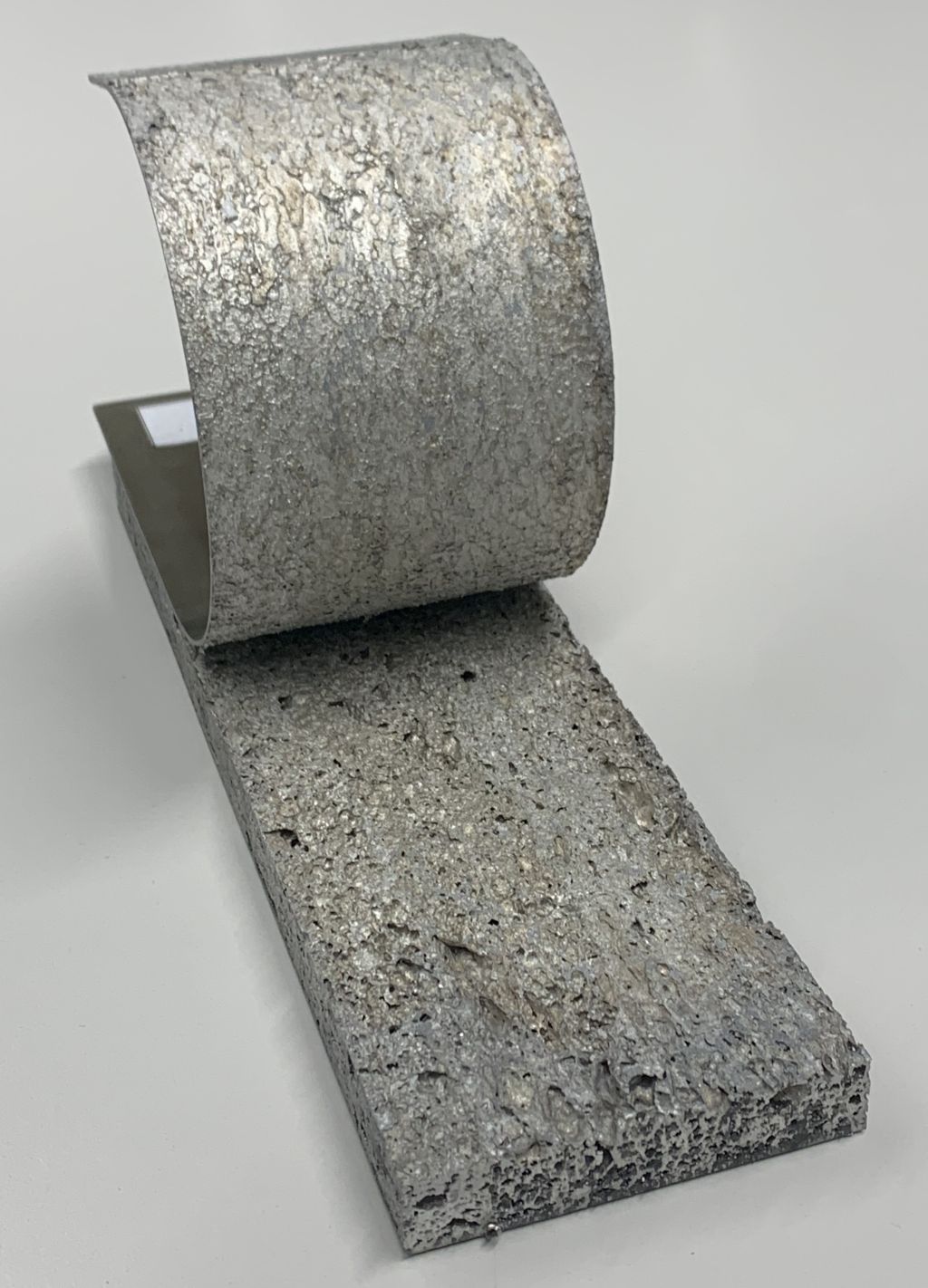
Holds: The drum shear test according to DIN 53 295 proves that cover plates and sandwich cores form a stable connection. © Fraunhofer IWU Robot arms constructed in sandwich design would benefit from high stiffness at low mass, as lower weight allows for higher speeds and accelerations.
- Reinforcement structures made of aluminum foam are already used in crash structures of series automobiles, but without particle-filled hollow spheres, whose primary role is to reduce vibrations. Foam structures are sufficient for energy absorption.
- In rail vehicles, wall and floor elements are suitable for the use of HoverLIGHT; in the Beijing subway, the floor plates are constructed as sandwiches with aluminum foam cores - for better damping at lower weight.
- In servers and high-performance computers, lightweight and stiff housings are necessary to ensure stability and heat dissipation while damping vibrations.
- Medical technology applications such as MRI or ultrasound devices rely on lightweight and stiff designs; only in this way can precise measurements be guaranteed and vibrations that impair image quality minimized.
The next goal: attractive manufacturing costs
Researchers are continuously working to further develop HoverLIGHT and expand its application possibilities. The aim is to adapt the properties of the composite material to the requirements of additional applications and to reduce its manufacturing costs through industrialized processes. The production of hollow spheres is complex, energy-intensive, and not yet reproducible. A promising approach is to use metallic blisters that are easier and thus cheaper to produce instead of hollow spheres - similar to those in medication packaging. The Fraunhofer team is confident that significant cost progress can be achieved within a few years.
Contact: