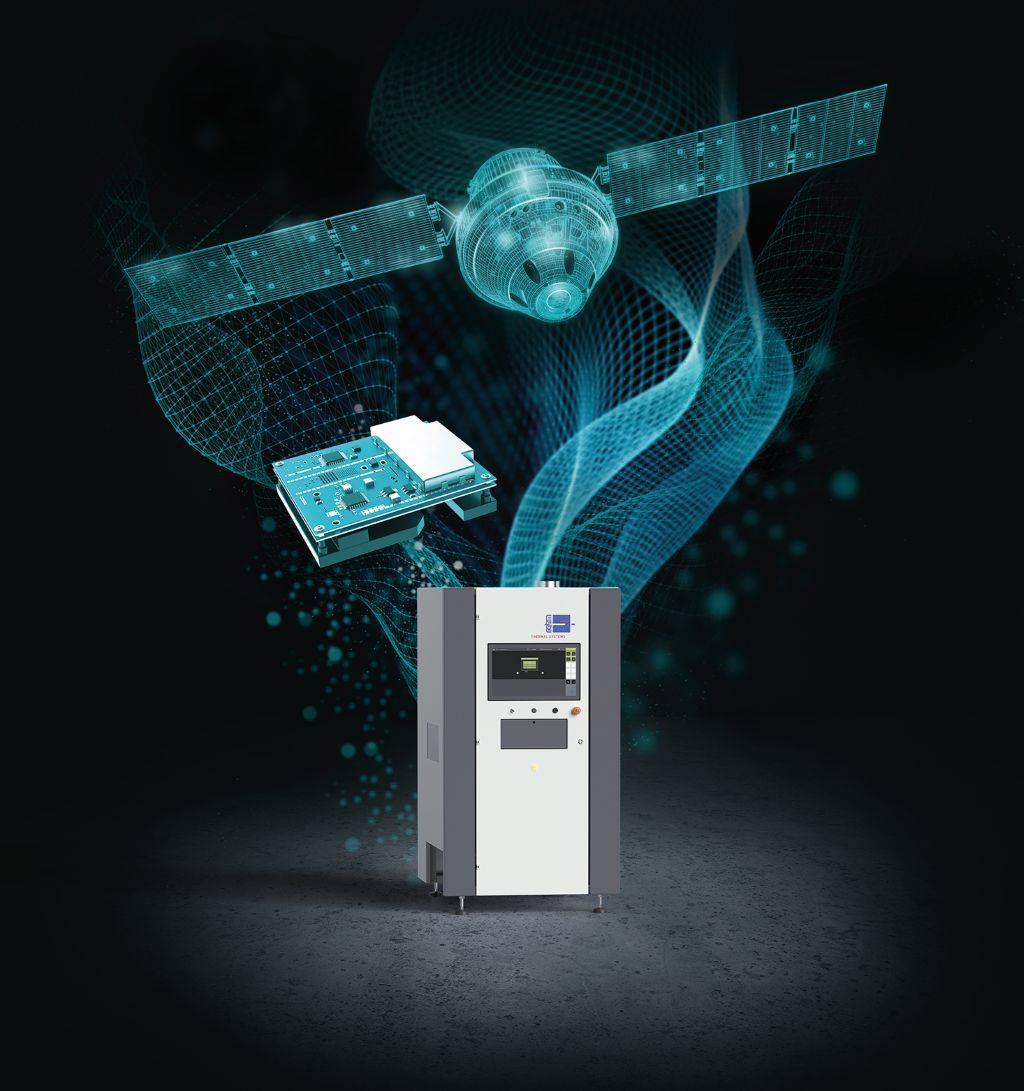
UV-LED technology is becoming a key technology for electronics manufacturing when protective coatings, adhesives, or potting compounds need to be cured quickly, reproducibly, and energy-efficiently. With the RDS UV LED, Rehm Thermal Systems transfers the advantages of modern LED radiation sources into a compact, inline-capable oven concept. The system has been developed for high-precision curing processes and combines short cycle times with controlled, homogeneous exposure as well as a significantly improved energy, space, and cost balance.
Compared to classic UV systems with mercury vapor lamps, UV-LED technology operates without warm-up time, is immediately ready for operation, and can be precisely regulated. It is mercury-free, does not produce ozone at the relevant UVA wavelengths, and reduces heat input into the assembly. This offers clear advantages for future-proof manufacturing, especially for temperature-sensitive components, increasing sustainability requirements, and the growing importance of traceability.
Stationary Full-Surface Exposure as the Core of the Process
The central process principle of the RDS UV LED is stationary full-surface exposure. While inline systems can be influenced by transport dynamics, conveyor speed, and position-dependent dwell times, the circuit board is fixed in position during the defined exposure time and irradiated simultaneously over the entire activated area. This creates reproducible conditions: exposure time, intensity, working distance, and active segment areas are clearly definable and recipe-able.
Especially for assemblies with different component heights, this concept strengthens process reliability. Distance and alignment remain constant during the exposure step; shadow areas and fluctuations due to relative movement are reduced. For users, this means uniform curing across the entire usable area and thus high coating quality – even with demanding layouts and sensitive coating systems.
Homogeneity through Segmentation and Targeted Overexposure
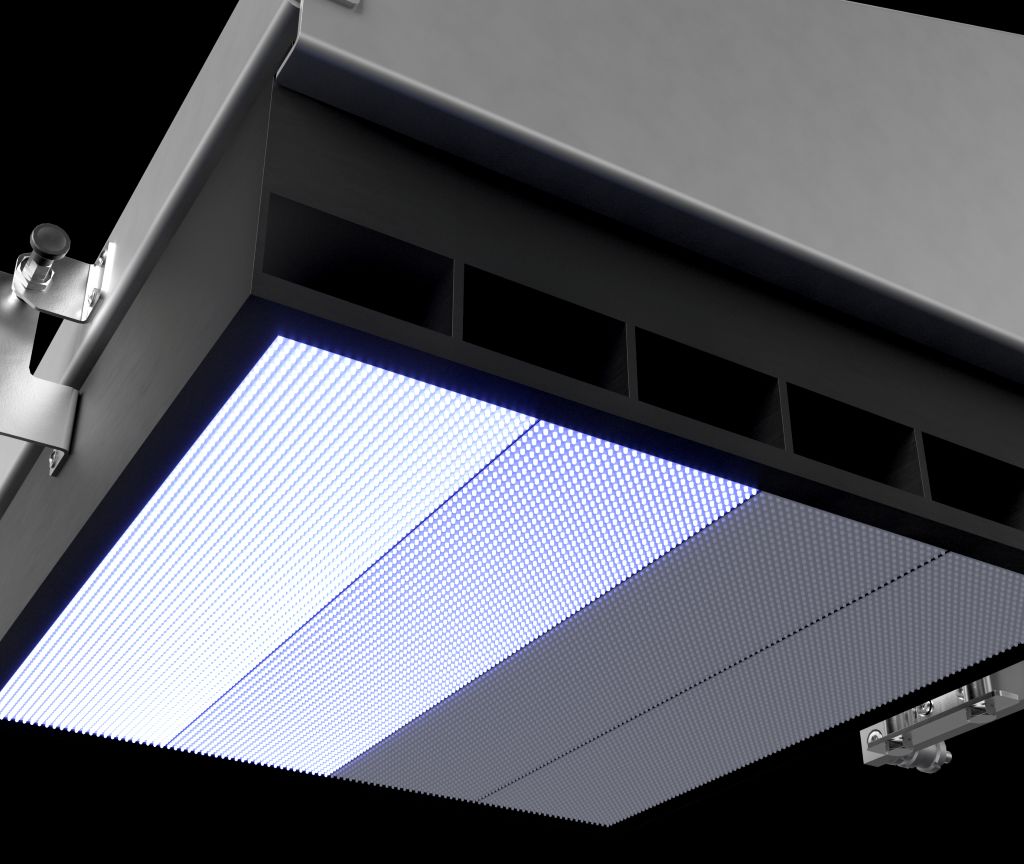
The RDS UV LED operates with a UV-LED exposure field of 500 x 500 mm. The LED light source consists of four separately controllable segments, each 125 mm wide, which can be activated depending on the defined circuit board width. This activates only the area that is actually needed. It reduces unnecessary energy input outside the usable area and supports a gentle thermal process management.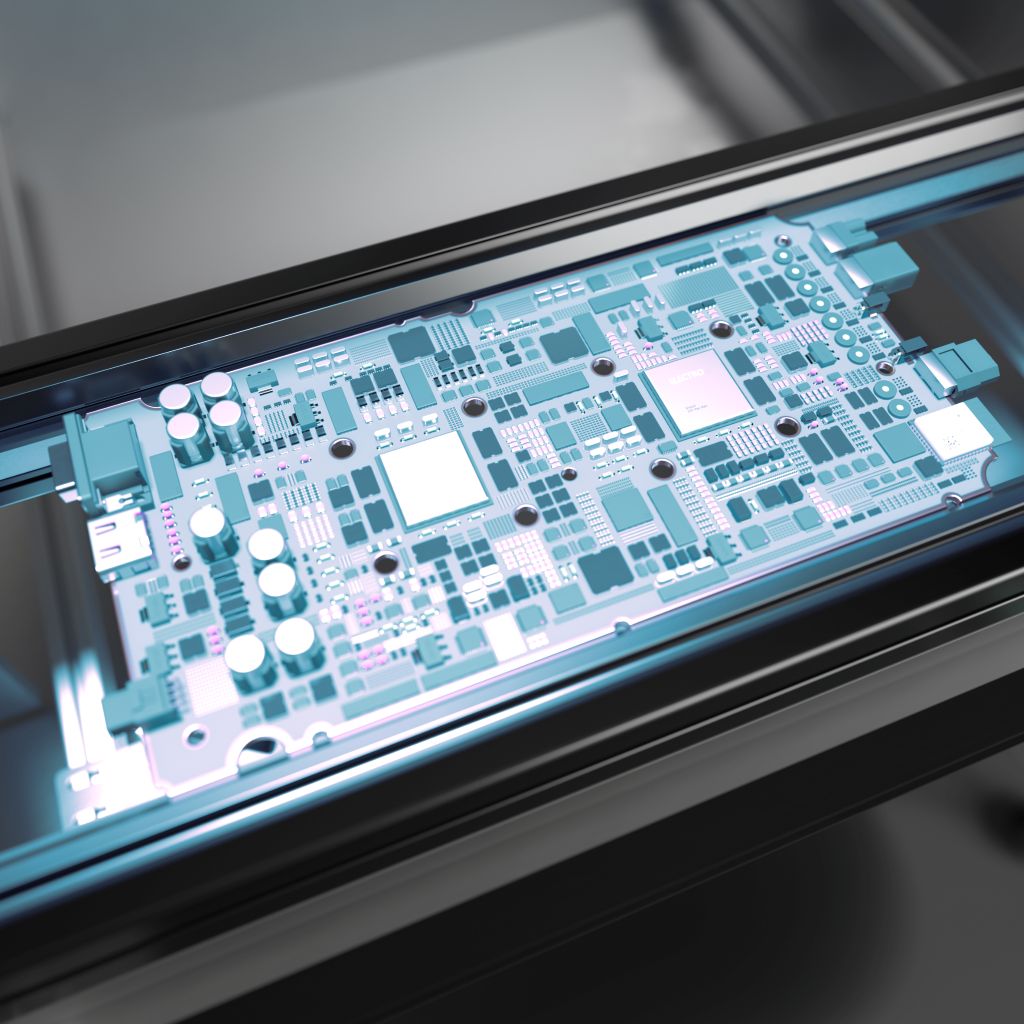
For the quality of UV curing, not only the maximum intensity is crucial, but also the uniformity of the radiation distribution. Therefore, the system concept includes targeted overexposure of the circuit board edge: For a circuit board size of up to 410 x 410 mm, 45 mm overexposure is available on each side. This places the assembly in the particularly homogeneous area of the exposure field with a homogeneity distribution of up to 95%. Optionally, the system can process circuit boards up to 500 x 500 mm; when fully utilizing the exposure field, edge homogeneity must be evaluated application-specifically.
Defined Wavelengths for Controlled Curing
UV-LED systems emit not a broad spectrum but defined wavelengths. The RDS UV LED is designed for modules with 365, 385, 395, or 405 nm. This allows the irradiated energy to be precisely matched to the respective coating or adhesive system. The selection of the appropriate wavelength depends on photoinitiators, layer thickness, and material approval. Rehm Thermal Systems points out that switching from broadband UV to UV-LED is not a simple lamp exchange: for stable results, wavelengths, dose, intensity, homogeneity, temperature management, and material chemistry must be validated together.
The precise controllability of UV-LED technology opens up a very robust process window. Since LED modules reach full power without warm-up time, they can be activated with cycle accuracy and put into standby mode during breaks. This reduces energy consumption and simplifies process control. At the same time, the long lifespan of the LED modules of over 20,000 operating hours reduces maintenance effort and increases system availability.
Compact, Integrated, and Industry 4.0 Ready
The RDS UV LED has been developed for the requirements of modern electronics lines. In semi-batch operation, the system combines the advantages of stationary exposure with the requirements of inline manufacturing and enables cycle times of just a few seconds. The automatic transport width adjustment covers 50 to 508 mm. The system is designed as an inline solution and is prepared for integration into digitized manufacturing concepts.
Traceable process values include exposure time, intensity, active UV-LED segments, segment temperatures, operating hours, and system status messages. Through interfaces such as SMEMA, Hermes, or MES connection, the curing process can be linked with quality-relevant production data. The user-friendly ViCON software supports operation via touch functions and provides central system and process information in a clear manner.
Sustainability with Economic Benefits
In addition to process quality, the drying system RDS UV LED addresses central economic and sustainability goals. The UV-LED technology enables up to 70% lower energy consumption compared to conventional UV lamps and up to 70% less footprint. The exhaust air volume is at 500 m³/h, significantly lower than many classic systems. Since no mercury-containing emitters are used and no ozone is generated, the oven supports environmentally friendly and legally compliant production processes.
"With the RDS UV LED, we think of UV curing as a controlled process – not just as a light source," says Manuel Schwarzenbolz, Research & Development Rehm Thermal Systems. "Stationary full-surface exposure, segmentation, homogeneity management, and digital process data create the basis for reproducible quality, short cycle times, and resource-saving electronics manufacturing."
Product Information RDS UV LED at a Glance
The RDS UV LED cures UV protective coatings, adhesives, and potting compounds quickly, evenly, and resource-efficiently. Core elements include a 500 x 500 mm UV-LED panel, four segments of 125 mm each, defined wavelengths of 365, 385, 395, or 405 nm, stationary full-surface exposure, overexposure of up to 45 mm on each side for high edge homogeneity, low heat load, LED modules with over 20,000 operating hours, automatic transport width adjustment from 50 to 508 mm, ViCON user interface, and inline, MES, and Hermes compatibility.
Contact: