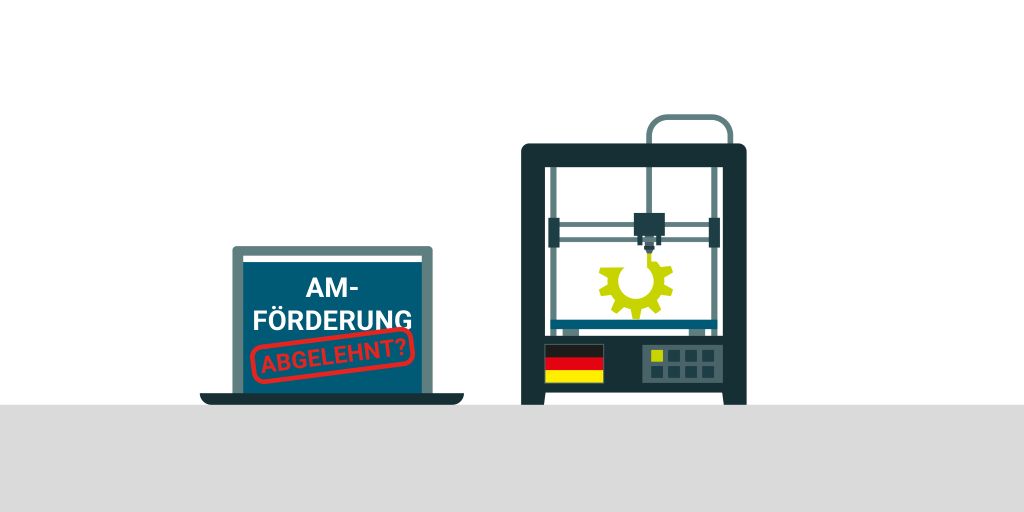
Formnext and leading experts in the field of Additive Manufacturing (AM) in Germany are calling for a rethinking of government support for AM. The current draft budget of the federal government does not plan any new funding for AM and lightweight construction.
"We miss a clear commitment to this future technology, especially after it was already promised in the coalition agreement," said Sascha Wenzler, who as Vice President of Formnext at Mesago Messe Frankfurt is responsible for the world's most important trade fair for Additive Manufacturing and the next generation of industrial production. Other leading German AM experts also express disappointment and call for an update of the political strategy.
Just a few weeks ago, the new German government had indicated that it would focus more on future technologies such as Additive Manufacturing. 3D printing was explicitly mentioned as a fundable technology in the coalition agreement of CDU, CSU, and SPD on page 4. Under the title "Responsibility for Germany," it stated: "We promote lightweight technology, additive manufacturing, and 3D printing."
This position was confirmed in early June when the economic ministers of the federal states met for two days in Stuttgart: "The Conference of Economic Ministers welcomes that the promotion of lightweight technologies, additive manufacturing, and 3D printing continues to be among the political objectives at the federal level – an important signal that should now be backed by concrete measures," it said in the minutes of the meeting.
Only winding down
In the current draft budget of the federal government from 26.06.2025, Additive Manufacturing (which has previously been supported under the term lightweight construction) is not included. On page 3364, instead of new projects, only funds are planned for the lightweight construction sector that "are exclusively for financing the commitments made in previous years and for winding down the lightweight construction program."
Impact on the AM industry and other sectors
If this draft is implemented, Sascha Wenzler sees "the globally leading position of the German AM industry at risk in the long term. This would certainly also have an impact on the innovative capacity of numerous German industrial sectors." Because Additive Manufacturing is a young and simultaneously extremely innovative technology. Additively manufactured components and parts already enable new, more powerful, and often more sustainable products and solutions in numerous industries today. This affects, among others, the automotive industry, medicine, the energy sector, as well as safety-relevant industries such as aerospace and defense.
"Countries like the USA, China, and many others have recognized this great importance for innovations and implemented it in corresponding funding programs," adds Christoph Stüker, also Vice President Formnext at Mesago Messe Frankfurt. "The German AM industry plays in the leading league worldwide. The innovations that German companies and research institutes regularly develop successfully range from new AM systems to materials and solutions for post-processing." This is also evident every year at Formnext, which, as the most important international industry event, brings the global AM scene to Frankfurt. "In order for the solutions of German AM companies to continue enabling innovations in large parts of the industry in the future, we also need government support for this industry that is so important for the entire industry," says Stüker.
"Strategy urgently needs updating"
Important German AM experts also view the current development critically. "We had associated the new coalition agreement with the hope that Additive Manufacturing would receive systematic support both in the short term and medium term to remain competitive in the leading group globally," says Prof. Christian Seidel from Munich University of Applied Sciences and Wohlers Associates. The consequences for the AM landscape in Germany are not foreseeable for Seidel: "While other countries promote progress in Additive Manufacturing with large amounts, it is now urgently necessary in Germany to update its own strategy and implement it together between politics and business. A 'business as usual' could lead to mediocrity."
Similar concerns are expressed by Markus Heering, Managing Director of the Additive Manufacturing Working Group in the VDMA: "We view the current economic policy development in Germany regarding new production technologies, especially Additive Manufacturing, critically. Innovations from industry and research are also enormously important for domestic machinery and plant engineering with powerful AM solutions. This is a key to developing technological leadership and maintaining the technological sovereignty of the location Germany. For this, we demand strong engagement from politics."
Contact: